


Ginkgo leaf extract as a National Health Insurance-covered prescription drug will be phased out due to a lack of solid evidence of its clinical effectiveness, the National Health Insurance Administration (NHIA) said.
Ginkgo biloba extract has been permitted by the health authority for medical use as a supplement treatment for peripheral arterial disease (PAD). While countries such as the US, Canada and Japan classify the extract as functional food, ginkgo falls under the category of drugs in Taiwan, the agency said.
As of last month, a total of 59 drug items containing ginkgo extract —— 14 in oral liquid or drop forms, six as injections and 39 as tablets — were covered by the National Health Insurance (NHI), the agency said. Of the 59, 52 are prescription drugs.
In October 2006, the NHIA began restricting NHI reimbursements to medical facilities that exceed a certain prescription rate of ginkgo-based medicines.
The measure has achieved commendable results, the agency said, pointing to a decrease in the expense for ginkgo-containing drugs from NT$270 million (US$8.97 million) in 2005 to NT$160 million in 2007. The total expenditure for prescribed ginkgo leaf extracts was further reduced to NT$49 million and the number of prescriptions down to 460,000.
The Food and Drug Administration will gradually have ginkgo medicines reclassified as over-the-counter drugs that can be procured without a doctor’s prescription, but have to be used with instructions from physicians or pharmaceutical personnel, according to the NHIA.
The agency said the decision was made out of the consideration that the efficacy of ginkgo extract has not been proved by consistent evidence of benefit. It added that it is mulling suspending NHI coverage for ginkgo extract.
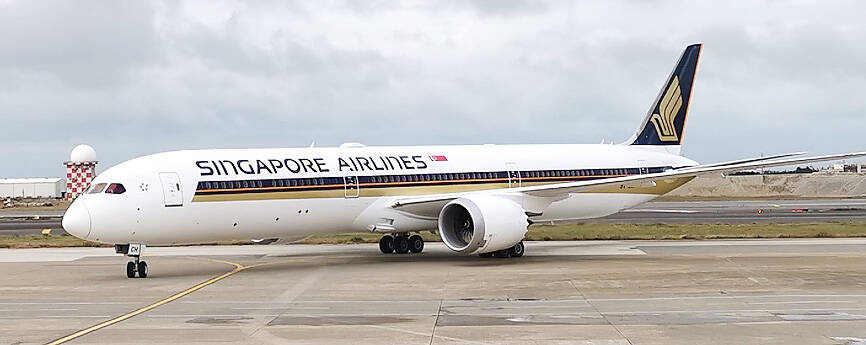
INCREASED CAPACITY: The flights on Mondays, Wednesdays, Fridays and Sundays would leave Singapore in the morning and Taipei in the afternoon Singapore Airlines is adding four supplementary flights to Taipei per week until May to meet increased tourist and business travel demand, the carrier said on Friday. The addition would raise the number of weekly flights it operates to Taipei to 18, Singapore Airlines Taiwan general manager Timothy Ouyang (歐陽漢源) said. The airline has recorded a steady rise in tourist and business travel to and from Taipei, and aims to provide more flexible travel arrangements for passengers, said Ouyang, who assumed the post in July last year. From now until Saturday next week, four additional flights would depart from Singapore on Monday, Wednesday, Friday
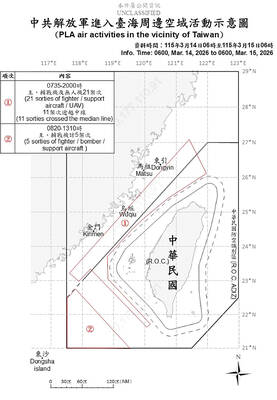
The Ministry of National Defense yesterday reported the return of large-scale Chinese air force activities after their unexplained absence for more than two weeks, which had prompted speculation regarding Beijing’s motives. China usually sends fighter jets, drones and other military aircraft around the nation on a daily basis. Interruptions to such routine are generally caused by bad weather. The Ministry of National Defense said it had detected 26 Chinese military aircraft in the Taiwan Strait over the previous 24 hours. It last reported that many aircraft on Feb. 25, when it spotted 30 aircraft, saying Beijing was carrying out another “joint combat

Taiwan successfully defended its women’s 540 kilogram title and won its first-ever men’s 640 kg title at the 2026 World Indoor Tug of War Championships in Taipei yesterday. In the women’s event, Taiwan’s eight-person squad reached the final following a round-robin preliminary round and semifinals featuring teams from Ukraine, Japan, Thailand, Vietnam, the Basque Country and South Korea. In the finals, they swept the Basque team 2-0, giving the team composed mainly of National Taiwan Normal University students and graduates its second championship in a row, and its fourth in five years. Team captain
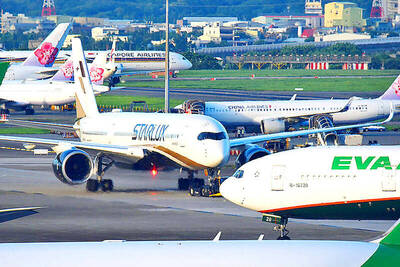
Taiwan’s three major international carriers are increasing booking fees, with EVA Airways having already increased the charge to US$28 per flight segment from US$25, while China Airlines (CAL) and Starlux Airlines are set to follow suit. Booking fees are charged by airlines through a global distribution system (GDS) and passed on to passengers. Carriers that apply the fees include CAL, EVA, Starlux and Tigerair Taiwan. A GDS is a computerized network operated by a company that connects airlines with travel agents and ticketing platforms, allowing reservations to be made and processed in real time. Major players include Amadeus, Sabre and Travelport. EVA Air began


 RSS
RSS