


Chinese Communist Party authorities have restored an 80-year-old house once used by Chiang Kai-shek (蔣介石), as changing relations with Taiwan transform an archenemy into a recognized figure.
Political differences were plastered over as Nanjing — once China’s capital under the Chinese Nationalist Party (KMT) — spent US$4.9 million to renovate the three-story house at the base of a hill.
It was one of several houses used by Chiang and his wife Soong Mayling (宋美齡) before they fled to Taiwan in 1949 at the end of the Chinese civil war.
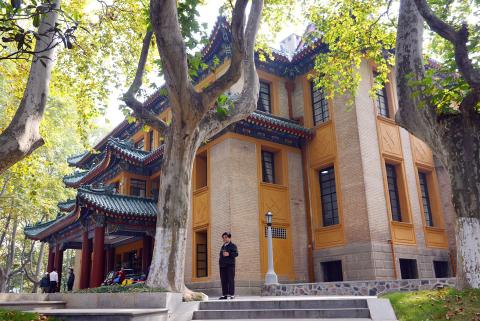
Photo: AFP
Chiang led Taiwan as president until his death 26 years later, still proclaiming himself the rightful ruler of the whole of China.
For decades, the building was kept as a state guesthouse and closed to the public, but the doors were thrown open after a year-long renovation was completed in October.
“This renovation has a very important use for cross-strait cultural exchanges, so we considered that,” said Liao Jinhan, deputy head of the Chinese government agency that administers the surrounding scenic area. “Our feeling is that the house is a very important cultural heritage landmark.”
The chance discovery of an original architectural plan in a closet in the house allowed workers to faithfully restore the building, down to the basement coal room.
“We completely followed the blueprint from that time. You can see from photos of the time, it is exactly the same,” property manager Zhou Zhongxing said.
“The renovation is significant for cross-strait cultural contacts as it shows the mainland’s focus on preserving historical heritage related to the Kuomintang [KMT],” Shanghai Institute for International Studies research fellow Tong Liqun (童立群) said.
“To take relations one step further would mean exchanges in the field of politics, and that is where the two sides are having trouble,” she said.
The historical sensitivity is such that officials commonly refer to the house as the “Mayling Palace” after Chiang’s last wife, despite its status as the former residence of a Chinese head of state.
Soong Mayling was one of the three Soong sisters, who between them married two top Chinese leaders and a wealthy businessman who served as Chinese finance minister.
Few images of Chiang can be seen inside the property, although the study holds a portrait of Sun Yat-sen (孫中山), founding father of the Republic of China — who is revered by both Communists and Nationalists, and whose tomb is on the hill and visible from the house.
An exhibit on the couple’s lives in Taiwan is called “Years on Taiwan island,” highlighting the Chinese doctrine that it is not a country, but part of Chinese territory.
The house has Chinese features, such as the curved roof, but the interior is Western in style, reflecting Soong’s education in the US.
The building also gives subtle hints about the couple’s lifestyle.
Chiang had a room off the main bedroom where he slept, reflecting his military habit of rising early, while Soong Mayling required a Western-style oven, which still survives, and kept ashtrays in the rooms for smoking — a habit she picked up in the US.
A small chapel shows the couple’s embrace of Christianity: Soong Mayling, who was Methodist, insisted that her husband convert to her religion.
“The manor is like its mistress: graceful and elegant, knowing both Chinese and Western style,” a sign reads.
Soong’s achievements are on display in an exhibition which praises her for building support for China in its fight against Japan in the 1930s and 1940s, and her charitable causes.
“She had class,” tour-guide Chen Chen said. “Soong Ching-ling (宋慶齡), the second one, was very pretty.”
The middle Soong sister, Ching-ling, was Sun’s wife and stayed in China after the Communist takeover. The eldest of the trio, Soong Ai-ling (宋靄齡), married financier Kung Hsiang-hsi (孔祥熙).
Since opening in October, tens of thousands have paid the 30 yuan (US$5) ticket price to see the house, but it has proved especially popular with the elderly, some of them old enough to remember Chiang’s time.
A panel in one part of the exhibition reads: “The perfect combination of traditional Chinese architectural style and modern Western construction technology puts this building in the perfect realm of architectural history in modern China.”
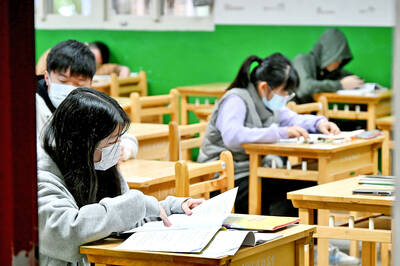
CHANGES: After-school tutoring periods, extracurricular activities during vacations or after-school study periods must not be used to teach new material, the ministry said The Ministry of Education yesterday announced new rules that would ban giving tests to most elementary and junior-high school students during morning study and afternoon rest periods. The amendments to regulations governing public education at elementary schools and junior high schools are to be implemented on Aug. 1. The revised rules stipulate that schools are forbidden to use after-school tutoring periods, extracurricular activities during summer or winter vacation or after-school study periods to teach new course material. In addition, schools would be prohibited from giving tests or exams to students in grades one to eight during morning study and afternoon break periods, the

GOOD DIPLOMACY: The KMT has maintained close contact with representative offices in Taiwan and had extended an invitation to Russia as well, the KMT said The Chinese Nationalist Party (KMT) would “appropriately handle” the fallout from an invitation it had extended to Russia’s representative to Taipei to attend its international banquet last month, KMT Chairman Eric Chu (朱立倫) said yesterday. US and EU representatives in Taiwan boycotted the event, and only later agreed to attend after the KMT rescinded its invitation to the Russian representative. The KMT has maintained long-term close contact with all representative offices and embassies in Taiwan, and had extended the invitation as a practice of good diplomacy, Chu said. “Some EU countries have expressed their opinions of Russia, and the KMT respects that,” he
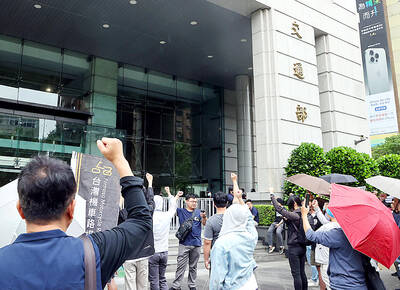
Advocates of the rights of motorcycle and scooter riders yesterday protested in front of the Ministry of Transportation and Communications in Taipei, making three demands. They were joined by 30 passenger vehicles, which surrounded the ministry to make three demands related to traffic regulations — that motorcycles and scooters above 250cc be allowed on highways, that all motorcycles and scooters be allowed on inside lanes, and that driver and rider training programs be reformed. The ministry said that it has no plans to allow motorcycles on national highways for the time being, and said that motorcycles would be allowed on the inner
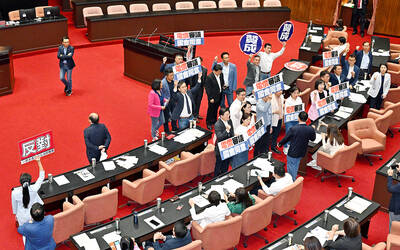
AMENDMENT: Contact with certain individuals in China, Hong Kong and Macau must be reported, and failure to comply could result in a prison sentence, the proposal stated The Chinese Nationalist Party (KMT) and the Taiwan People’s Party (TPP) yesterday voted against a proposed bill by Democratic Progressive Party (DPP) lawmakers that would require elected officials to seek approval before visiting China. DPP Legislator Puma Shen’s (沈伯洋) proposed amendments to the Act Governing Relations Between the People of the Taiwan Area and the Mainland Area (臺灣地區與大陸地區人民關係條例), stipulate that contact with certain individuals in China, Hong Kong and Macau should be reported, while failure to comply would be punishable by prison sentences of up to three years, alongside a fine of NT$10 million (US$309,041). Fifty-six voted with the TPP in opposition


 RSS
RSS