


Test results from Taipei City Government’s health bureau concluded that cola beverages sold in Taiwan — including Coca-cola, Coca-cola Zero, and Pepsi Cola — contain 4-methylimidazole (4-MI) at 93 times the level found in cola drinks marketed in the US, Democratic Progressive Party Taipei City Councilor Kao Chia-yu (高嘉瑜) said yesterday.
She demanded that the companies change their product formulation to correspond with those produced in the US and urged the Ministry of Health and Welfare to lay down stricter standards.
Kao said 4-MI was used for coloring in beverages, but has been found in medical studies to cause cancer in animals, although there is still insufficient evidence of 4-MI as a carcinogen in humans.
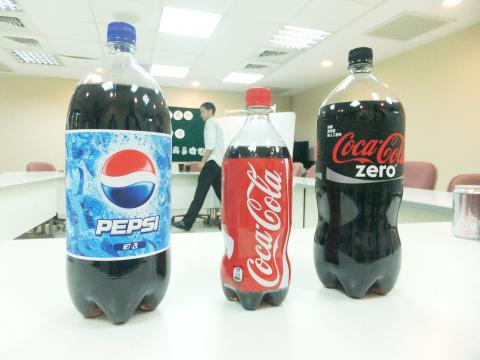
Photo: Shih Chih-ju, Taipei Times
Referring to a report from the city health bureau, she said results for 4-MI content in a regular-sized 355ml can of Coca-cola, Coca-cola Zero and Pepsi Cola were 156 micrograms, 170 micrograms and 373 micrograms respectively.
“California has introduced a regulation requiring companies to place a ‘May Cause Cancer’ warning on beverages containing more than 29 micrograms of 4-MI. Following implementation of this law, Coca-cola Co, PepsiCo and other cola companies in the US have announced they will reduce 4-MI in cola drinks to 4 micrograms,” Kao said.
She said this indicated that the beverage companies are capable of adjusting their product formulation, “but Coca-cola Taiwan and other cola companies in this country have done nothing,” she said.
In July, the ministry placed a limit on 4-MI at 250 micrograms per 1kilogram, for Class 4 caramel coloring used in the manufacturing of cola drinks for the amendment bill on food additives, she said, adding that even as such, toxicologist Lin Chieh-liang (林杰樑) at the time disputed the cap amount as too high.
Ministry official Chiu Hsiu-yi (邱秀儀) said the regulation for 4-MI in cola beverages is based on EU specifications and all products sold in Taiwan conform to this standard.
“As the food additive amendment is not promulgated yet, we cannot require companies to disclose their product formulation, but we will continue to speak with beverage companies on this issue,” Chiu said.
Meanwhile, Swire Coca-cola Taiwan and PepsiCo Foods Taiwan Co issued statements yesterday stating that caramel coloring is used in a wide array of consumer foods and beverages. Both firms emphasized the coloring in their products conform to Taiwan’s law and do not pose a health risk to consumers.

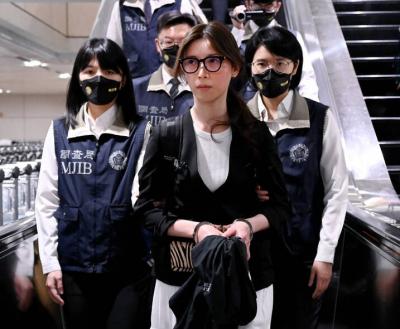
A fugitive in a suspected cosmetic surgery fraud case today returned to Taiwan from Canada, after being wanted for six years. Internet celebrity Su Chen-tuan (蘇陳端), known as Lady Nai Nai (貴婦奈奈), and her former boyfriend, plastic surgeon Paul Huang (黃博健), allegedly defrauded clients and friends of about NT$1 billion (US$30.66 million). Su was put on a wanted list in 2019 when she lived in Toronto, Canada, after failing to respond to subpoenas and arrest warrants from the Taipei District Prosecutors’ Office. Su arrived at Taiwan Taoyuan International Airport at 5am today on an EVA Air flight accompanied by a
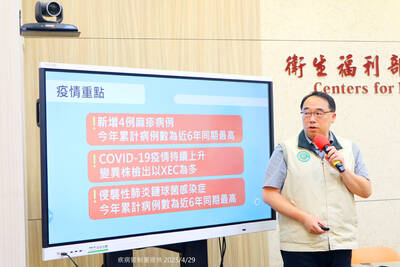
COVID-19 infections have climbed for three consecutive weeks and are likely to reach another peak between next month and June, the Centers for Disease Control (CDC) said yesterday. Weekly hospital visits for the disease increased by 19 percent from the previous week, CDC Epidemic Intelligence Center Director Guo Hung-wei (郭宏偉) said. From Tuesday last week to yesterday, 21 cases of severe COVID-19 and seven deaths were confirmed, and from Sept. 1 last year to yesterday, there were 600 cases and 129 deaths, he said. From Oct. 1 last year to yesterday, 95.9 percent of the severe cases and 96.7 percent of the deaths
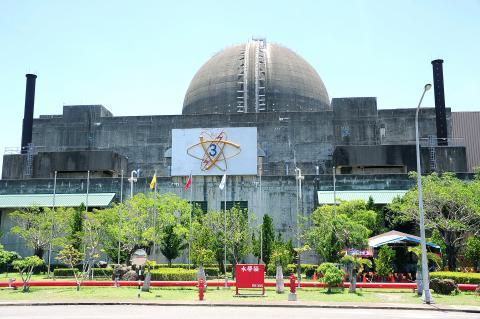
Restarting the No. 2 reactor at the Ma-anshan Nuclear Power Plant would take up to 18 months, Minister of Economic Affairs J.W. Kuo (郭智輝) said today. Kuo was answering questions during a meeting of the Legislative Yuan’s Economics Committee, where legislators are considering amendments to the Renewable Energy Development Act (再生能源發展條) amid concerns about the consequences of the Pingtung County reactor’s decommissioning scheduled for May 17. Its decommissioning is to mark the end of Taiwan’s nuclear power production. However, Chinese Nationalist Party (KMT) lawmakers have proposed an amendment to the Nuclear Reactor Facilities Regulation Act (核子反應器設施管制法) that would extend the life of existing
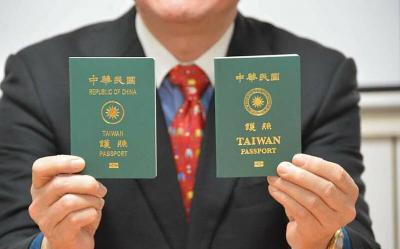
The Ministry of Foreign Affairs yesterday demanded that Somalia reverse its decision prohibiting Taiwanese passport holders from entering or transiting through the country. Somalia said it is following the “one China” principle based on UN Resolution 2758. The ministry said that Somalia is misinterpreting the resolution under China’s instigation, creating a false impression that Taiwan is subordinate to China. The Somali Civil Aviation Authority told airlines on Tuesday last week that starting today, any passengers with passports or travel documents issued from Taiwan or its affiliated institutions would not be allowed to enter or transit through Somalia. The decision comes as Taiwan is boosting


 RSS
RSS