


The Green Citizen Action Alliance (GCAA) yesterday protested outside a forum held by Taiwan Power Co (Taipower) and Chung-hwa Nuclear Society, criticizing the organizers for inviting speakers who they said had a pro-nuclear power stance.
“Distorting the real facts about nuclear power,” several GCAA members chanted together, while holding a banner that implied that the organizers and speakers at the forum were all part of a “pro-nuclear power fraudulent organization.”
The group said the Japanese speakers had been advocates for nuclear power in their country for many years, even after the Fukushima Di-ichi nuclear power plant disaster in 2011, so by inviting them to talk about nuclear power, Taipower seems to be trying to misguide the media and the public.
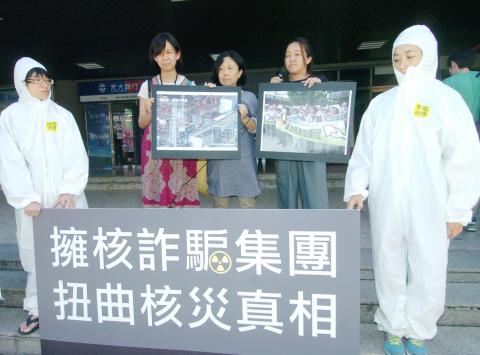
Photo: Wang Min-wei, Taipei Times
One of the speakers, Michio Ishikawa, a supreme adviser at the Japan Nuclear Technology Institute, said the main cause of the Fukushima Di-ichi disaster was not the devastating earthquake, but rather the following tsunami that led to a 10-day blackout at the plant, causing a nuclear meltdown and radiation leak.
There is no problem with the safety designs at present, but the risk of blackouts cannot be avoided with the current level of technology, he said, adding that the disaster was man-made and resulted from the failings of the government and related agencies.
However, the GCAA said Ishikawa has long been an advocate of nuclear power, and that the official report made by the Fukushima Nuclear Accident Independent Investigation Commission of Japan’s Diet had stated “we believe there is a possibility that the earthquake damaged equipment necessary for ensuring safety.”
They also questioned the background of another speaker, Masao Nakamura, an honorary adviser at the Central Research Institute of Electric Power Industry and a former journalist who wrote about nuclear power issues for many years for Japan’s Yomiuri Shimbun daily, by saying that he had been commissioned by the Japan Atomic Energy Relations Organization to write a propaganda strategy report back in 1991.
The group said another speaker — Noboru Takamura, a professor at the Nagasaki University’s Department of Radiation Epidemiology — has spoken about how being exposed to certain levels of radiation may not necessary lead to negative health impacts, but they questioned why recent news reports have shown several children living near the Fukushima Dai-ichi nuclear power plant having been diagnosed with thyroid carcinoma.
Minister of Economic Affairs Chang Chia-juch (張家祝) told the forum: “We will allow the public to make the final decision [about the Fourth Nuclear Power Plant in New Taipei City’s Gongliao District (貢寮)], but no matter what, we will definitely complete its construction safely.”
He said many reports have exaggerated the impact of the Fukushima Dai-ichi disaster, such as the number of deaths or the cost of compensation and restoration, but until today the Japanese government’s official report showed that only seven people died at the plant and none of the deaths were directly attributable to radiation exposure.
“There is no so-called ‘safe’ nuclear power,” GCAA secretary-general Tsuei Su-hsin (崔愫欣) said. “The most serious problem about using nuclear power is that if a serious accident happens, the scale of the disaster would be so large that everyone in Taiwan would have to bear the consequences, and the risks posed would last for generations.”

ANOTHER EMERGES: The CWA yesterday said this year’s fourth storm of the typhoon season had formed in the South China Sea, but was not expected to affect Taiwan Tropical Storm Gaemi has intensified slightly as it heads toward Taiwan, where it is expected to affect the country in the coming days, the Central Weather Administration (CWA) said yesterday. As of 8am yesterday, the 120km-radius storm was 800km southeast of Oluanpi (鵝鑾鼻), Taiwan’s southernmost tip, moving at 9kph northwest, the agency said. A sea warning for Gaemi could be issued tonight at the earliest, it said, adding that the storm is projected to be closest to Taiwan on Wednesday or Thursday. Gaemi’s potential effect on Taiwan remains unclear, as that would depend on its direction, radius and intensity, forecasters said. Former Weather Forecast

As COVID-19 cases in Japan have been increasing for 10 consecutive weeks, people should get vaccinated before visiting the nation, the Centers for Disease Control (CDC) said. The centers reported 773 hospitalizations and 124 deaths related to COVID-19 in Taiwan last week. CDC Epidemic Intelligence Center Director Guo Hung-wei (郭宏偉) on Tuesday said the number of weekly COVID-19 cases reported in Japan has been increasing since mid-May and surpassed 55,000 cases from July 8 to July 14. The average number of COVID-19 patients at Japan’s healthcare facilities that week was also 1.39 times that of the week before and KP.3 is the dominant

The Chinese Communist Party’s (CCP) working group for Taiwan-related policies is likely to be upgraded to a committee-level body, a report commissioned by the Mainland Affairs Council (MAC) said. As Chinese President Xi Jinping (習近平) is increasingly likely to upgrade the CCP’s Central Leading Group for Taiwan Affairs, Taiwanese authorities should prepare by researching Xi and the CCP, the report said. At the third plenary session of the 20th Central Committee of the CCP, which ended on Thursday last week, the party set a target of 2029 for the completion of some tasks, meaning that Xi is likely preparing to

US-CHINA TRADE DISPUTE: Despite Beijing’s offer of preferential treatment, the lure of China has dimmed as Taiwanese and international investors move out Japan and the US have become the favored destinations for Taiwanese graduates as China’s attraction has waned over the years, the Ministry of Labor said. According to the ministry’s latest income and employment advisory published this month, 3,215 Taiwanese university graduates from the class of 2020 went to Japan, surpassing for the first time the 2,881 graduates who went to China. A total of 2,300 graduates from the class of 2021 went to the US, compared with the 2,262 who went to China, the document showed. The trend continued for the class of 2023, of whom 1,460 went to Japan, 1,334 went to


 RSS
RSS