


Formosan sika deer (Cervus nippon taioanus) raised in captivity at the Kinmen Livestock Research Institute may be the most genetically similar yet to their extinct wild cousins, National Taiwan University researcher Ju Yu-ten (朱有田) said.
The Kinmen Livestock Research Institute commissioned Ju, an associate professor at the university’s Department of Animal Science and Technology, to conduct research on the institute’s Formosan sika deer breeding program as part of an effort to promote tourism to the island chain and set a good example of environmental conservation.
Presenting his findings on Friday, Ju said that compared with the deer raised at Kenting National Park, the animals bred in Kinmen had a “purer” genetic makeup that showed a continuity with the genetic structure of the original wild Formosan sika deer.
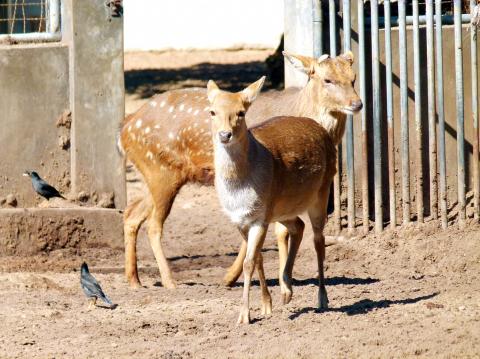
Photo: CNA
Ju said that he had arrived at this conclusion after comparing the genetic material of the deer raised in Kinmen and Kenting with material gleaned from the tooth of a Formosan sika deer unearthed at an archeological dig.
The Formosan sika deer is a subspecies endemic to Taiwan, but all wild Formosan sika are extinct due to extensive hunting of the animal during the era of Dutch colonization and during the modernization undertaken by the Japanese colonial government, Ju said. All surviving specimens of the Formosan subspecies have been raised in captivity and then introduced into the wild, he added.
Ju said that the current stock of deer raised in captivity were not genetically pure, because those that were genetically closest to the wild Formosan sika deer — which were raised at the Taipei Zoo in the 1980s — had to be put down en masse after the group was infected with tuberculosis.
Kenting and Kinmen both received deer from Taipei Zoo prior to the outbreak, but while Kenting National Park introduced other subspecies of deer to its population, the Kinmen Livestock Research Institute kept its Formosan sika deer separate from others.
This separation, coupled with the geographic isolation of Kinmen, has made inter-breeding with other species nearly impossible, which is what has made the Kinmen sika deer the most “Aboriginal” of their kind, Ju said.
Meanwhile, institute director Wen Shuei-cheng (文水成) said that the facility has also developed a drink made from the deer’s antlers. Wen said the insitute aimed to use the drink in addition to the deer program to promote tourism to Kinmen.

NATIONAL SECURITY: Authorities are working to confirm the identities of the military personnel involved and investigating possible illegal conduct and regulatory violations Authorities are probing possible national security implications after Kinmen police and immigration officers on Sunday found a Chinese woman allegedly posing as a tourist while engaging in prostitution involving more than 10 military personnel. The woman, surnamed Chen (陳), has since been deported, authorities said, adding that investigators are still working to confirm the identities of those implicated, as the records only listed code names and aliases. The case stemmed from a report received by the Kinmen District Prosecutors’ Office on Friday last week from the Jinhu Precinct of the Kinmen County Police Bureau. On Sunday, police, along with the National Immigration

GLOBALGIVING: ‘ Caving to external pressure is not acceptable for an organization that has cultivated justice reform and human rights for 30 years,’ one NGO said A slew of non-government organizations (NGOs) have withdrawn from the GlobalGiving fundraising platform after it announced it would use “Chinese Taipei” instead of “Taiwan” from next month. The Taiwan Good Rice Association wrote on Facebook on Friday that it was informed on April 28 via a teleconference call of the change, which was made because the platform wanted to operate in China. Taiwan Good Rice is to terminate all cooperative relationships with GlobalGiving in response to the platform’s “unilateral and non-negotiable” decision to remove references to Taiwan, the NGO said. “Taiwan is in the official name of Taiwan Good Rice Association and the

HEAVY WEATHER: Typhoon Jangmi is due to crash straight into the Ryukyus as airlines look to shift flights to larger aircraft or cancel flights to Okinawa entirely Taiwan’s international air carriers announced flight adjustments over the weekend as Typhoon Jangmi is forecast to hit the Ryukyu Islands today and tomorrow. The Central Weather Administration (CWA) upgraded Jangmi from a tropical storm to a typhoon at 8am yesterday, with the eye located 580km south of Naha city. It was moving north at 19kph. Today, China Airlines’ CI-120, CI-121, CI-122 and CI-123 flights between Taoyuan and Naha, Okinawa, have been canceled as well as CI-132 and CI-133 between Kaohsiung and Naha. EVA Air’s BR-112, BR-113, BR-186 and BR-185 flights between Taoyuan and Naha are also canceled. Low-cost carrier Tigerair Taiwan canceled IT-230,

REASONS FOR TRAVEL: An assistant professor said that proposed amendments to penalize drivers if they used drugs overseas would not deter people from traveling People who operate a motor vehicle under the influence of marijuana would have their driver’s license revoked, even if they used the substance while overseas, the Ministry of Transportation and Communications said yesterday, citing proposed amendments to the Road Traffic Management and Penalty Act (道路交通管理處罰條例). The amendments would also authorize the government to revoke the licenses of people determined to have used Category 1 or Category 2 narcotics, even if they were not operating a vehicle while under the influence of drugs, as well as ban them from taking the license test for three years, the ministry said. People aged 18 or


 RSS
RSS