


More than a dozen folk art groups from different countries are to congregate in Greater Tainan next month to attend the Nanying International Folklore Festival, a biennial event that celebrates its eighth edition this year.
The festival is set to open with an afternoon parade on Oct. 6, with performers and troupes from home and abroad performing on the streets of Sinying District (新營).
According to Cultural Affairs Bureau of Tainan City Government, the event organizer, the origin of the word nanying (南瀛) can be traced back to the Warring States Period in ancient China. The term yingzhou (瀛洲) first appeared during this period to indicate a mythical island in the Bohai Sea, a part of the Yellow Sea on the coast of Northeastern China.
As the Han-Chinese migrated southward, the words yingzhou and nanying became the names for Quanzhou (泉州) and Zhangzhou (漳州) in China’s Fujian Province during the Ming and Qing dynasties, the bureau’s researcher Lee Ming-yu (李明育) said.
“The inhabitants in Quanzhou and Zhangzhou referred to themselves as people of ying. As a large number of people immigrated to Taiwan from the these two regions during the Qing Dynasty, Taiwan became known as Nanying, Lee said.
The festival is to highlight cultural diversity and folk traditions from different corners of the world.
From Russia, the State Chuvash Academic Song and Dance Ensemble has preserved and promoted folk heritage of the Chuvash people since its establishmeny in 1924.
The Bulgarian troupe Sofia-6 was founded in 1976 by choreographer Nestor Nestorov in the hope of passing down traditional music and dance. Over the years, the troupe has trained more than 1480 performers and toured regularly around the world.
Closer to home, Miyabi Daiko has celebrated the art of taiko drumming for the past 20 years. Meanwhile, award-winning Sanggar Ayudha is to bring traditional Indonesian dance to the festival’s audience.
To further facilitate cultural exchanges, the organizer has arranged homestays with local families for the foreign performers. Elementary and high schools in Tainan as well as community-based art groups are also encouraged to visit the festival to share their experiences.
This year, 26 host families, 45 schools and nine local dance troupes have signed up to welcome the visiting guests.
The festival is set to take place between Oct. 6 and Oct. 14 at two main venues, Nanying Green Heart Park and Tainan Municipal Cultural Center, as well as at various locations across the greater Tainan areas. The event’s Web site, nyiff.tnc.gov.tw, is currently under construction, but should be ready by the end of next week, the bureau said.

A magnitude 6.1 earthquake struck off the coast of Yilan County at 8:39pm tonight, the Central Weather Administration (CWA) said, with no immediate reports of damage or injuries. The epicenter was 38.7km east-northeast of Yilan County Hall at a focal depth of 98.3km, the CWA’s Seismological Center said. The quake’s maximum intensity, which gauges the actual physical effect of a seismic event, was a level 4 on Taiwan’s 7-tier intensity scale, the center said. That intensity level was recorded in Yilan County’s Nanao Township (南澳), Hsinchu County’s Guansi Township (關西), Nantou County’s Hehuanshan (合歡山) and Hualien County’s Yanliao (鹽寮). An intensity of 3 was
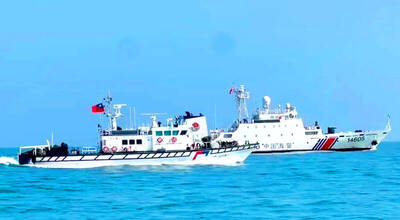
Instead of focusing solely on the threat of a full-scale military invasion, the US and its allies must prepare for a potential Chinese “quarantine” of Taiwan enforced through customs inspections, Stanford University Hoover fellow Eyck Freymann said in a Foreign Affairs article published on Wednesday. China could use various “gray zone” tactics in “reconfiguring the regional and ultimately the global economic order without a war,” said Freymann, who is also a nonresident research fellow at the US Naval War College. China might seize control of Taiwan’s links to the outside world by requiring all flights and ships entering or leaving Taiwan
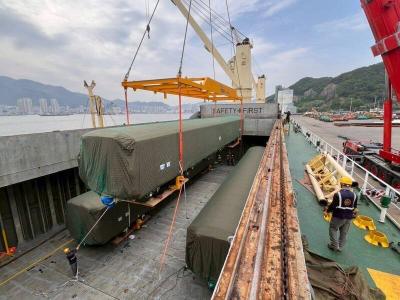
The first of 10 new high-capacity trains purchased from South Korea’s Hyundai Rotem arrived at the Port of Taipei yesterday to meet the demands of an expanding metro network, Taipei Rapid Transit Corp (TRTC) said yesterday. The train completed a three-day, 1,200km voyage from the Port of Masan in South Korea, the company said. Costing NT$590 million (US$18.79 million) each, the new six-carriage trains feature a redesigned interior based on "human-centric" transportation concepts, TRTC said. The design utilizes continuous longitudinal seating to widen the aisles and optimize passenger flow, while also upgrading passenger information displays and driving control systems for a more comfortable
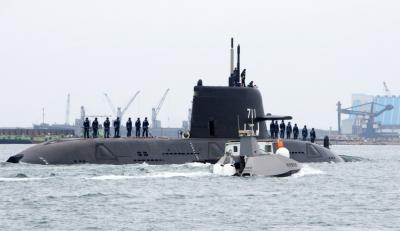
Taiwan's first indigenous defense submarine, the SS-711 Hai Kun (海鯤, or Narwhal), departed for its 13th sea trial at 7am today, marking its seventh submerged test, with delivery to the navy scheduled for July. The outing also marked its first sea deployment since President William Lai (賴清德) boarded the submarine for an inspection on March 19, drawing a crowd of military enthusiasts who gathered to show support. The submarine this morning departed port accompanied by CSBC Corp’s Endeavor Manta (奮進魔鬼魚號) uncrewed surface vessel and a navy M109 assault boat. Amid public interest in key milestones such as torpedo-launching operations and overnight submerged trials,


 RSS
RSS