


With the mercury in Taipei rising past 37°C for six consecutive days last week, the number of passengers on the Maokong Gondola has been dwindling.
Touted by the city government as one of Taipei’s top tourist attractions, the gondola has received growing complaints about poor ventilation and the frequency with which operations are suspended.
A thermometer placed inside one of the gondola cabins on the side facing the sun at noon on Saturday registered a temperature of 37.4°C, which was even higher than the outside temperature at the time.
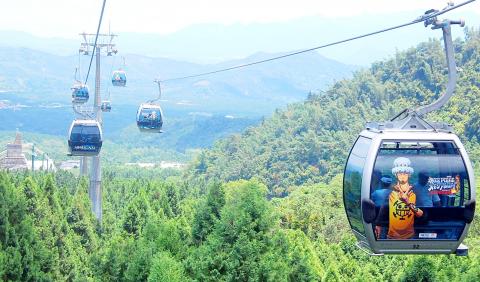
Photo: Hsieh Chieh-yu, Taipei Times
Passengers taking a 20-minute ride on the cable car system from the Taipei Zoo Station to the Maokong Station often find themselves soaked in sweat by the end because of the poor ventilation.
Although the Taipei Rapid Transit Corp (TRTC) has introduced slats to the originally airtight windows in an effort to provide better ventilation, the problem has yet to be fully addressed.
To boost the transport capacity of the system, the TRTC launched a seasonal promotional campaign targeting students on summer break, offering free rides to passengers aged 12 or under and a “buy one, get one free” deal for those aged above 12.
Despite the promotions, parents are reluctant to take their children for a gondola ride, fearing that the lack of air-conditioning and ventilation could put their children at risk of heatstroke.
Another deal breaker for passengers is the frequent suspension of the gondola service due to poor weather conditions, in particular during the summer when afternoon thundershowers are commonplace.
Taipei City Councilor Chuang Ruei-hsiung (莊瑞雄) of the Democratic Progressive Party said the gondola system was built by the French company POMA and had never been used in countries in a subtropical zone.
“The Taipei City Government should certainly be scolded for approving these ‘roasting cabins’ without considering Taiwan’s climate,” Chuang said.
In response to the criticism, TRTC general manager Tan Gwa-guang (譚國光) said the gondola cabins could not be equipped with air-conditioners mainly because they do not have power systems.
Tan said the ventilation provided by the addition of window shades in each cable car had already reached maximum capacity.
Compared with the Maokong Gondola’s seemingly dwindling popularity, the cable car system linking Sun Moon Lake and the Formosan Aboriginal Culture Village amusement park in Nantou County, on the other hand, is drawing more passengers despite the rising temperatures.
The Sun Moon Lake Ropeway, a 1.87km route — built, owned and operated by the park — has carried more than 5 million passengers since it started operations in December 2009. On Saturday, the cable car system logged more than 8,000 visits.
“The Sun Moon Lake Ropeway travels at about 1,000m above sea level, with four fanlights and two large entrance doors installed in each cabin in addition to numerous ventilation holes on the floor,” said Huang Jui-chi (黃瑞奇), a manager at the culture village.
This design allows good air circulation in the cable cars, thereby lowering the cabin temperature, Huang said.
In addition to offering passengers an ideal riding environment, the park has also launched a host of creative promotion campaigns to boost local tourism, observers said.
This year, for example, the park decorated the cabins with characters of the popular Japanese manga series One Piece, successfully attracting flocks of fans eager to have a ride.

Considering that most countries issue more than five denominations of banknotes, the central bank has decided to redesign all five denominations, the bank said as it prepares for the first major overhaul of the banknotes in more than 24 years. Central bank Governor Yang Chin-lung (楊金龍) is expected to report to the Legislative Yuan today on the bank’s operations and the redesign’s progress. The bank in a report sent to the legislature ahead of today’s meeting said it had commissioned a survey on the public’s preferences. Survey results showed that NT$100 and NT$1,000 banknotes are the most commonly used, while NT$200 and NT$2,000

The Centers for Disease Control (CDC) yesterday reported the first case of a new COVID-19 subvariant — BA.3.2 — in a 10-year-old Singaporean girl who had a fever upon arrival in Taiwan and tested positive for the disease. The girl left Taiwan on March 20 and the case did not have a direct impact on the local community, it said. The WHO added the BA.3.2 strain to its list of Variants Under Monitoring in December last year, but this was the first imported case of the COVID-19 variant in Taiwan, CDC Deputy Director-General Lin Ming-cheng (林明誠) said. The girl arrived in Taiwan on

South Korea is planning to revise its controversial electronic arrival card, a step Taiwanese officials said prompted them to hold off on planned retaliatory measures, a South Korean media report said yesterday. A Yonhap News Agency report said that the South Korean Ministry of Foreign Affairs is planning to remove the “previous departure place” and “next destination” fields from its e-arrival card system. The plan, reached after interagency consultations, is under review and aims to simplify entry procedures and align the electronic form with the paper version, a South Korean ministry official said. The fields — which appeared only on the electronic form

The Ministry of Foreign Affairs (MOFA) is suspending retaliation measures against South Korea that were set to take effect tomorrow, after Seoul said it is updating its e-arrival system, MOFA said today. The measures were to be a new round of retaliation after Taiwan on March 1 changed South Korea's designation on government-issued alien resident certificates held by South Korean nationals to "South Korea” from the "Republic of Korea," the country’s official name. The move came after months of protests to Seoul over its listing of Taiwan as "China (Taiwan)" in dropdown menus on its new online immigration entry system. MOFA last week


 RSS
RSS