


The heads of 10 journalism and communication schools nationwide yesterday issued a statement opposing a bid by Want Want Broadband to acquire the the cable TV systems owned by China Network Systems (CNS).
The statement is expected to be the focus of discussions at the legislature’s Transportation Committee meeting today, when lawmakers review four nominations for commissioner of the National Communications Commission.
The Want Want-CNS deal involves the merger of a media conglomerate owning newspapers, magazines and TV networks with the nation’s second-largest multiple service operator (MSO).

Photo: Fang Pin-chao, Taipei Times
The commission has yet to approve the merger, which it has been reviewing for 16 months.
Three of the department chairs — Lin Yuan-huei (林元輝), chair of the department of journalism at National Chengchi University; Lin Lih-yun (林麗雲), director of the Graduate Institute of Journalism at National Taiwan University; and Hu Guang-shiash (胡光夏), chair of the department of journalism at Shih Hsin University — yesterday attended a press conference called by Taiwan Media Watch board director Lin Fu-yueh (林福岳). Want Want China Broadband was represented by special assistant to its chairman, Chao Yu-pei (趙育培).
Lin Fu-yueh said that the group of journalism department directors do not want a media group to monopolize public opinion in Taiwan.
“We reviewed the performance of the Want Want China Times Group over the past year or so and feel the group is not qualified to manage media,” they said. “We are thus strongly against allowing such a group to manage even more media.”
The experts also listed several actions taken by the group that they said were unprofessional and failed to live to up to its corporate responsibility, including allowing the Chinese government to buy news coverage at the Chinese-language daily China Times and lashing out at individuals and groups with opposing views.
In response, Chao said Want Want China Broadband and Want Want China Times Group were different companies, adding that the former was prepared to make 29 commitments if the Want Want-CNS deal were approved.
He said the China Times was fined NT$1.8 million (US$61,000) for allowing embedded marketing by the Chinese government, and added that Want Want China Broadband would have an internal review on all aspects of marketing.
Chao said the company would not give preferential treatment to channels from the Want Want China Times Group, adding that media controlled by the group represented only one of many different voices in Taiwan and it is unlikely that the deal would monopolize opinions.
“We welcome specific examples about how stories in the China Times betrayed the faith of Taiwanese, not abstract thoughts and observations,” Chao said.
Lin Fu-yueh said he had read the list of commitments and doubted the company had the ability to keep them.
“If Want Want China Broadband and the Want Want China Times Group are indeed unrelated, I could not help but ask why the latter defended the former by devoting an entire page at the China Times to the coverage of a public hearing on the deal,” he said. “Would you do the same if it was another group that wanted to purchase the CNS? Would you give favorable coverage to that group, too?”
Lin Lih-yun quoted Want Want chairman Tsai Eng-meng (蔡衍明), who said at the public hearing earlier this month that he did not know what was wrong with getting paid by the Chinese government to write news for them.
“The commission should have rejected this deal a long time ago because Tsai was doing something illegal,” she said. “They should have revoked the licenses of their television networks, too.”
The statement was drafted by Taiwan Media Watch and endorsed by: Aaron Chiu (邱誌勇), chairman of the department of mass communication at Providence University; Chen Chih-hsien (陳志賢), chair of the department of cultural development at National Kaohsiung University of Applied Science; Mark Chen (陳春富), chair of the department of communication arts at Fu Jen Catholic University; Chen Ping-hung (陳炳宏), chair of the Graduate Institute of Mass Communication at National Taiwan Normal University; Tseng Kuo-feng (曾國峰), director of the department of radio and television at National Chengchi University; Shaw Pin (蕭蘋), head of the Institute of Communications Management at National Sun Yat-sen University; and Day Wan-wen (戴皖文), chair of the department of communication at National Chung Cheng University.


UPGRADE: The Kang Ding-class frigate is replacing its Chaparall missiles with Tien Chien II and Hua Yang VLS, which would provide it with long-range, 360° air defense Taiwan plans to produce 1,200 to 1,376 Hai Chien II missiles (海劍二, Sea Sword II) — also known as TC-2N — to serve as the standard air defense system of the navy’s surface combatant fleet, a source said yesterday. Last week, the Hai Chien II, the naval version of the Tien Kung II missile (天劍二, Sky Sword II), completed a live-fire test in waters off the National Chungshan Institute of Science and Technology’s Jiupeng facility (九鵬) in Pingtung County’s Manjhou Township (滿州). The MIM72 Chaparral and other dated air defense missiles that currently arm Taiwanese ships have inadequate range to combat Chinese

REASONS FOR TRAVEL: An assistant professor said that proposed amendments to penalize drivers if they used drugs overseas would not deter people from traveling People who operate a motor vehicle under the influence of marijuana would have their driver’s license revoked, even if they used the substance while overseas, the Ministry of Transportation and Communications said yesterday, citing proposed amendments to the Road Traffic Management and Penalty Act (道路交通管理處罰條例). The amendments would also authorize the government to revoke the licenses of people determined to have used Category 1 or Category 2 narcotics, even if they were not operating a vehicle while under the influence of drugs, as well as ban them from taking the license test for three years, the ministry said. People aged 18 or
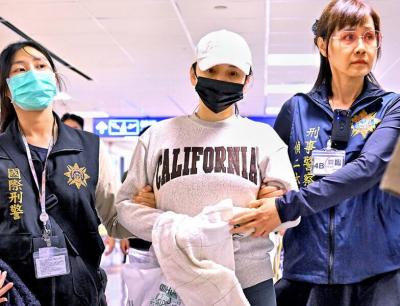
Johanne Liou (劉喬安), a Taiwanese woman who shot to unwanted fame during the Sunflower movement protests in 2014, returned to Taiwan last night after being deported from the US. She is to stand trial in Taiwan for charges involving embezzlement, fraud and drug crimes. The Criminal Investigation Bureau (CIB) said it took her into custody at Taiwan Taoyuan International Airport and would first question her before transferring her to the New Taipei District Prosecutors’ Office. She was arrested upon disembarking a flight from San Francisco that landed shortly before 7pm. Liou absconded to the US in 2019 after jumping bail
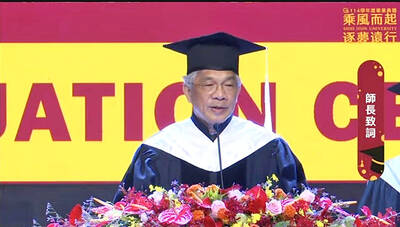
Shih Hsin University President Chen Ching-he (陳清河) yesterday issued a public apology for comments made in his commencement speech last week, stating that he has asked the school to suspend his duties and halt his wages for two months as a show of contrition. At the commencement ceremony on May 30, Chen said, “If you don’t manage your time well, or your own emotions, or your health, then I am telling every one of you — put a quick end to ‘you,’ because the world has no need for ‘you.’” The comments have sparked significant controversy online, and Chen through an open


 RSS
RSS