


A leopard cat found last month in Miaoli County’s Gongguan Township (公館) is recovering from injuries and dehydration, the Miaoli County Unique Animals Preservation Association said yesterday.
The leopard cat is an indigenous wild cat that is endangered and protected. According to research by National Pingtung University’s Institute of Wildlife Conservation, there are fewer than 1,000 in the country.
Called leopard cats because of their leopard-like spots, the animals are marked with twin white stripes across the forehead and are slightly larger than domestic cats, but have long thick tails and are nocturnal carnivores.
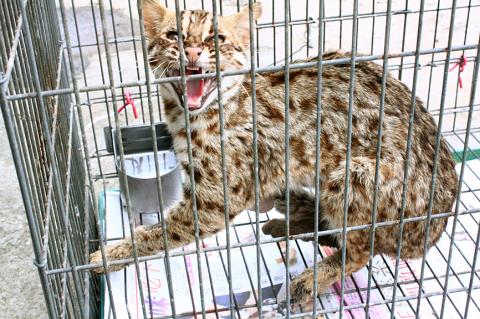
Photo: Ho Tsung-han, Taipei Times
The association said it found the leopard cat on Cianshan (淺山) in Gongguan with its right front leg caught in a trap. Association director Lin Ching-chi (林清棋) alerted the county’s Agriculture Department and sent the leopard cat to a veterinarian.
The mating season for leopard cats is from December to April, and the routes the cats take tend to follow the paths of their prey and are unpredictable, Lin said, adding that the leopard cat the association found could have been caught in the trap for as long as eight days.
There were maggots in its wounds and the cat was lucky that it rained recently or it would have died of dehydration, Lin said. After the veterinarian amputated the limb and injected the cat with nutrients, it gradually regained its health, he added.
Meanwhile, the county’s Agriculture Department yesterday reminded the public that if they found leopard cats preying on domestic animals, they should not attempt to capture or kill them, but contact the local fire station.
Capturing or selling leopard cats is against the Wildlife Conservation Act (野生動物保育法) and is punishable with a prison sentence of six months to five years, along with a fine of NT$200,000 to NT$1 million, the department said.
Translated by Jake Chung, Staff Writer

ANOTHER EMERGES: The CWA yesterday said this year’s fourth storm of the typhoon season had formed in the South China Sea, but was not expected to affect Taiwan Tropical Storm Gaemi has intensified slightly as it heads toward Taiwan, where it is expected to affect the country in the coming days, the Central Weather Administration (CWA) said yesterday. As of 8am yesterday, the 120km-radius storm was 800km southeast of Oluanpi (鵝鑾鼻), Taiwan’s southernmost tip, moving at 9kph northwest, the agency said. A sea warning for Gaemi could be issued tonight at the earliest, it said, adding that the storm is projected to be closest to Taiwan on Wednesday or Thursday. Gaemi’s potential effect on Taiwan remains unclear, as that would depend on its direction, radius and intensity, forecasters said. Former Weather Forecast

As COVID-19 cases in Japan have been increasing for 10 consecutive weeks, people should get vaccinated before visiting the nation, the Centers for Disease Control (CDC) said. The centers reported 773 hospitalizations and 124 deaths related to COVID-19 in Taiwan last week. CDC Epidemic Intelligence Center Director Guo Hung-wei (郭宏偉) on Tuesday said the number of weekly COVID-19 cases reported in Japan has been increasing since mid-May and surpassed 55,000 cases from July 8 to July 14. The average number of COVID-19 patients at Japan’s healthcare facilities that week was also 1.39 times that of the week before and KP.3 is the dominant

The Chinese Communist Party’s (CCP) working group for Taiwan-related policies is likely to be upgraded to a committee-level body, a report commissioned by the Mainland Affairs Council (MAC) said. As Chinese President Xi Jinping (習近平) is increasingly likely to upgrade the CCP’s Central Leading Group for Taiwan Affairs, Taiwanese authorities should prepare by researching Xi and the CCP, the report said. At the third plenary session of the 20th Central Committee of the CCP, which ended on Thursday last week, the party set a target of 2029 for the completion of some tasks, meaning that Xi is likely preparing to

US-CHINA TRADE DISPUTE: Despite Beijing’s offer of preferential treatment, the lure of China has dimmed as Taiwanese and international investors move out Japan and the US have become the favored destinations for Taiwanese graduates as China’s attraction has waned over the years, the Ministry of Labor said. According to the ministry’s latest income and employment advisory published this month, 3,215 Taiwanese university graduates from the class of 2020 went to Japan, surpassing for the first time the 2,881 graduates who went to China. A total of 2,300 graduates from the class of 2021 went to the US, compared with the 2,262 who went to China, the document showed. The trend continued for the class of 2023, of whom 1,460 went to Japan, 1,334 went to


 RSS
RSS