

Two new species of shallow-water coral have been discovered just off the coast of Taiwan, but their natural habitat is being threatened by construction projects in the area, environmentalists said yesterday, urging the government to put greater emphasis on ocean conservation.
Chen Chao-lun (陳昭倫), an associate researcher with the Biodiversity Research Center at Academia Sinica, yesterday told a press conference that after more than 20 years of research on corals in Taiwan, Academia Sinica’s research lab has confirmed the recent discovery of two new endemic species of coral — Pseudosiderastrea formosa and Polycyanthus chiashanensis.
The discoveries were made during a cross-national collaboration research project involving researchers from Taiwan, Japan, Australia, Kenya and Brazil. News of the discoveries was published in the academic journal Zoological Studies in January and last month.
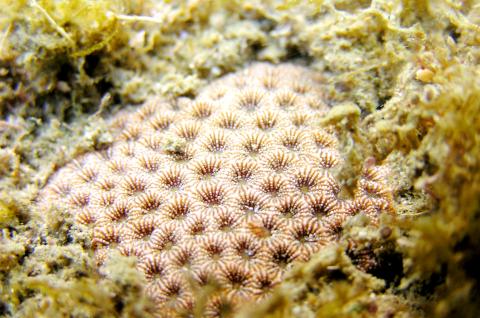
Photo: Liu Chiu-jen, Taipei Times
Chen said the significance of the discoveries is that from the perspective of biogeography, Taiwan is located on the northern rim of the Pacific Ocean’s coral triangle. Despite this, nearly 300 species of coral have been found in the area, so the two new species underlines that there is great biodiversity in waters near Taiwan.
From the perspective of species evolution, Pseudosiderastrea formosa is only the second species of Pseudosiderastrea coral identified and 77 years had passed since the first species, Pseudosiderastrea tayamai, was found in 1935 in waters between Australia and Papua New Guinea, he added.
From the perspective of marine species conservation and environmental protection, Chen said: “The two species of coral have not been described in other parts of the world.”
“Both of them are small in size and inhabit shallow waters that are less than 10m deep, mostly water only about 1m to 3m deep, but because their habitat is very close to areas where there are human activity, they are very easily affected by human behaviors,” he said.
The Polycyanthus chiashanensis was first found in shallow waters near Greater Kaohsiung’s Takao Hill (also named Chiashan, 柴山) in 2010, at just about the same time the local government had began drilling the reef coast at Siz-ihwan (西子灣) to erect border dikes in a sea reclamation construction project, said Lan Pei-rong (藍培榮), a former chairperson of the Takao Hill Association.
“There are also many illegal constructions near the western coast of Takao Hill and these commercial activities will affect the habitat of the corals,” he said.
The association urged the government to apply to the International Union for Conservation of Nature and Natural Resources to list the two new species of coral as endangered. This would allow them to receive better protection.
Meanwhile, the Taiwan Environmental Information Center said it is particularly concerned about construction plans in the coastal regions of Taitung County, the location of some of the nation’s major coral reefs.
The Environmental Impact Assessment review should add the underwater ecological environment to its list of evaluation items, the center suggested.
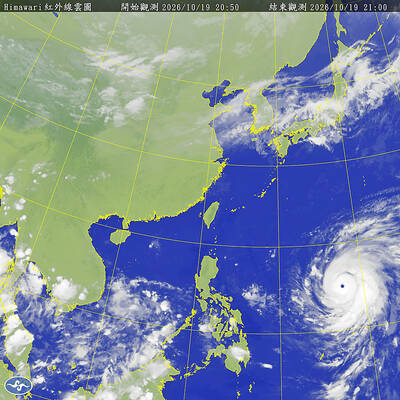
Typhoon Champi is forecast to turn northward earlier than previously expected, sparing Taiwan a direct hit but still bringing heavy rain to the north of the country on Friday and Saturday, the Central Weather Administration (CWA) said yesterday. Typhoon Champi had strengthened and increased in size over the past 12 hours, and as of yesterday afternoon, was packing sustained winds of 198kph near its center, CWA forecaster Cheng Chieh-jen (鄭傑仁) said. However, due to the weakening of a Pacific high-pressure system the storm is now expected to turn northward earlier than initially forecast, likely around Japan’s Ishigaki Island, Cheng said. As Champi brushes
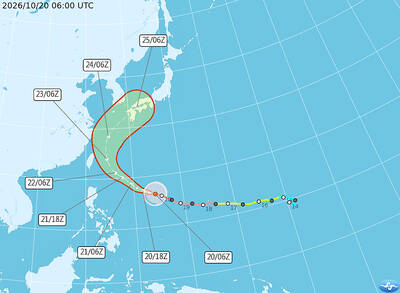
A sea warning for Typhoon Champi might be issued tonight, while the storm’s trajectory would determine whether a land warning is to be issued tomorrow night, the Central Weather Administration (CWA) said yesterday. As of 2pm yesterday, Champi was about 1,536km east-southeast of Taiwan proper’s southernmost point, Oluanpi (鵝鑾鼻), packing maximum sustained winds of 198kph, CWA forecaster Tseng Chao-cheng (曾昭誠) said. The storm was moving west-northwest at 23kph and was expected to strengthen over the next 24 hours before weakening slightly as it approaches cooler waters east of Taiwan, Tseng said. Champi is expected to turn north tomorrow, with the angle of the
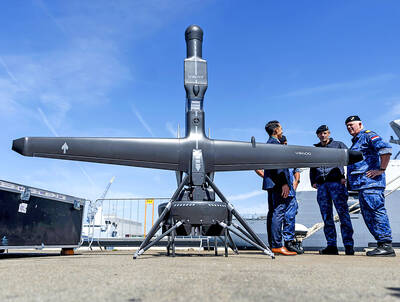
DEFENSE PROCUREMENT: Taiwan could become the largest operator of V-BAT drones outside the US if the contract is finalized, the Ministry of National Defense said The navy and the coast guard reportedly plan to acquire 292 units of MQ-35A V-BAT vertical takeoff and landing (VTOL) surveillance drones. If the contract is awarded and finalized, it would make Taiwan one of the largest buyers of the uncrewed aerial vehicle (UAV) developed by the US-based defense technology company Shield AI. The Coast Guard Administration budgeted NT$1.2 billion (US$37.1 million) to buy 12 drones, which have been delivered, Shield AI said in a report on Oct 13. The navy is planning to spend NT$36 billion under a four-year program code-named Project Yuan Hsiao (遠鴞) to acquire 280 V-BAT drones,
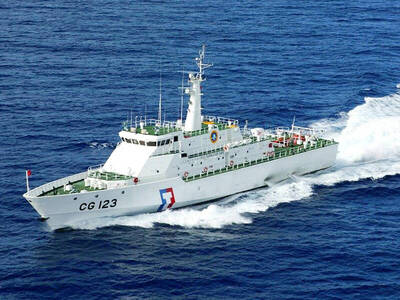
A patrol vessel donated by the Coast Guard Administration (CGA) to the Philippines would not be used in waters near Taiwan or areas where Taiwanese fishing vessels operate, Premier Cho Jung-tai (卓榮泰) said yesterday. The vessel, formerly the CGA's 500-tonne-class Kinmen (金門), was commissioned into the Philippine Coast Guard on Oct. 2. Speaking at the Legislative Yuan, Cho said the Philippines had pledged during the donation process that the vessel would be used only for designated missions and would not operate in waters related to Taiwan. The vessel could even provide assistance to Taiwan if needed, he added. Responding to questions from Chinese


 RSS
RSS