


Taiwan has become the first country to make an international purchase of the Block III Longbow Fire Control Radar (FCR), a powerful target acquisition and prioritization system and a key component of the AH-64D Apache helicopter.
This was made official in a Lockheed Martin Corp press release on Wednesday, which stated that Longbow Limited Liability Co, a joint venture of Lockheed Martin and Northrop Grumman Corp, had received a US$181 million contract from the US Army for AH-64D Apache Block III Longbow systems.
According to the press release, the contract includes the first international purchase of the Block III Longbow Fire Control Radar (FCR), for a total of 15 Block III Longbow FCR systems.
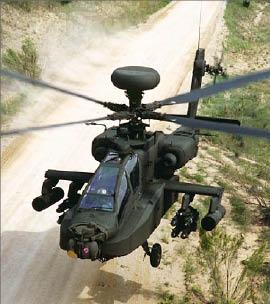
Photo: Boeing Web site
The Boeing Co-made Apaches are part of a US$6.4 billion arms package notified to US Congress in October 2008. The 30 attack helicopters will cost Taiwan an estimated US$2.5 billion and will supplement the AH-1W Super Cobra that has been used by the Taiwanese army since 1993. The notification also included 1,000 AGM-114L Longbow Hellfire missiles and 66 M299 Hellfire Longbow missile launchers.
Wednesday’s announcement represents the first batch of Longbow radar systems for Taiwan, with orders for the remaining 15 expected to be placed sometime in the future.
“The Longbow Apache is the world’s premier attack helicopter and the FCR is one of the key elements that make it that way,” Colonel Shane Openshaw, US Army project manager for the Apache helicopters, was quoted as saying.
The FCR provides all-terrain and all-weather detection, location, classification and prioritization of multiple air and ground targets, the Web site says. As it is mounted atop the helicopter’s main rotor, the FCR enhances the Apache’s ability to acquire and track targets without being detected. The Longbow FCR integrates with the Hellfire missile, enhancing the Apache’s lethality fourfold and increasing its survivability sevenfold, the release says.
The first Apache is scheduled for delivery in October. Taiwan’s acquisition of the world’s most advanced combat helicopter is part of a project codenamed Tian Ying, or “Sky Eagle.”

Taipei has once again made it to the top 100 in Oxford Economics’ Global Cities Index 2025 report, moving up five places from last year to 60. The annual index, which was published last month, evaluated 1,000 of the most populated metropolises based on five indices — economics, human capital, quality of life, environment and governance. New York maintained its top spot this year, placing first in the economics index thanks to the strength of its vibrant financial industry and economic stability. Taipei ranked 263rd in economics, 44th in human capital, 15th in quality of life, 284th for environment and 75th in governance,

The Sports Administration yesterday demanded an apology from the national table tennis association for barring 17-year-old Yeh Yi-tian (葉伊恬) from competing in the upcoming World Table Tennis (WTT) United States Smash tournament in Las Vegas this July. The sports agency said in a statement that the Chinese Taipei Table Tennis Association (CTTTA) must explain to the public why it withdrew Yeh from the WTT tournament in Las Vegas. The sports agency said it contacted the association to express its disapproval of the decision-making process after receiving a complaint from Yeh’s coach, Chuang
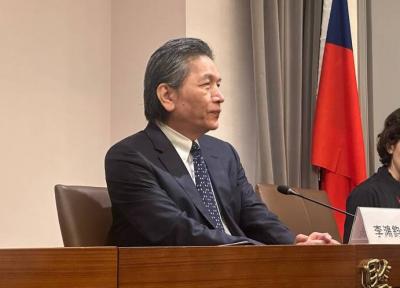
Control Yuan Secretary-General Lee Chun-yi (李俊俋) tendered his resignation last night, admitting that he had misused a government vehicle, as reported by media. His resignation was immediately accepted by the Control Yuan. In a statement explaining why he had resigned, Lee apologized for using a Control Yuan vehicle to transport his dog to a pet grooming salon on May 20. The issue first came to light late last month, when TVBS News reported that Lee had instructed his driver to take the dog to the salon. The news channel broadcast photos that it said were taken by an unnamed whistle-blower, which purportedly showed the

Democratic Progressive Party caucus chief executive Rosalia Wu, front, grabs the pennant in a dragon boat race hosted by Qu Yuan Temple in the Shuanghsi River in Taipei’s Beitou District yesterday.


 RSS
RSS