


Following three years of studies on the health of Taiwan’s coral reefs, the non-profit Taiwan Environmental Information Association yesterday said the ocean ecology surrounding Taiwan was threatened by overfishing and urged the three presidential candidates to enforce ocean protection policies.
The association said that from studies on the health of Taiwan’s coral reefs done by association volunteers beginning in 2009, it discovered that aside from the condition of coral reefs, a rapid exhaustion of fish in coral reef habitats was common.
Global Coral Reef Monitoring Network East Asia planning director and Penghu Symbiotic Algae Association chairperson Allen Chen (陳昭倫) said indicator fish species and invertebrate species that are edible, such as sweetlips, lobsters and sea urchins, are very scarce, a sign of exhaustion of marine resources caused by overfishing.
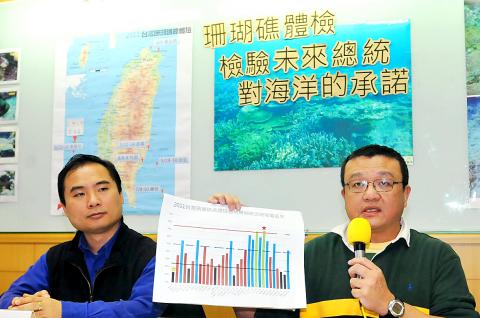
Photo: CNA
“Almost all the edible fish resources in these areas have been caught,” he said, adding that based on data provided by the Council of Agriculture’s Fishery Agency, the annual catch from coastal fisheries last year had dropped 42.69 percent in comparison with the catch in 2001, with a 19.75 percent drop in offshore fisheries.
He said that although the coral cover, the proportion of reef surface covered by live stony coral, over the seven surveyed sites varied, with Green Island (綠島) presenting the highest cover rate, the overall condition was considered “medium,” according to the Reef Check Worldwide organization’s standards.
The association said an agreement was reached at an international conference in 2003, held by the International Union Conservation of Nature, promising to set aside 12 percent of oceans worldwide as marine reserves, but currently less than 6 percent of Taiwan’s ocean area is protected by regulations.
Taiwan Environmental Information Association secretary-general Chen Juei-pin (陳瑞賓) urged the government and the three presidential candidates to set up marine reserves to ensure the sustainable development of the ocean, improve ocean protection and to push for tougher regulations.
He also said the association had sent a letter to all three presidential candidates on Wednesday urging them to recognize the importance of ocean protection, but that so far there have not been any replies.
“We can wait for their replies, but marine life cannot wait anymore. So we hope the government can give us answers as soon as possible,” he said, adding that the association would continue to monitor whether ocean protection policies are being enforced after the Jan. 14 elections.

The Ministry of Education (MOE) is to launch a new program to encourage international students to stay in Taiwan and explore job opportunities here after graduation, Deputy Minister of Education Yeh Ping-cheng (葉丙成) said on Friday. The government would provide full scholarships for international students to further their studies for two years in Taiwan, so those who want to pursue a master’s degree can consider applying for the program, he said. The fields included are science, technology, engineering, mathematics, semiconductors and finance, Yeh added. The program, called “Intense 2+2,” would also assist international students who completed the two years of further studies in

Former president Tsai Ing-wen (蔡英文) departed for Europe on Friday night, with planned stops in Lithuania and Denmark. Tsai arrived at Taiwan Taoyuan International Airport on Friday night, but did not speak to reporters before departing. Tsai wrote on social media later that the purpose of the trip was to reaffirm the commitment of Taiwanese to working with democratic allies to promote regional security and stability, upholding freedom and democracy, and defending their homeland. She also expressed hope that through joint efforts, Taiwan and Europe would continue to be partners building up economic resilience on the global stage. The former president was to first

Former president Tsai Ing-wen (蔡英文) on Monday called for greater cooperation between Taiwan, Lithuania and the EU to counter threats to information security, including attacks on undersea cables and other critical infrastructure. In a speech at Vilnius University in the Lithuanian capital, Tsai highlighted recent incidents in which vital undersea cables — essential for cross-border data transmission — were severed in the Taiwan Strait and the Baltic Sea over the past year. Taiwanese authorities suspect Chinese sabotage in the incidents near Taiwan’s waters, while EU leaders have said Russia is the likely culprit behind similar breaches in the Baltic. “Taiwan and our European

The Taipei District Court sentenced babysitters Liu Tsai-hsuan (劉彩萱) and Liu Jou-lin (劉若琳) to life and 18 years in prison respectively today for causing the death of a one-year-old boy in December 2023. The Taipei District Prosecutors’ Office said that Liu Tsai-hsuan was entrusted with the care of a one-year-old boy, nicknamed Kai Kai (剴剴), in August 2023 by the Child Welfare League Foundation. From Sept. 1 to Dec. 23 that year, she and her sister Liu Jou-lin allegedly committed acts of abuse against the boy, who was rushed to the hospital with severe injuries on Dec. 24, 2023, but did not


 RSS
RSS