


The military display on Double Ten National Day on Monday will mainly showcase the military’s disaster relief capability while the show of armed force would be of secondary importance, Wang Jin-pyng (王金平), chairman of the National Day Ceremony Organizing Committee said yesterday.
“What we wanted to show in the military display is its ability to protect the homeland, rather than to engage in war,” Wang told a press conference held to announce the series of celebrations planned to mark Taiwan’s (Republic of China, ROC) centennial.
General Lieutenant Chu Yu-shu (朱玉書), commanding officer of the 6th Army Corps, said the military display was designed to embody the principle declared by President Ma Ying-jeou (馬英九) that Taiwan would not engage in an arms race with China.
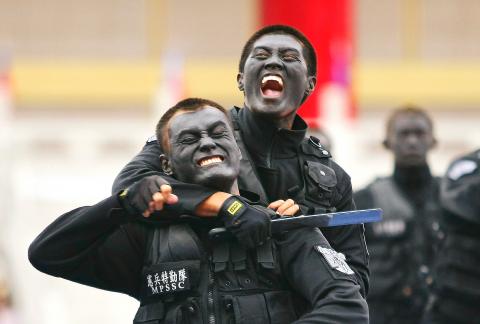
Photo: CNA
The defense display is set to last 40 minutes and will consist of various elements, including a ground parade, an air show and a parachute-jumping display that will involve a total of 1,082 military personnel, 71 aircraft and 168 vehicles, with a view to “demonstrate our self-defense determination and strength to defend the country,” Chu said.
The weapons on display will include RT2000 multiple rocket launch systems; Unmanned Air Vehicles (UAVs); 3,000 gallon water purifier vehicles; nuclear, biological and chemical reconnaissance vehicles; decontamination vehicles associated with chemical weapons activity; and various multifunction squad cars to showcase the country’s self-reliance ability and results, Chu said.
Military hardware used by the special operation forces, the chemical corps, the engineering corps, the telegraph corps and the marine corps will be introduced to the public for the first time in history, he added.
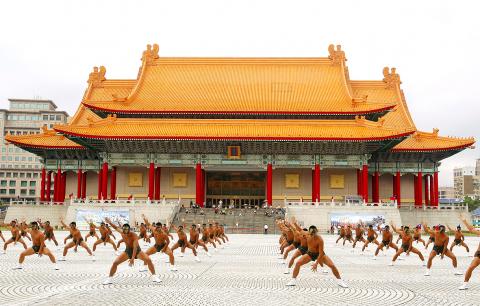
Photo: REUTERS
Along with the defense display, the exemplary military personnel who engaged in disaster relief work after Typhoon Morakot, last year’s Haiti earthquake, Typhoon Megi and Typhoon Nanmadol are to receive acclaim from citizens at the ceremony — a gesture to highlight the importance of civil-military cooperation in the event of multiple disasters, Chu said.
The ceremony, to be held in front of the Presidential Office, is planned to start at 9:22am with a performance by the Joint Military Marching Band, the Armed Forces Honor Guard, as well as the March bands and Honor Guards of Taipei First Girls’ School and Taipei Jingmei Girls’ School.
Chen Shu-chu (陳樹菊), the vegetable vendor and philanthropist who was named one of last year’s most influential people by Time magazine, is scheduled to lead the audience in singing the national anthem at the ceremony, followed by a speech by President Ma Ying-jeou (馬英九).
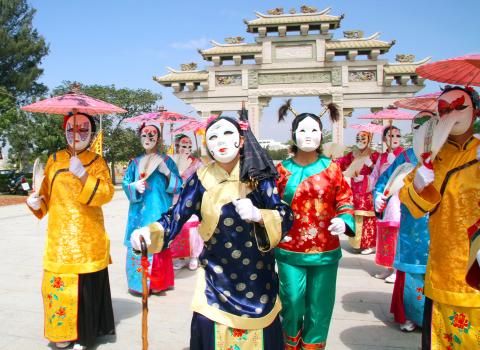
Photo: CNA
Among the six leaders of political parties invited to the ceremony, Chinese Nationalist Party (KMT) Honorary Chairman Wu Po-hsiung (吳伯雄), New Party Chairman Yok Mu-ming (郁慕明) and People First Party Chairman James Soong (宋楚瑜) said they would attend, while Taiwan Solidarity Union Chairman Huang Kun-huei (黃昆輝) and Non-Partisan Solidarity Union Chairman Lin Pin-kuan (林炳坤) said they would not be able to make it, Wang said.
Wang added that he had not yet had a reply from Democratic Progressive Party Chairperson Tsai Ing-wen (蔡英文) and hoped a decision would be made by today at the latest.
The main National Day firework display, which will last 40 minutes starting from 7pm, is scheduled in the Lugang Changbin Industrial Zone of Changhua County, in which 16-inch firework shells will be set off, unlike the 12-inch and 10-inch shells in the past, enabling the fireworks’ explosive force to spread to a diameter of 600m, the organizing committee said.
In Taipei, the Taipei Dadaocheng Firework Festival will be held at the Dadaocheng wharf from 3pm.
The fireworks display is scheduled to begin at 8:30pm and last 20 minutes.
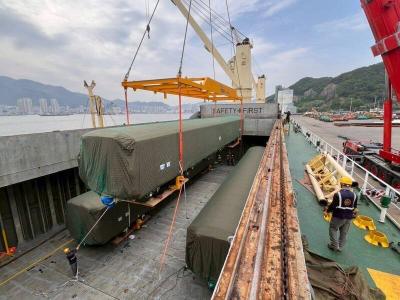
The first of 10 new high-capacity trains purchased from South Korea’s Hyundai Rotem arrived at the Port of Taipei yesterday to meet the demands of an expanding metro network, Taipei Rapid Transit Corp (TRTC) said yesterday. The train completed a three-day, 1,200km voyage from the Port of Masan in South Korea, the company said. Costing NT$590 million (US$18.79 million) each, the new six-carriage trains feature a redesigned interior based on "human-centric" transportation concepts, TRTC said. The design utilizes continuous longitudinal seating to widen the aisles and optimize passenger flow, while also upgrading passenger information displays and driving control systems for a more comfortable
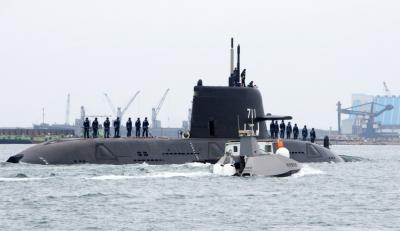
Taiwan's first indigenous defense submarine, the SS-711 Hai Kun (海鯤, or Narwhal), departed for its 13th sea trial at 7am today, marking its seventh submerged test, with delivery to the navy scheduled for July. The outing also marked its first sea deployment since President William Lai (賴清德) boarded the submarine for an inspection on March 19, drawing a crowd of military enthusiasts who gathered to show support. The submarine this morning departed port accompanied by CSBC Corp’s Endeavor Manta (奮進魔鬼魚號) uncrewed surface vessel and a navy M109 assault boat. Amid public interest in key milestones such as torpedo-launching operations and overnight submerged trials,
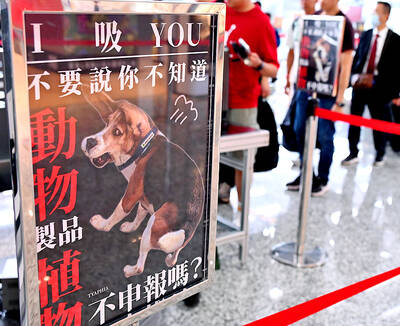
Quarantine awareness posters at Taiwan Taoyuan International Airport have gone viral for their use of wordplay. Issued by the airport branch of the Animal and Plant Health Inspection Agency, the posters feature sniffer dogs making a range of facial expressions, paired with advisory messages built around homophones. “We update the messages for holidays and campaign needs, periodically refreshing materials to attract people’s attention,” quarantine officials said. “The aim is to use the dogs’ appeal to draw focus to quarantine regulations.” A Japanese traveler visiting Taiwan has posted a photo on X of a poster showing a quarantine dog with a
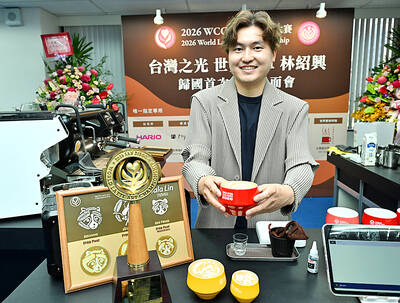
Taiwan’s coffee community has launched a “one-person-one-e-mail” campaign, calling for people to send a protest-e-mail to the World Coffee Championships (WCC) urging it to redesignate Taiwanese competitors as from “Taiwan,” rather than “Chinese Taipei.” The call followed sudden action last week after the WCC changed all references to Taiwanese competitors from “Taiwan” to “Chinese Taipei,” including recent World Latte Art champion Bala (林紹興), who won the World Latte Art Championship in San Diego earlier this month. When Bala received the trophy, he was referred to as representing Taiwan, as well as in the announcement on the WCC’s Web site, until it


 RSS
RSS