


Taiwan could achieve “meaningful participation” in the UN Framework Convention on Climate Change (UNFCCC) and International Civil Aviation Organization (ICAO) within a year, Deputy Minister of Foreign Affairs Shen Lyn-shun (沈呂巡) said yesterday.
Taiwan formally declared its desire to participate in the ICAO and the UNFCCC in September 2009, though a formal request has yet to be made.
Answering a question from Chinese Nationalist Party (KMT) Legislator Justin Chou (周守訓) at the legislature’s Foreign and Defense Committee, Shen said that while Taiwan was moving toward its goal “inch by inch,” success “would come within a year.”
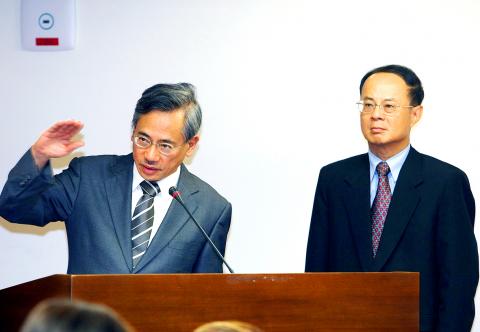
Photo: CNA
“Actually it’s happening right now. We are now able to attend side-events at the UNFCCC meeting,” he said.
Briefing the committee on the nation’s participation at the 64th session of the WHA in Geneva last week, Shen said that although the government was not entirely satisfied with the arrangements by which Taiwan took part, it was “sort of acceptable.”
The government plans to seek participation in more international organizations using the same model, Shen said.
The WHA model entails participation in international organizations under the name “Chinese Taipei” in the capacity of an “observer at the government level,” Shen said.
In this way the nation is represented by ministerial level officials and attends events at the highest level of the organizations, he said.
The WHA model marked the first time the nation was allowed to participate in a UN agency using the name “Chinese Taipei” since 1971, Shen said.
“Chinese Taipei” stands for “Republic of China [ROC], Taipei,” Shen said, adding that the use of Taipei rather than “Taibei,” as it is written by Beijing, clearly showed it stood for the ROC and not the People’s Republic of China.
Asked by KMT Legislator Chang Hsien-yao (張顯耀) to comment on the possible use of a “two China” approach when participating in international organizations, as suggested by former American Institute in Taiwan chairman Richard Bush, Shen said: “It would be difficult to apply ‘dual representation’ now, but what we can do is follow the WHA model.”
However, some legislators said they were not entirely satisfied with the delegation’s performance at the WHA and said the “WHA model” denigrated Taiwan’s sovereignty.
KMT Legislator Hsu Shu-po (許舒博) asked when the Ministry of Foreign Affairs first became aware of an internal WHO memo, leaked earlier this month, that instructed staff at the global health body to refer to Taiwan as a “province of China.”
“If it knew years ago, what measures were taken, when was the president informed, and why wasn’t the information made public?” Hsu asked.
Shen declined to answer.
“I’m sorry, but it’s not convenient for me to provide such details here,” he said.
Unhappy with Shen’s reply, Hsu banged the desk with his hand and said that if the ministry refused to share “confidential” information with the legislature, it should respond to the public directly.
In addition, he asked why Taiwan’s delegates at the WHA did not make public the protest letter by placing copies of it on the desks of other nations.
Defending the delegation’s efforts, Department of Health Minister Chiu Wen-ta (邱文達) said he had strongly protested by using the phrases “utmost dissatisfaction” and “strongly protest,” which “were probably the strongest words I have ever used.”
Lawmakers said there was a difference between what one person considered a strong protest and how it was perceived by others.
Holding a copy of the protest letter handed by Chiu to the WHO Secretariat last week, DPP legislator Huang Sue-ying (黃淑英) said: “They didn’t even dare to use an official letter heading because they were afraid it would offend China,” adding that only the word “health” appeared in the heading, while the nation’s name was not mentioned even once.
Such a protest was “soft and weak,” Huang said.
“If Taiwan were to attend international meetings in such a manner, it would be like being China’s ‘concubine,’ because we would only be able to appear with its consent,” DPP Legislator Tien Chiu-chin (田秋堇) said.

ANOTHER EMERGES: The CWA yesterday said this year’s fourth storm of the typhoon season had formed in the South China Sea, but was not expected to affect Taiwan Tropical Storm Gaemi has intensified slightly as it heads toward Taiwan, where it is expected to affect the country in the coming days, the Central Weather Administration (CWA) said yesterday. As of 8am yesterday, the 120km-radius storm was 800km southeast of Oluanpi (鵝鑾鼻), Taiwan’s southernmost tip, moving at 9kph northwest, the agency said. A sea warning for Gaemi could be issued tonight at the earliest, it said, adding that the storm is projected to be closest to Taiwan on Wednesday or Thursday. Gaemi’s potential effect on Taiwan remains unclear, as that would depend on its direction, radius and intensity, forecasters said. Former Weather Forecast

As COVID-19 cases in Japan have been increasing for 10 consecutive weeks, people should get vaccinated before visiting the nation, the Centers for Disease Control (CDC) said. The centers reported 773 hospitalizations and 124 deaths related to COVID-19 in Taiwan last week. CDC Epidemic Intelligence Center Director Guo Hung-wei (郭宏偉) on Tuesday said the number of weekly COVID-19 cases reported in Japan has been increasing since mid-May and surpassed 55,000 cases from July 8 to July 14. The average number of COVID-19 patients at Japan’s healthcare facilities that week was also 1.39 times that of the week before and KP.3 is the dominant

The Chinese Communist Party’s (CCP) working group for Taiwan-related policies is likely to be upgraded to a committee-level body, a report commissioned by the Mainland Affairs Council (MAC) said. As Chinese President Xi Jinping (習近平) is increasingly likely to upgrade the CCP’s Central Leading Group for Taiwan Affairs, Taiwanese authorities should prepare by researching Xi and the CCP, the report said. At the third plenary session of the 20th Central Committee of the CCP, which ended on Thursday last week, the party set a target of 2029 for the completion of some tasks, meaning that Xi is likely preparing to

US-CHINA TRADE DISPUTE: Despite Beijing’s offer of preferential treatment, the lure of China has dimmed as Taiwanese and international investors move out Japan and the US have become the favored destinations for Taiwanese graduates as China’s attraction has waned over the years, the Ministry of Labor said. According to the ministry’s latest income and employment advisory published this month, 3,215 Taiwanese university graduates from the class of 2020 went to Japan, surpassing for the first time the 2,881 graduates who went to China. A total of 2,300 graduates from the class of 2021 went to the US, compared with the 2,262 who went to China, the document showed. The trend continued for the class of 2023, of whom 1,460 went to Japan, 1,334 went to


 RSS
RSS