


A 24-member group from China, which includes family members of tourists who were killed or injured in Wednesday’s Alishan Forest Railway train crash, arrived in Taiwan early yesterday.
Immediately after arriving at Taiwan Taoyuan International Airport, the group traveled by tour bus to Chiayi County where the crash site is located.
Five people have been confirmed killed and 109 others injured in the train accident. All of those killed and the majority of those injured were Chinese citizens.
Luo Wanfei (駱萬飛), deputy director of the Tourism Administration of Qingdao in Shandong Province, who headed the group, said the relatives of those killed or injured in the accident were hoping to learn more about the situation as soon as possible.
Other groups of the crash victims’ family members were set to arrive in Taiwan from various parts of China later yesterday, tourism sources said.
The accident took place at the 70km mark on the Alishan Forest Railway between the Sacred Tree Station and Alishan Station.
Five Chinese tour groups from Guangdong, Shandong, Sichuan, Henan and Zhejiang provinces were traveling on the eight-carriage train when it was struck by a rotten tree branch.
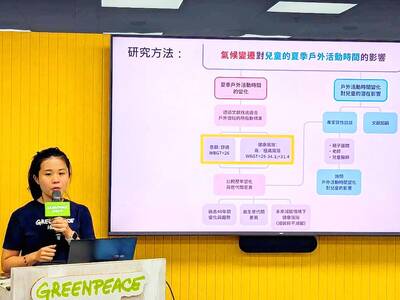
The government should improve children’s outdoor spaces and accelerate carbon reduction programs, as the risk of heat-related injury due to high summer temperatures rises each year, Greenpeace told a news conference yesterday. Greenpeace examined summer temperatures in Taipei, New Taipei City, Taoyuan, Hsinchu City, Taichung, Tainan and Kaohsiung to determine the effects of high temperatures and climate change on children’s outdoor activities, citing data garnered by China Medical University, which defines a wet-bulb globe temperature (WBGT) of 29°C or higher as posing the risk of heat-related injury. According to the Central Weather Administration, WBGT, commonly referred to as the heat index, estimates
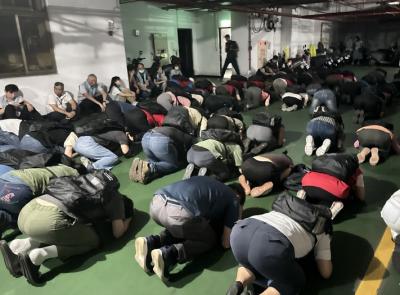
Taipei and other northern cities are to host air-raid drills from 1:30pm to 2pm tomorrow as part of urban resilience drills held alongside the Han Kuang exercises, Taiwan’s largest annual military exercises. Taipei, New Taipei City, Keelung, Taoyuan, Yilan County, Hsinchu City and Hsinchu County are to hold the annual Wanan air defense exercise tomorrow, following similar drills held in central and southern Taiwan yesterday and today respectively. The Taipei Mass Rapid Transit (MRT) and Maokong Gondola are to run as usual, although stations and passenger parking lots would have an “entry only, no exit” policy once air raid sirens sound, Taipei
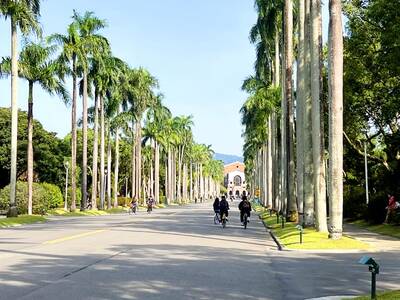
Taipei placed 14th in the Quacquarelli Symonds (QS) Best Student Cities 2026 list, its highest ever, according to results released yesterday. With an overall score of 89.1, the city climbed 12 places from the previous year, surpassing its previous best ranking of 17th in 2019. Taipei is “one of Asia’s leading higher-education hubs,” with strong employer activity scores and students “enjoying their experience of the city and often keen to stay after graduation,” a QS staff writer said. In addition to Taipei, Hsinchu (71st), Tainan (92nd), Taichung (113th) and Taoyuan (130th) also made QS’ list of the top 150 student cities. Hsinchu showed the
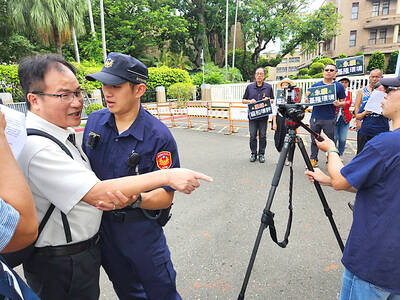
Environmental groups yesterday filed an appeal with the Executive Yuan, seeking to revoke the environmental impact assessment (EIA) conditionally approved in February for the Hsieh-ho Power Plant’s planned fourth liquefied natural gas (LNG) receiving station off the coast of Keelung. The appeal was filed jointly by the Protect Waimushan Seashore Action Group, the Wild at Heart Legal Defense Association and the Keelung City Taiwan Head Cultural Association, which together held a news conference outside the Executive Yuan in Taipei. Explaining the reasons for the appeal, Wang Hsing-chih (王醒之) of the Protect Waimushan Seashore Action Group said that the EIA failed to address


 RSS
RSS