


Inspections by the Consumers’ Foundation and the Bureau of Standards, Metrology and Inspection on children’s toys showed that small figurines sometimes contain levels of toxic chemicals more than 100 times more than acceptable levels.
Inspectors in May tested 28 types of children’s toys sold at supermarkets, toy stores and online shopping sites and found that two contained toxic chemicals exceeding maximum allowable levels.
A sea creature coin bank made by an unknown manufacturer in China and a South Korean doll figurine manufactured by Apple Toys in China contained levels of chemical substances used as plasticizers that were more than 100 times the maximum of 0.1 percent allowed by the Chinese National Standards (CNS).

PHOTO: CNA
Chuang Suh-chyng (莊素琴), deputy director of the bureau, said the chemicals were a type of environmental hormone that acts as an endocrine disruptor, which can cause men to develop feminine characteristics and can increase risks of breast cancer in women. The chemicals can damage the liver and kidneys.
The doll figurine was also found to contain 251 parts per million (ppm) of lead, 2.8 times the legal limit of 90ppm. Lead can damage the nervous system or induce toxic overdose if consumed.
The bureau has ordered the toys to be taken off the shelves and returned to the manufacturer or destroyed.
“Young children who play with these toys may accidentally consume the harmful chemicals if they put the toys in their mouth or chew on them,” said Hwang Yu-sheng (黃鈺生), secretary general of the foundation.
Five of the toys included in the study did not come with adequate labeling of important information such as the name of the manufacturer, the manufacturer’s address, the serial number, relevant warnings and age suitability.
The consumer rights watchdog urged parents to look for product safety stickers when purchasing toys for their children and to ensure the products are clearly labeled with manufacturer information in Chinese.
Parents should also keep an eye on their children when they are playing with toys to prevent them from putting the toys in their mouth and increasing their exposure to potentially harmful substances, Hwang said.

The military has spotted two Chinese warships operating in waters near Penghu County in the Taiwan Strait and sent its own naval and air forces to monitor the vessels, the Ministry of National Defense (MND) said. Beijing sends warships and warplanes into the waters and skies around Taiwan on an almost daily basis, drawing condemnation from Taipei. While the ministry offers daily updates on the locations of Chinese military aircraft, it only rarely gives details of where Chinese warships are operating, generally only when it detects aircraft carriers, as happened last week. A Chinese destroyer and a frigate entered waters to the southwest

A magnitude 6.1 earthquake struck off the coast of Yilan County at 8:39pm tonight, the Central Weather Administration (CWA) said, with no immediate reports of damage or injuries. The epicenter was 38.7km east-northeast of Yilan County Hall at a focal depth of 98.3km, the CWA’s Seismological Center said. The quake’s maximum intensity, which gauges the actual physical effect of a seismic event, was a level 4 on Taiwan’s 7-tier intensity scale, the center said. That intensity level was recorded in Yilan County’s Nanao Township (南澳), Hsinchu County’s Guansi Township (關西), Nantou County’s Hehuanshan (合歡山) and Hualien County’s Yanliao (鹽寮). An intensity of 3 was

Japanese Prime Minister Sanae Takaichi’s comment last year on Tokyo’s potential reaction to a Taiwan-China conflict has forced Beijing to rewrite its invasion plans, a retired Japanese general said. Takaichi told the Diet on Nov. 7 last year that a Chinese naval blockade or military attack on Taiwan could constitute a “survival-threatening situation” for Japan, potentially allowing Tokyo to exercise its right to collective self-defense. Former Japan Ground Self-Defense Force general Kiyofumi Ogawa said in a recent speech that the remark has been interpreted as meaning Japan could intervene in the early stages of a Taiwan Strait conflict, undermining China’s previous assumptions
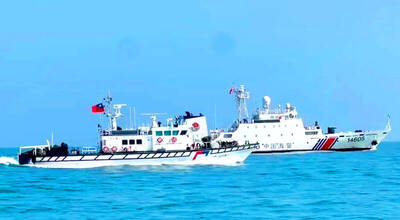
Instead of focusing solely on the threat of a full-scale military invasion, the US and its allies must prepare for a potential Chinese “quarantine” of Taiwan enforced through customs inspections, Stanford University Hoover fellow Eyck Freymann said in a Foreign Affairs article published on Wednesday. China could use various “gray zone” tactics in “reconfiguring the regional and ultimately the global economic order without a war,” said Freymann, who is also a nonresident research fellow at the US Naval War College. China might seize control of Taiwan’s links to the outside world by requiring all flights and ships entering or leaving Taiwan


 RSS
RSS