


Premier Wu Den-yih (吳敦義) yesterday voiced support for the Ministry of the Interior’s (MOI) decision to ban Uighur activist Rebiya Kadeer from entering the nation for the next three years.
Wu said he did not agree with local media’s description that the decision was a move to “shut out” Kadeer.
“Every nation enjoys the power to control the security of its borders based on national security and mutual trust between different nations,” Wu said.
Wu made the remark after Guts United Taiwan (GUT), which is hosting screenings of a documentary about Kadeer today and tomorrow, learned recently that the Taiwanese government had placed the exiled World Uyghur Congress leader on a three-year blacklist after she was denied entry to Taipei last year.
The Chinese Nationalist Party (KMT) government came under fire when Minister of the Interior Jiang Yi-huah (江宜樺) announced in September that Taiwan would not allow Kadeer to enter the country in a bid to protect the nation’s interests and national security.
Jiang at that time said the decision was made because “the World Uyghur Congress is closely related to one or two terrorist groups, although the group itself is not a terrorist organization.”
Wu yesterday said the ban showed that Taiwan is an independent sovereign nation.
He added that many countries he would like to visit also denied him entry for many different reasons. He did not elaborate.
GUT originally planned to invite Kadeer to Taiwan to attend screenings of The 10 Conditions of Love. The ban forced the GUT to change its plan and instead invite Kadeer’s daughter, Raela Tosh, who arrived in Taipei yesterday.
Tosh was originally scheduled to be accompanied by congress vice president Omer Kanat. However, Kanat found out on Saturday that he would not be able to travel to Taiwan because the Taiwanese office in Washington said that his visa application needs further review.
Kanat holds a Turkish passport and a US green card.
Asked to comment, Ministry of Foreign Affairs deputy spokesman James Chang (章計平) said the Taipei Economic and Cultural Representative Office in Washington has its own requirements when reviewing visa applications.

The Executive Yuan yesterday approved a southwestern extension of the Sanying MRT Line from New Taipei to Bade District (八德) in Taoyuan, with a goal of starting construction by late 2026. The 4.03-kilometer extension, featuring three new stations, will run from the current terminus at Yingtao Fude Station (LB12) in New Taipei City to Dannan Station (LB14), where it will connect with Taoyuan’s Green Line, New Taipei City Metro Corp said in a statement. This extension will follow the completion of core Sanying Line, a 14.29-kilometer medium-capacity system linking Tucheng (土城), Sansia (三峽)

CARGO LOSS: About 50 containers at the stern of the ‘Ever Lunar’ cargo ship went overboard, prompting the temporary closure of the port and disrupting operations Evergreen Marine Corp, Taiwan’s largest container shipper, yesterday said that all crew members aboard the Ever Lunar (長月) were safe after dozens of containers fell overboard off the coast of Peru the previous day. The incident occurred at 9:40am on Friday as the Ever Lunar was anchored and waiting to enter the Port of Callao when it suddenly experienced severe rolling, Evergreen said in a statement. The rolling, which caused the containers to fall, might have been caused by factors including a tsunami triggered by an earthquake in Russia, poor winter sea conditions in South America or a sudden influx of waves,

The Ministry of Culture yesterday officially launched the “We TAIWAN” cultural program on Osaka’s Nakanoshima sandbank, with the program’s mascot receiving overwhelming popularity. The cultural program, which runs from Aug. 2 to 20, was designed to partner with and capitalize on the 2025 World Expo that is being held in Osaka, Japan, from April 13 to Oct. 13, the ministry said. On the first day of the cultural program, its mascot, a green creature named “a-We,” proved to be extremely popular, as its merch was immediately in high demand. Long lines formed yesterday for the opening
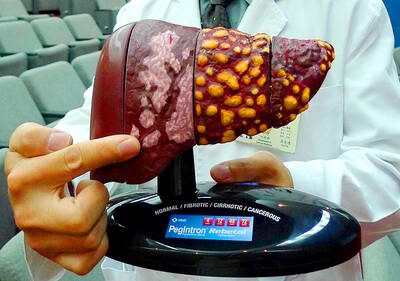
STAY VIGILANT: People should reduce the risk of chronic liver inflammation by avoiding excessive alcohol consumption, smoking and eating pickled foods, the physician said A doctor last week urged people to look for five key warning signs of acute liver failure after popular producer-turned-entertainer Shen Yu-lin (沈玉琳) was reportedly admitted to an intensive care unit for fulminant hepatitis. Fulminant hepatitis is the rapid and massive death of liver cells, impairing the organ’s detoxification, metabolic, protein synthesis and bile production functions, which if left untreated has a mortality rate as high as 80 percent, according to the Web site of Advancing Clinical Treatment of Liver Disease, an international organization focused on liver disease prevention and treatment. People with hepatitis B or C are at higher risk of


 RSS
RSS