


The long-delayed Neihu MRT Line in Taipei began operations on July 4 after seven years of construction, but frequent malfunctions and a major system shutdown have sparked concerns about the line’s stability.
A sudden power outage on the Muzha and Neihu Line on July 10 forced some 700 passengers to walk along the tracks to the nearest station and thousands more to find alternative transportation until the service resumed the following day.
The line has also experienced at least eight malfunctions and false alarms since its inauguration — from sudden stops to train doors closing too quickly or not opening at all. Such frequent malfunctions have highlighted problematic system integration and poor system testing, experts and local city councilors said.
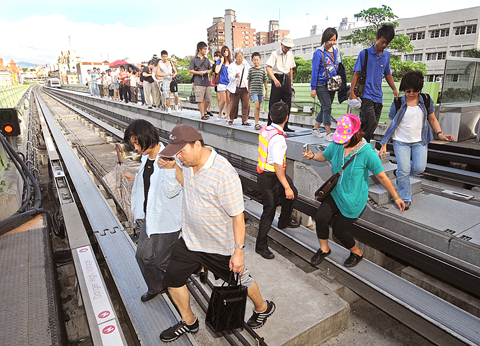
PHOTO: FANG PIN-CHAO, TAIPEI TIMES
The 14.8km Neihu Line, which cost NT$63 billion (US$1.8 billion), is a medium capacity extension of the Muzha Line. Rather than adopting the system used on the Muzha Line — France’s Matra — the Neihu Line was built by Montreal-based Bombardier.
“Each medium capacity system has a different control system. Integrating two different systems is taking a great risk with passenger safety,” said Lawrence Wang (藍武王), a professor of transportation at Mingdao University.
To integrate the two systems, trains, signs, communication, electrical and mechanical systems on the Muzha Line should switch over to the Bombardier system. Taipei City Secretariat Deputy Director Tan Gwo-guang (譚國光) said that aside from 51 trains that had yet to be converted for usage on the new system, the process of integration was almost complete.
Tsai Tien-ho (蔡天和), director of the electrical and mechanical engineering department at Taipei Rapid Transit Corp (TRTC), said that no other country had ever attempted to integrate two systems on a subway line.
The US has adopted a different system for a subway extension line, but the original line was rebuilt to be compliable with the new system, he said.
Tan, who was also a member of the inspection committee at the Ministry of Transportation and Communication, said insufficient inspection of the system before full operations were launched made it difficult to detect all the problems, adding that similar system shutdowns could happen again if TRTC and the city’s Department of Rapid Transit Systems (DORTS) failed to stabilize the system soon.
DORTS director Tom Chang (常歧德) said the July 10 shutdown was caused by an outage at the “uninterruptible” power supply system at the Zhongshan Junior High School Station.
Chang denied the outage was caused by problematic system integration, but would not provide explanations for the power outage.
The Democratic Progressive Party (DPP) and some critics blame the problem-plagued Neihu Line on President Ma Ying-jeou (馬英九) and accuse him of making a series of bad decisions when commissioning the line as former Taipei mayor, including making it only medium capacity system and switching contractors from Matra to Bombardier.
DPP Taipei City Councilor Hsu Chia-ching (徐佳青), who voted against the city government’s proposal to adopt a medium capacity system, said many city councilors and residents had called on Ma’s administration to adopt a high capacity system to reflect population growth and rapid development in the area.
“The Neihu Science Park was already in the planning stage. How could Ma not know that the population in Neihu would grow?” she said, calling on him to take responsibility for the poor system integration and cramped space in the cars.
Construction of the Neihu Line was approved by the Executive Yuan in 1993 for a medium capacity system.
In 2000, Neihu residents and local city councilors proposed to change the system to high capacity. Ma’s administration insisted on using the medium capacity system to accelerate construction and the pan-blue dominated city council approved the proposal in 2001.
“Ma didn’t want to change the system so that he could hasten the construction and stay within budget, but the construction was delayed for two years because of system integration and the city government ended up wasting more money,” Hsu said.
Construction of the line started in 2002 and was scheduled for completion in 2006. It was not completed until last year following electrical and mechanical problems, driving up the cost from NT$30 billion to NT$63 billion.


UPGRADE: The Kang Ding-class frigate is replacing its Chaparall missiles with Tien Chien II and Hua Yang VLS, which would provide it with long-range, 360° air defense Taiwan plans to produce 1,200 to 1,376 Hai Chien II missiles (海劍二, Sea Sword II) — also known as TC-2N — to serve as the standard air defense system of the navy’s surface combatant fleet, a source said yesterday. Last week, the Hai Chien II, the naval version of the Tien Kung II missile (天劍二, Sky Sword II), completed a live-fire test in waters off the National Chungshan Institute of Science and Technology’s Jiupeng facility (九鵬) in Pingtung County’s Manjhou Township (滿州). The MIM72 Chaparral and other dated air defense missiles that currently arm Taiwanese ships have inadequate range to combat Chinese

REASONS FOR TRAVEL: An assistant professor said that proposed amendments to penalize drivers if they used drugs overseas would not deter people from traveling People who operate a motor vehicle under the influence of marijuana would have their driver’s license revoked, even if they used the substance while overseas, the Ministry of Transportation and Communications said yesterday, citing proposed amendments to the Road Traffic Management and Penalty Act (道路交通管理處罰條例). The amendments would also authorize the government to revoke the licenses of people determined to have used Category 1 or Category 2 narcotics, even if they were not operating a vehicle while under the influence of drugs, as well as ban them from taking the license test for three years, the ministry said. People aged 18 or

Johanne Liou (劉喬安), a Taiwanese woman who shot to unwanted fame during the Sunflower movement protests in 2014, returned to Taiwan last night after being deported from the US. She is to stand trial in Taiwan for charges involving embezzlement, fraud and drug crimes. The Criminal Investigation Bureau (CIB) said it took her into custody at Taiwan Taoyuan International Airport and would first question her before transferring her to the New Taipei District Prosecutors’ Office. She was arrested upon disembarking a flight from San Francisco that landed shortly before 7pm. Liou absconded to the US in 2019 after jumping bail
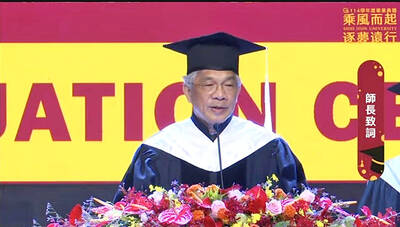
Shih Hsin University President Chen Ching-he (陳清河) yesterday issued a public apology for comments made in his commencement speech last week, stating that he has asked the school to suspend his duties and halt his wages for two months as a show of contrition. At the commencement ceremony on May 30, Chen said, “If you don’t manage your time well, or your own emotions, or your health, then I am telling every one of you — put a quick end to ‘you,’ because the world has no need for ‘you.’” The comments have sparked significant controversy online, and Chen through an open


 RSS
RSS