


President Ma Ying-jeou (馬英九) yesterday pledged to improve diplomatic ties with the nation’s allies as it was reported that El Salvador was moving to establish ties with China.
He said that the government would not recognize diplomatic ties between Taiwan’s allies and China.
“Dual recognition is not what we are pursuing. The government will focus its efforts on strengthening ties with its allies,” Ma told reporters at the Presidential Office.
Salvadoran president-elect Mauricio Funes has repeatedly promised to switch ties to Beijing upon taking office in June.
Ma said more and more countries in Latin America were electing leftist national leaders, but his administration would seek to maintain ties with existing allies, regardless of their political ideology.
“Our diplomatic truce with the mainland does not mean that we are having a diplomatic vacation and it certainly doesn’t mean a diplomatic coma. We will continue strengthening ties with our allies and promoting relations with non-allies,” he said.
In discussing the nation’s bid for an observership at the World Health Assembly (WHA) in May, the president promised to defend Taiwan’s sovereignty while seeking the observer status.
Ma said the government would apply for observer status under the name “Republic of China,” “Taiwan” or “Chinese Taipei,” and insisted that the nation would not join international organizations as part of China.
“Of course we will not return to international society as part of mainland China because it would be belittling our sovereignty ... We will not sacrifice our sovereignty and national dignity in return for participation in international organizations,” Ma said.
When asked to comment on his previous remarks that the government would conduct negotiations with China at an undisclosed location outside of Taiwan next month about the WHA bid, Ma declined to elaborate on the issue, but said the government would make public the negotiation results at a proper time.
The president defended his “diplomatic truce” with China and his flexible diplomacy policy, saying he was confident that these policies were having a positive impact on cross-strait relations.
Ma said the issue regarding Taiwan’s participation in the WHA should be handled under the “1992 consensus,” which pan-blue figures say means “one China, with each side having its own interpretation.”
China’s Taiwan Affairs Office Director Wang Yi (王毅) told CCTV earlier this month that he was “cautiously optimistic” on Taiwan’s bid to join the WHA as an observer.
The WHA, the decision-making body of the WHO, is scheduled to meet from May 18 to May 27 in Geneva, Switzerland.
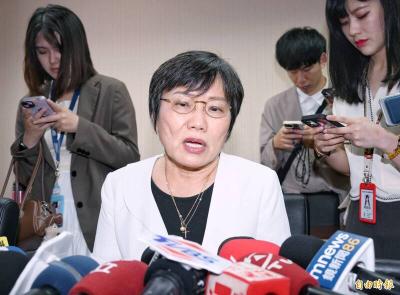
Chinese Nationalist Party (KMT) Chairman Eric Chu (朱立倫), spokeswoman Yang Chih-yu (楊智伃) and Legislator Hsieh Lung-chieh (謝龍介) would be summoned by police for questioning for leading an illegal assembly on Thursday evening last week, Minister of the Interior Liu Shyh-fang (劉世芳) said today. The three KMT officials led an assembly outside the Taipei City Prosecutors’ Office, a restricted area where public assembly is not allowed, protesting the questioning of several KMT staff and searches of KMT headquarters and offices in a recall petition forgery case. Chu, Yang and Hsieh are all suspected of contravening the Assembly and Parade Act (集會遊行法) by holding
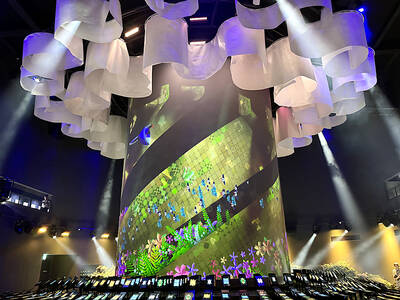
PRAISE: Japanese visitor Takashi Kubota said the Taiwanese temple architecture images showcased in the AI Art Gallery were the most impressive displays he saw Taiwan does not have an official pavilion at the World Expo in Osaka, Japan, because of its diplomatic predicament, but the government-backed Tech World pavilion is drawing interest with its unique recreations of works by Taiwanese artists. The pavilion features an artificial intelligence (AI)-based art gallery showcasing works of famous Taiwanese artists from the Japanese colonial period using innovative technologies. Among its main simulated displays are Eastern gouache paintings by Chen Chin (陳進), Lin Yu-shan (林玉山) and Kuo Hsueh-hu (郭雪湖), who were the three young Taiwanese painters selected for the East Asian Painting exhibition in 1927. Gouache is a water-based
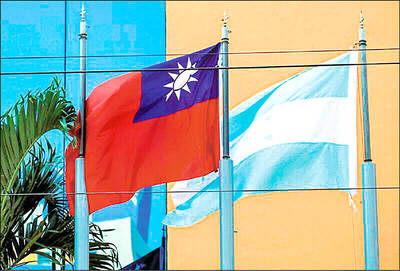
Taiwan would welcome the return of Honduras as a diplomatic ally if its next president decides to make such a move, Minister of Foreign Affairs Lin Chia-lung (林佳龍) said yesterday. “Of course, we would welcome Honduras if they want to restore diplomatic ties with Taiwan after their elections,” Lin said at a meeting of the legislature’s Foreign Affairs and National Defense Committee, when asked to comment on statements made by two of the three Honduran presidential candidates during the presidential campaign in the Central American country. Taiwan is paying close attention to the region as a whole in the wake of a

OFF-TARGET: More than 30,000 participants were expected to take part in the Games next month, but only 6,550 foreign and 19,400 Taiwanese athletes have registered Taipei city councilors yesterday blasted the organizers of next month’s World Masters Games over sudden timetable and venue changes, which they said have caused thousands of participants to back out of the international sporting event, among other organizational issues. They also cited visa delays and political interference by China as reasons many foreign athletes are requesting refunds for the event, to be held from May 17 to 30. Jointly organized by the Taipei and New Taipei City governments, the games have been rocked by numerous controversies since preparations began in 2020. Taipei City Councilor Lin Yen-feng (林延鳳) said yesterday that new measures by


 RSS
RSS