


The nation’s declining birth rate has dealt a death blow to a considerable number of small elementary schools over the past seven years.
Ministry of Education statistics showed that, in the past school year, there were 859 primary schools in the country that had only six classes per school.
A number of local governments, such as the Tainan and Chiayi county governments, have actively sought to close small primary schools in a bid to cut government expenditure.
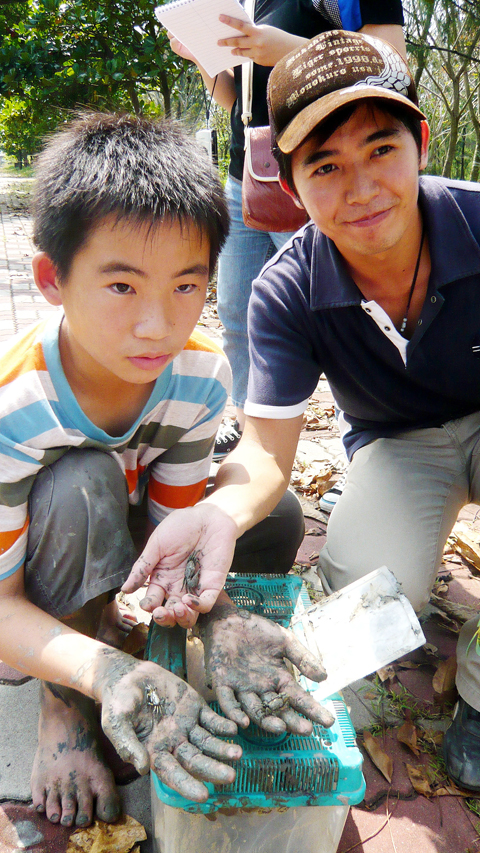
PHOTO: FLORA WANG, TAIPEI TIMES
As many as 138 schools nationwide, particularly in remote areas in central and southern Taiwan, were shut down or merged with neighboring schools by local education bureaus between 2001 and the last academic year, ministry statistics show.
For the schools that remained, fighting for survival is an immediate concern.
Tainan County’s Shuangchun Elementary School faced the same problem other tiny schools did.
“We were informed two days after Tainan County Commissioner Su Huan-chih (蘇煥智) was re-elected [in 2005] that the school would be closed,” Wang Li-hui (王麗惠), director of the school’s academic and student affairs, said earlier this month.
The school was placed on the county government’s chopping board because it did not meet the new minimum student number — 60 students — set by the government in 2005.
However, the school was able to reverse its fate by emphasizing its unique character and promoting courses that made it irreplaceable.
The key to the school’s success was helping its students gain a better understanding of the neighborhood they live in.
Located between the mouths of Pachang Creek (八掌溪) and Jishuei River (急水溪), the school enjoys a rich ecology.
Students at the school are surrounded by extensive fish ponds, large schools of fiddler crabs and seemingly endless mangroves.
However, the location of the school also made it vulnerable to flooding.
Despite this disadvantage, “we managed to transform [the school] into an experimental and model school promoting marine education by taking advantage of [the surrounding] environment,” Wang said.
“The county government now gives a lot of credit to the school [for the transformation],” she said.
The school began its makeover by first building a windmill to help draw floodwater away and diverting the wastewater into an ecological pond, she said.
The mill then served as a small wind turbine, which the school’s teachers used to help students understand power-generating technology and the importance of finding alternative resources, she said.
ECOLOGY LESSONS
Students are required to take weekly ecology lessons to learn about the plant and animal life surrounding them, she said.
“[During the sessions, students are introduced to] seashore animals and plants, nearby waters, tides and waves,” she said.
The lessons help prepare the students for the school’s guided ecological tour program — a “show and tell” opportunity for students to present the unique characteristics of their neighborhood.
Wang Chun-chieh, who teaches the subject to fifth and sixth graders, said six to seven children who passed the ecological coursewere chosen as the school’s “little ecological tour guides.”
They are tasked with introducing the local ecosystem to visitors to the school, Wang Chun-chieh said while taking reporters on a tour to the nearby Shuangchun Coastal Recreation Area on Oct. 7.
As Wang Chun-chieh was explaining the program to reporters, three 12-year-old boys jumped into the wetlands to search for fiddler crabs as part of their demonstration of the ecosystem in the Shuangchun area.
Although they were covered in mud during the hunt, the children did not stop laughing as they filled the aquarium they brought to keep the crabs.
EXCITEMENT
“The kids are particularly excited when they are allowed to catch crabs,” Wang Chun-chieh said.
Hung Yo-shuan (洪宥瑄), one of the school’s student tour guides, said she was also driven by her thirst to find out more on the Internet about the ecosystem of the community she lives in after taking the course.
“I love searching for information on the Internet. This way, I can provide a thorough explanation [of the neighborhood’s ecology] to school visitors,” she said.
“I am very happy [to serve as a tour guide],” she said.

ANOTHER EMERGES: The CWA yesterday said this year’s fourth storm of the typhoon season had formed in the South China Sea, but was not expected to affect Taiwan Tropical Storm Gaemi has intensified slightly as it heads toward Taiwan, where it is expected to affect the country in the coming days, the Central Weather Administration (CWA) said yesterday. As of 8am yesterday, the 120km-radius storm was 800km southeast of Oluanpi (鵝鑾鼻), Taiwan’s southernmost tip, moving at 9kph northwest, the agency said. A sea warning for Gaemi could be issued tonight at the earliest, it said, adding that the storm is projected to be closest to Taiwan on Wednesday or Thursday. Gaemi’s potential effect on Taiwan remains unclear, as that would depend on its direction, radius and intensity, forecasters said. Former Weather Forecast

As COVID-19 cases in Japan have been increasing for 10 consecutive weeks, people should get vaccinated before visiting the nation, the Centers for Disease Control (CDC) said. The centers reported 773 hospitalizations and 124 deaths related to COVID-19 in Taiwan last week. CDC Epidemic Intelligence Center Director Guo Hung-wei (郭宏偉) on Tuesday said the number of weekly COVID-19 cases reported in Japan has been increasing since mid-May and surpassed 55,000 cases from July 8 to July 14. The average number of COVID-19 patients at Japan’s healthcare facilities that week was also 1.39 times that of the week before and KP.3 is the dominant

The Chinese Communist Party’s (CCP) working group for Taiwan-related policies is likely to be upgraded to a committee-level body, a report commissioned by the Mainland Affairs Council (MAC) said. As Chinese President Xi Jinping (習近平) is increasingly likely to upgrade the CCP’s Central Leading Group for Taiwan Affairs, Taiwanese authorities should prepare by researching Xi and the CCP, the report said. At the third plenary session of the 20th Central Committee of the CCP, which ended on Thursday last week, the party set a target of 2029 for the completion of some tasks, meaning that Xi is likely preparing to

US-CHINA TRADE DISPUTE: Despite Beijing’s offer of preferential treatment, the lure of China has dimmed as Taiwanese and international investors move out Japan and the US have become the favored destinations for Taiwanese graduates as China’s attraction has waned over the years, the Ministry of Labor said. According to the ministry’s latest income and employment advisory published this month, 3,215 Taiwanese university graduates from the class of 2020 went to Japan, surpassing for the first time the 2,881 graduates who went to China. A total of 2,300 graduates from the class of 2021 went to the US, compared with the 2,262 who went to China, the document showed. The trend continued for the class of 2023, of whom 1,460 went to Japan, 1,334 went to


 RSS
RSS