


People who wish to avoid cancer should live balanced and healthy lifestyles instead of obsessing over fad diets and supplements, a cancer expert said yesterday at a press conference.
To examine the level of understanding in Taiwan when it comes to prevalence, prevention and treatment of cancer, CommonWealth Magazine in March surveyed 1,011 adults using a 13-item questionnaire, said Hsieh Juie-kun (謝瑞坤), head of the oncology department at Taipei’s Mackay Hospital.
“Although 85.8 percent of respondents received passing scores with eight out of 13 points or more, some of the survey questions received an alarming number of incorrect responses, indicating that the public is still confused by a number of ‘urban legends’ concerning cancer,” Hsieh said.
For example, while about 60 percent of people erroneously believe that most cancer patients have a family history of the illness, about 40 percent wrongly believe consumption of certain supplement pills can help ward off cancer, he said.
“The truth is, most cancer patients do not have a family history of the kind of cancer they develop — in fact, people with a family history of certain cancers — such as lung, cervical, or certain types of breast cancer — may not be at higher risk since their etiology have little to do with heredity,” Hsieh said.
Instead, the chances of contracting cancer are strongly related to one’s diet, lifestyle and exercise regime, director of the Koo Foundation Sun Yat-sen Cancer Center’s nutrition department, Wang Li-min (王麗民) said.
“Today, we know that only 20 percent of cancers are hereditary, meaning that with a balanced diet, a relatively relaxed lifestyle and a healthy exercising schedule, most people can stay cancer-free,” she said.
“Because stress impairs one’s immunity, exercising kills two birds with one stone, since it not only helps one stay fit, it also relieves stress,” she said.
A balanced diet means one that contains more fiber [from fruits and vegetables], less fat and less meat, Wang said.
“An average adult needs about four portions of meat a day [at 37.5g per portion], however many people consume four portions in a single meal,” Wang said.
For example, a typical chicken drumstick or pork fillet lunchbox contains three portions of meat, she said.
Wang also warned people about fad diets or taking self-proclaimed cancer-preventing pills.
“Most fad diets emphasize a particular food group, whereas all six food groups should be consumed, as advises the Department of Health,” Wang said.
“Because humans need some 40 different types of nutrients, it is easy for people to fall for ‘short cuts,’ however, in terms of a balanced diet, no supplements are sufficient enough to replace real, fresh foods,” she said.

‘NON-RED’: Taiwan and Ireland should work together to foster a values-driven, democratic economic system, leveraging their complementary industries, Lai said President William Lai (賴清德) yesterday expressed hopes for closer ties between Taiwan and Ireland, and that both countries could collaborate to create a values-driven, democracy-centered economic system. He made the remarks while meeting with an Irish cross-party parliamentary delegation visiting Taiwan. The delegation, led by John McGuinness, deputy speaker of the Irish house of representatives, known as the Dail, includes Irish lawmakers Malcolm Byrne, Barry Ward, Ken O’Flynn and Teresa Costello. McGuinness, who chairs the Ireland-Taiwan Parliamentary Friendship Association, is a friend of Taiwan, and under his leadership, the association’s influence has grown over the past few years, Lai said. Ireland is

A saleswoman, surnamed Chen (陳), earlier this month was handed an 18-month prison term for embezzling more than 2,000 pairs of shoes while working at a department store in Tainan. The Tainan District Court convicted Chen of embezzlement in a ruling on July 7, sentencing her to prison for illegally profiting NT$7.32 million (US$248,929) at the expense of her employer. Chen was also given the opportunity to reach a financial settlement, but she declined. Chen was responsible for the sales counter of Nike shoes at Tainan’s Shinkong Mitsukoshi Zhongshan branch, where she had been employed since October 2019. She had previously worked
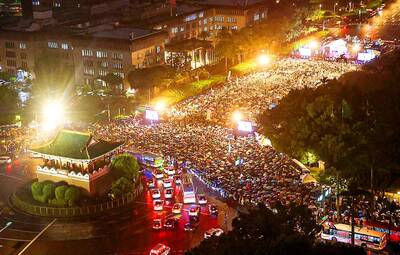
FINAL COUNTDOWN: About 50,000 attended a pro-recall rally yesterday, while the KMT and the TPP plan to rally against the recall votes today Democracy activists, together with arts and education representatives, yesterday organized a motorcade, while thousands gathered on Ketagalan Boulevard in Taipei in the evening in support of tomorrow’s recall votes. Recall votes for 24 Chinese Nationalist Party (KMT) lawmakers and suspended Hsinchu City mayor Ann Kao (高虹安) are to be held tomorrow, while recall votes for seven other KMT lawmakers are scheduled for Aug. 23. The afternoon motorcade was led by the Spring Breeze Culture and Arts Foundation, the Tyzen Hsiao Foundation and the Friends of Lee Teng-hui Association, and was joined by delegates from the Taiwan Statebuilding Party and the Taiwan Solidarity
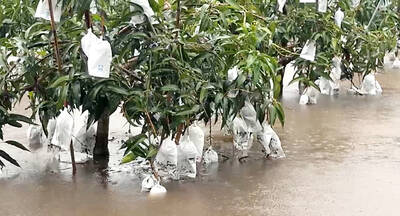
TRANSPORT DISRUPTION: More than 100 ferry services were suspended due to rough seas and strong winds, and eight domestic flights were canceled, the ministry said Tropical Storm Wipha intensified slightly yesterday as it passed closest to Taiwan, dumping more than 200mm of rain in Hualien and Taitung counties, the Central Weather Administration (CWA) said. As of 11am, Wipha was about 210km southwest of Cape Oluanpi (鵝鑾鼻) and was moving west-northwest at 27km per hour (kph). The storm carried maximum sustained winds of 101kph and gusts reaching 126kph, with a 150km radius of strong winds, CWA data showed. Wipha’s outer rainbands began sweeping across Taiwan early yesterday, delivering steady rainfall in the east and scattered showers in other regions, forecasters said. More heavy rain was expected, especially in the eastern


 RSS
RSS