


The Democratic Progressive Party (DPP) is scheduled to elect a new party chief on May 25, following the resignation of Frank Hsieh (謝長廷), who is expected to step down as chairman today.
The DPP's Central Standing Committee will meet today to elect an acting chair to fill the vacancy until May 25.
Hsieh spokesman Chao Tien-lin (
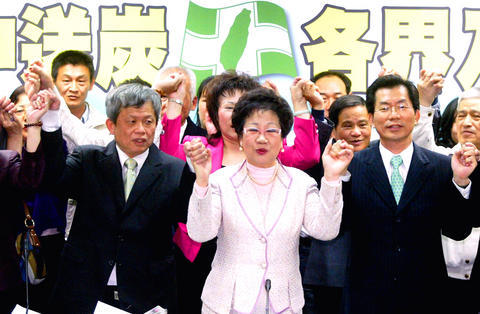
PHOTO: LIN CHENG-KUNG, TAIPEI TIMES
Shortly after his loss in the presidential election on Saturday night, Hsieh told reporters that he would "keep every promise" he had made in the run-up to the election.
Hsieh had vowed to quit politics if he lost the presidential election. It is also customary at the DPP for the party chairman to bear responsibility for an election loss by resigning.
Hsieh succeeded President Chen Shui-bian (陳水扁) as party chairman following the DPP's losses in the legislative elections in January.
Vice President Annette Lu (
"You don't need to guess whether I will contest the race, because I won't," she said. "I won't be a member of the Central Standing Committee once I leave office."
Lu made the remarks while officiating at the inauguration of 157 new DPP members at party headquarters yesterday afternoon.
Yesterday's Chinese-language China Times insinuated that the ceremony, which had been initiated by Lu, was her attempt to drum up support for a chairmanship bid.
But Lu said that the event had originally been scheduled to take place before Feb. 28, but was postponed because of the election.
Describing the DPP as "the eldest grandson of Taiwan's democracy," Lu said the 22-year-old party was sick and needed to see a doctor, take medicine and regain its health.
"We must take a good look at ourselves and get back on our feet again," she said. "We don't have time to feel sorry or lose heart."
Lu proposed the establishment of a taskforce to reform party affairs and amend certain internal rules in response to the new situation.
She also asked the public to give the DPP time to do some soul searching and select a new leader, and urged the media to refrain from selecting a chairman for the party.
"I hope the new chairman is creative, makes a breakthrough in party affairs and responds to the new challenges," she said.
Meanwhile, Premier Chang Chun-hsiung (
Chang said he told Chen that whether the party would be able to recover depended on whether senior party members were willing to hand over power to the party's younger generation.
The premier made the comment during a question-and-answer session with KMT Legislator Lee Ching-hua (
Chang said Ma's margin of victory had come as a surprise, but added that the DPP, including "everyone who has participated in government over the past eight years," should humbly accept the result.
He said he also told the president that he would not run for the party chairmanship.
Yunlin County Commissioner Su Chih-fen (蘇治芬) suggested that the party's leadership be handed over to the "student movement generation," referring to the Young Turks who participated in Taiwan's student movement in the 1980s and 1990s.
"It's time for a change of generations," Su said, as the Formosa generation "were knocked off their pedestals by the Taiwanese people" in Saturday's election.
The Formosa generation refers to the DPP politicians who were jailed for their part in the Kaohsiung Incident of 1979, a pro-democracy demonstration against the former KMT regime, and those who defended them in court.
"It would be appropriate for former DPP legislator Luo Wen-chia (
"As the [Chinese] proverb says, he who is successful in a revolt becomes a king, and he who fails in such an attempt becomes a bandit. The Formosa generation are old; they should share their experience with the next generation," Su said.
The election result did not mean that Taiwanese have lost faith in the DPP's Taiwan-centric path, Su said.
"The problem lies in the party's implementation of the policy," he said. "For example, the DPP enshrined the idea of sustainable development. But when it was in power, it advocated the Suhua Freeway project, which contradicted that. That is what led to the party's failure."
"There were lots of reasons, not a single incident, that contributed to the defeat. [The DPP's loss] is not an overnight phenomenon," Su said.
Also yesterday, Kuo Cheng-deng (
He described the move as "long overdue."
"But it's better late than never," he said.
Additional reporting by Flora Wang

The manufacture of the remaining 28 M1A2T Abrams tanks Taiwan purchased from the US has recently been completed, and they are expected to be delivered within the next one to two months, a source said yesterday. The Ministry of National Defense is arranging cargo ships to transport the tanks to Taiwan as soon as possible, said the source, who is familiar with the matter. The estimated arrival time ranges from late this month to early next month, the source said. The 28 Abrams tanks make up the third and final batch of a total of 108 tanks, valued at about NT$40.5 billion
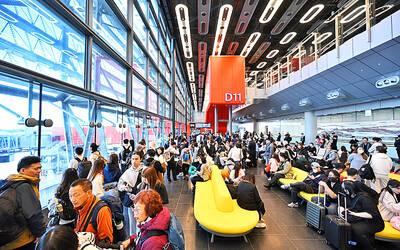
Travel agencies in Taiwan are working to secure alternative flights for travelers bound for New Zealand for the Lunar New Year holiday, as Air New Zealand workers are set to strike next week. The airline said that it has confirmed that the planned industrial action by its international wide-body cabin crew would go ahead on Thursday and Friday next week. While the Auckland-based carrier pledged to take reasonable measures to mitigate the impact of the workers’ strike, an Air New Zealand flight arriving at Taipei from Auckland on Thursday and another flight departing from Taipei for Auckland on Saturday would have to
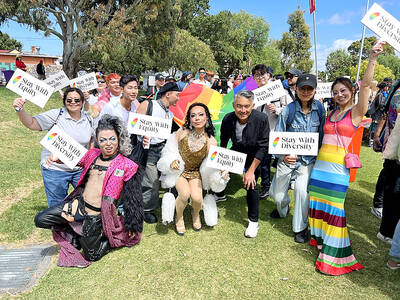
A group from the Taiwanese Designers in Australia association yesterday represented Taiwan at the Midsumma Pride March in Melbourne. The march, held in the St. Kilda suburb, is the city’s largest LGBTQIA+ parade and the flagship event of the annual Midsumma Festival. It attracted more than 45,000 spectators who supported the 400 groups and 10,000 marchers that participated this year, the association said. Taiwanese Designers said they organized a team to march for Taiwan this year, joining politicians, government agencies, professionals and community organizations in showing support for LGBTQIA+ people and diverse communities. As the first country in Asia to legalize same-sex
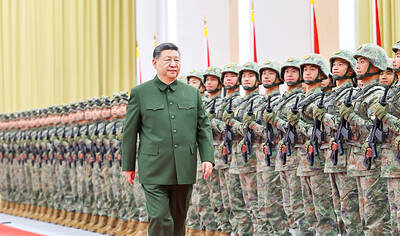
MOTIVES QUESTIONED The PLA considers Xi’s policies toward Taiwan to be driven by personal considerations rather than military assessment, the Epoch Times reports Chinese President Xi Jinping’s (習近平) latest purge of the Chinese People’s Liberation Army (PLA) leadership might have been prompted by the military’s opposition to plans of invading Taiwan, the Epoch Times said. The Chinese military opposes waging war against Taiwan by a large consensus, putting it at odds with Xi’s vision, the Falun Gong-affiliated daily said in a report on Thursday, citing anonymous sources with insight into the PLA’s inner workings. The opposition is not the opinion of a few generals, but a widely shared view among the PLA cadre, the Epoch Times cited them as saying. “Chinese forces know full well that


 RSS
RSS