


Democratic Progressive Party (DPP) Legislator Tsai Huang-liang (蔡煌瑯) yesterday accused prosecutors investigating the Taiwan Dental Association bribery case of being biased.
"It is my understanding that many Chinese Nationalist Party [KMT] lawmakers also accepted political `donations' [from the association], but none of them were indicted," Tsai said at the DPP's legislative caucus office.
But KMT Legislator Chang Tsa-mei (張蔡美) was indicted together with Tsai and six other former and incumbent lawmakers for accepting bribes from the association in return for their endorsement of the Oral Healthcare Act (口腔健康法) in 2003.
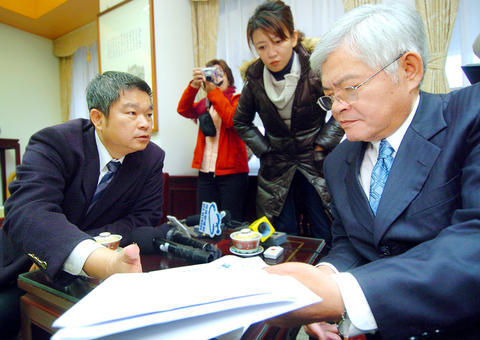
PHOTO: FANG PIN-CHAO, TAIPEI TIMES
Tsai was accused of accepting NT$3.5 million (US$110,000) through his brother Tsai Chao-cheng (
Tsai Huang-liang alleged yesterday that KMT Legislator Lin Yi-shih (
"I do not see any of them in trouble," Tsai Huang-liang said. "It is difficult to convince me that prosecutors did not act with favoritism during their investigation."
Tsai visited the Ministry of Justice yesterday and presented his allegations to Deputy Minister of Justice Lee Chin-yung (
Lee said the ministry would carefully examine the "evidence" Tsai had presented before it decided whether or not to launch another investigation.
Prosecutor Wu Wen-chung (
Wu denied any bias or political considerations were involved and said prosecutors had adopted an agreed set of standards when investigating the case.
As a result of those standards, he said, eight former and incumbent legislators had been indicted on corruption charges, while 33 former and incumbent legislators were not indicted.
For example, Wu said, DPP Legislator Chien Chao-tung (簡肇棟) had received NT$500,000 from the dental association, but had donated the money to two civil associations.
Wu said prosecutors confirmed the money had been received by the two associations, and had therefore not indicted Chien.
Lin Yi-shih dismissed Tsai's allegations. He said that as he had neither initiated or endorsed the act, the association's NT$1 million donation to him was not a bribe.
Legislator Shyu Jong-shyoung (
"This [indictment] had nothing to do with politics. KMT legislators were also indicted," he said.
Additional reporting by Flora Wang
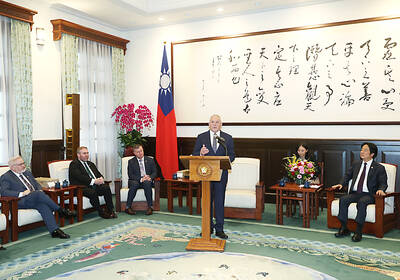
‘NON-RED’: Taiwan and Ireland should work together to foster a values-driven, democratic economic system, leveraging their complementary industries, Lai said President William Lai (賴清德) yesterday expressed hopes for closer ties between Taiwan and Ireland, and that both countries could collaborate to create a values-driven, democracy-centered economic system. He made the remarks while meeting with an Irish cross-party parliamentary delegation visiting Taiwan. The delegation, led by John McGuinness, deputy speaker of the Irish house of representatives, known as the Dail, includes Irish lawmakers Malcolm Byrne, Barry Ward, Ken O’Flynn and Teresa Costello. McGuinness, who chairs the Ireland-Taiwan Parliamentary Friendship Association, is a friend of Taiwan, and under his leadership, the association’s influence has grown over the past few years, Lai said. Ireland is
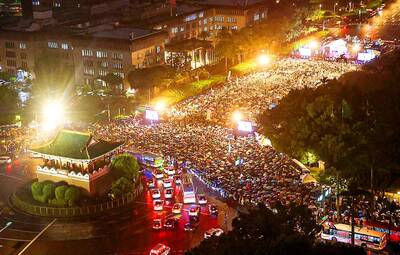
FINAL COUNTDOWN: About 50,000 attended a pro-recall rally yesterday, while the KMT and the TPP plan to rally against the recall votes today Democracy activists, together with arts and education representatives, yesterday organized a motorcade, while thousands gathered on Ketagalan Boulevard in Taipei in the evening in support of tomorrow’s recall votes. Recall votes for 24 Chinese Nationalist Party (KMT) lawmakers and suspended Hsinchu City mayor Ann Kao (高虹安) are to be held tomorrow, while recall votes for seven other KMT lawmakers are scheduled for Aug. 23. The afternoon motorcade was led by the Spring Breeze Culture and Arts Foundation, the Tyzen Hsiao Foundation and the Friends of Lee Teng-hui Association, and was joined by delegates from the Taiwan Statebuilding Party and the Taiwan Solidarity

A saleswoman, surnamed Chen (陳), earlier this month was handed an 18-month prison term for embezzling more than 2,000 pairs of shoes while working at a department store in Tainan. The Tainan District Court convicted Chen of embezzlement in a ruling on July 7, sentencing her to prison for illegally profiting NT$7.32 million (US$248,929) at the expense of her employer. Chen was also given the opportunity to reach a financial settlement, but she declined. Chen was responsible for the sales counter of Nike shoes at Tainan’s Shinkong Mitsukoshi Zhongshan branch, where she had been employed since October 2019. She had previously worked
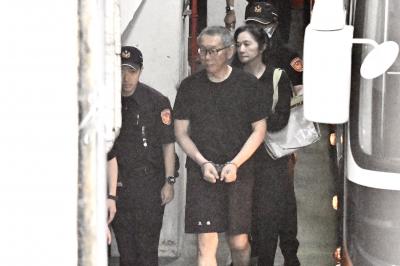
The Taipei District Court today ruled to extend the incommunicado detention of former Taipei mayor Ko Wen-je (柯文哲) and Taipei City Councilor Angela Ying (應曉薇) for two more months as part of an ongoing corruption trial. Codefendants in the case — real-estate tycoon Sheen Ching-jing (沈慶京) and Ko's former mayoral office head Lee Wen-tsung (李文宗) — were granted bail of NT$100 million (US$3.4 million) and NT$20 million respectively. Sheen and Lee would also be barred from leaving the country for eight months and prohibited from contact with, harassing, threatening or inquiring after the case with codefendants or witnesses. The two would also be


 RSS
RSS