


Democratic Progressive Party (DPP) legislators traded barbs with their Chinese Nationalist Party (KMT) counterparts yesterday over the legislature's resolution to freeze funding for the 228 Memorial Foundation.
DPP Legislator Tien Chiu-chin (田秋堇) yesterday said she felt "sad, sorry and indignant" that the Ministry of Education's NT$300 million (US$9.2 million) budget request for the 228 Memorial Foundation was frozen by the legislature.
"They [the KMT] said they would take care of the 228 Incident victims and their family members. It seems to me that they were lying," Tien told a news conference.

PHOTO: WANG YI-SUNG, TAIPEI TIMES
The 228 Incident is the name given to the KMT's crackdown on demonstrators and local elites after a confrontation between officials and Taipei residents on Feb. 27, 1947. The incident culminated in the slaughter of tens of thousands of Taiwanese.
Describing the 228 Incident as an example of "state violence," Tien said the foundation's operations were necessary "to prevent similar tragedies from happening again and to educate the people about the historical truth."
Chou Chen-tsai (周振才), a family member of a 228 victim, said that during elections the KMT always promised victims and their families that they would do their best to care for them in the legislature.
"Now, I feel that I have been fooled. The truth is, they never changed," Chou said.
KMT Legislator Hung Hsiu-chu (洪秀柱) said at a separate setting that the KMT had not slashed the budget without a reason.
"The DPP did not clearly explain when, where, what, who and how the money would be used in the proposal. Of course we would oppose it," she said.
Hung said the money should not have been allocated by the Ministry of Education and that the few staff of the foundation receive monthly salaries of NT$50,000 "without doing anything."
Quoting Ministry of Education officials who said the foundation was "facilitating ethnic harmony in Taiwanese society," Hung said that "enhancing ethnic harmony" was already a ministry policy and that this work had been done without the help of the foundation.
Additional reporting by Flora Wang

The Executive Yuan yesterday approved a southwestern extension of the Sanying MRT Line from New Taipei to Bade District (八德) in Taoyuan, with a goal of starting construction by late 2026. The 4.03-kilometer extension, featuring three new stations, will run from the current terminus at Yingtao Fude Station (LB12) in New Taipei City to Dannan Station (LB14), where it will connect with Taoyuan’s Green Line, New Taipei City Metro Corp said in a statement. This extension will follow the completion of core Sanying Line, a 14.29-kilometer medium-capacity system linking Tucheng (土城), Sansia (三峽)

CARGO LOSS: About 50 containers at the stern of the ‘Ever Lunar’ cargo ship went overboard, prompting the temporary closure of the port and disrupting operations Evergreen Marine Corp, Taiwan’s largest container shipper, yesterday said that all crew members aboard the Ever Lunar (長月) were safe after dozens of containers fell overboard off the coast of Peru the previous day. The incident occurred at 9:40am on Friday as the Ever Lunar was anchored and waiting to enter the Port of Callao when it suddenly experienced severe rolling, Evergreen said in a statement. The rolling, which caused the containers to fall, might have been caused by factors including a tsunami triggered by an earthquake in Russia, poor winter sea conditions in South America or a sudden influx of waves,

The Ministry of Culture yesterday officially launched the “We TAIWAN” cultural program on Osaka’s Nakanoshima sandbank, with the program’s mascot receiving overwhelming popularity. The cultural program, which runs from Aug. 2 to 20, was designed to partner with and capitalize on the 2025 World Expo that is being held in Osaka, Japan, from April 13 to Oct. 13, the ministry said. On the first day of the cultural program, its mascot, a green creature named “a-We,” proved to be extremely popular, as its merch was immediately in high demand. Long lines formed yesterday for the opening
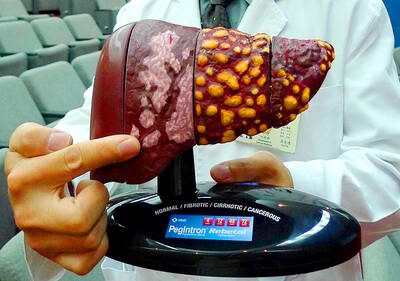
STAY VIGILANT: People should reduce the risk of chronic liver inflammation by avoiding excessive alcohol consumption, smoking and eating pickled foods, the physician said A doctor last week urged people to look for five key warning signs of acute liver failure after popular producer-turned-entertainer Shen Yu-lin (沈玉琳) was reportedly admitted to an intensive care unit for fulminant hepatitis. Fulminant hepatitis is the rapid and massive death of liver cells, impairing the organ’s detoxification, metabolic, protein synthesis and bile production functions, which if left untreated has a mortality rate as high as 80 percent, according to the Web site of Advancing Clinical Treatment of Liver Disease, an international organization focused on liver disease prevention and treatment. People with hepatitis B or C are at higher risk of


 RSS
RSS