


Imagine a world where cars fly, sushi plates float in the air, fires are put out minutes after they start and bones never ache from the impact of walking and running.
These were all possibilities created by high school students from around the country in the sixth annual Innovative Design Competition Using High Temperature Superconductors for Magnetic Levitation.
The competition, hosted by the National Science Council (NSC) at Kaohsiung's National Science and Technology Museum, saw 36 teams from Taiwan showcasing their projects in the final on Sunday. A team from Japan's Waseda University Affiliated Honjo High School was also invited.
The teams had eight months to prepare their exhibits.
"Our vision was to encourage students to prepare for jobs that don't yet exist, to use technologies not yet invented and solve problems we don't yet know about," said In-Gann Chen (陳引幹), a material science and engineering professor at Cheng Kung University and the moderator of the competition.
He was quoting US high school administrator Karl Fisch, whose Internet video Did You Know has received worldwide attention.
"The competition was designed to foster an informal education setting where students could learn by doing," Chen said.
High temperature superconductor magnetic levitation (HTS maglev) was the cornerstone of the competition.
Maglev is a technology in which objects are suspended in the air using only magnetic fields. HTS maglev uses superconductors in subzero temperatures; "HTS" refers to the relatively high temperature required when using li-quid nitrogen instead of helium.
Traditionally helium was the refrigerant used in HTS maglev, but in 1988 Wu Maw-kuen (
"The competition allows students to think outside of the box," National Science Council Deputy Minister Yang Hung-duen (
He praised Heping High School's HTS maglev car, which required only front wheels because the rest of the car floated. That entry won the Intel Think Tool prize.
Maglev cars are fuel-conservative since there is little friction, said Honjo team captain Satoru Wakabayashi, whose team also entered a maglev car in the competition.
Zhonglun High School's HTS maglev artificial joint was inspired by team captain Liang Ching-hung's (
"With HTS maglev technology, we can have an air joint instead of padding between two bones to prevent wear and tear during movement," Lee said.
Although the subzero temperature in HTS maglev limits the pro-ject's human applications, it opens the possibility for medical breakthroughs when the technology matures, Lee said.
Competition winner Ger-jyh High School's automatic fire hydrant system, which also won third place for Most Creative Entry, was a system that utilized a hose with a HTS maglev plug fixture, team captain Tsai Cheng-ta (蔡承達) said.
When a fire starts, the liquid nitrogen that stabilizes the plug evaporates and mixes with oxygen and puts out part of the fire, Tsai said. When enough nitrogen has evaporated, the plug loosens and water comes out of the hose to put out the fire completely, he said.
"The innovation is patent worthy," Wu said.
"Taiwanese schools tend to emphasize schoolwork over research and experimentation. We hope the competition will inspire teachers, parents and students to change their attitudes and realize that practice is as important as theory," Chen said.
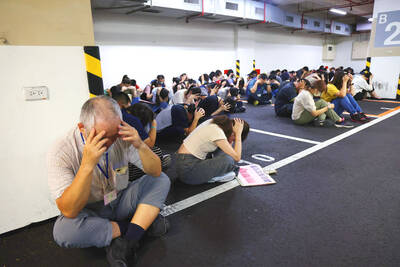
Taipei on Thursday held urban resilience air raid drills, with residents in one of the exercises’ three “key verification zones” reporting little to no difference compared with previous years, despite government pledges of stricter enforcement. Formerly known as the Wanan exercise, the air raid drills, which concluded yesterday, are now part of the “Urban Resilience Exercise,” which also incorporates the Minan disaster prevention and rescue exercise. In Taipei, the designated key verification zones — where the government said more stringent measures would be enforced — were Songshan (松山), Zhongshan (中山) and Zhongzheng (中正) districts. Air raid sirens sounded at 1:30pm, signaling the
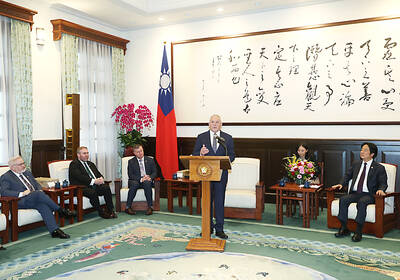
‘NON-RED’: Taiwan and Ireland should work together to foster a values-driven, democratic economic system, leveraging their complementary industries, Lai said President William Lai (賴清德) yesterday expressed hopes for closer ties between Taiwan and Ireland, and that both countries could collaborate to create a values-driven, democracy-centered economic system. He made the remarks while meeting with an Irish cross-party parliamentary delegation visiting Taiwan. The delegation, led by John McGuinness, deputy speaker of the Irish house of representatives, known as the Dail, includes Irish lawmakers Malcolm Byrne, Barry Ward, Ken O’Flynn and Teresa Costello. McGuinness, who chairs the Ireland-Taiwan Parliamentary Friendship Association, is a friend of Taiwan, and under his leadership, the association’s influence has grown over the past few years, Lai said. Ireland is

The number of people who reported a same-sex spouse on their income tax increased 1.5-fold from 2020 to 2023, while the overall proportion of taxpayers reporting a spouse decreased by 4.4 percent from 2014 to 2023, Ministry of Finance data showed yesterday. The number of people reporting a spouse on their income tax trended upward from 2014 to 2019, the Department of Statistics said. However, the number decreased in 2020 and 2021, likely due to a drop in marriages during the COVID-19 pandemic and the income of some households falling below the taxable threshold, it said. The number of spousal tax filings rebounded
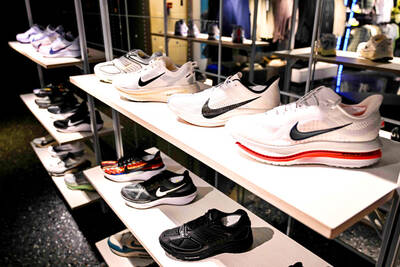
A saleswoman, surnamed Chen (陳), earlier this month was handed an 18-month prison term for embezzling more than 2,000 pairs of shoes while working at a department store in Tainan. The Tainan District Court convicted Chen of embezzlement in a ruling on July 7, sentencing her to prison for illegally profiting NT$7.32 million (US$248,929) at the expense of her employer. Chen was also given the opportunity to reach a financial settlement, but she declined. Chen was responsible for the sales counter of Nike shoes at Tainan’s Shinkong Mitsukoshi Zhongshan branch, where she had been employed since October 2019. She had previously worked


 RSS
RSS