


Less than a week after People First Party (PFP) Chairman James Soong (
The PFP announced that Soong will lead a PFP/Non-Partisan Solidarity Union think tank, thus leaving him as a political force to be reckoned with.
"Soong is a brave and ambitious man of a particular generation," said Chen Mao-hsiung (
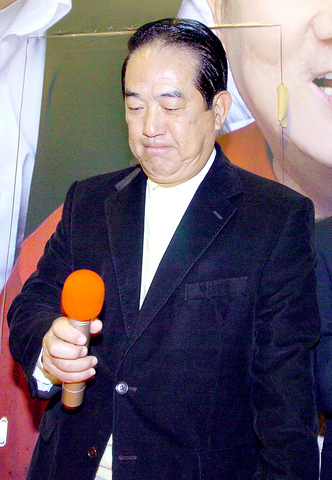
PHOTO: LIAO CHEN-HUEI, TAIPEI TIMES
When former president Chiang Ching-kuo (
The group sought to limit Lee's power, but Soong helped clear the way for Lee's succession to power.
"Soong made the choice because he knew that he had many rivals on the mainlanders' side. Establishing himself as one of the few mainlanders loyal to Lee would make him second only to Lee should Lee succeed," Chen said.
After serving as Lee's secretary-general of the Chinese Nationalist Party (KMT) for four years, Soong was appointed by Lee as governor of Taiwan Province, a level of government holding jurisdiction over most of the country except for the special municipalities of Taipei and Kaohsiung, in 1993. He was then elected governor the next year with 56 percent of the vote, or 4.7 million votes.
During his five-year governorship, Soong toured the country extensively and built a reputation as a potential presidential candidate.
"He was a hard-working governor who cared about people, always showing concern for the sufferings of individuals," said Lee Hung-yuan (李鴻源), a deputy commissioner of the Taipei County Government.
"Soong not only kept a close watch on how his staff were doing but also helped us solve problems should we encounter any," he added, having been in charge of the water resource department of the last two years of Soong's governorship.
Director of the department of information of the Taipei County Government Yang Ko-hua (
"Soong had a mobile office -- a vehicle that carried him around. Upon finishing an inspection, he called his government staffers telling them how to deal with the problems he had just learned about as soon as he got back to his vehicle," said Yang, who was then a political reporter.
The image of "a capable person," as Sooong often labeled himself, however, was not enough to get him elected president -- he failed in the 2000 presidential election as an independent candidate and in 2004 when he ran as vice presidential candidate to the KMT's Lien Chan (連戰).
Soong's recent defeat in the Taipei mayoral election, when he received a mere 4.1 percent of the vote, caused him to announce the end of his political career.
Commenting on Soong's fall, Chen Yi-shen (
"When Soong has been competing with KMT [former chairman] Lien Chan in showing off people who has better relationship with China, how could Soong, unacceptable to pan-green supporters and abandoned by pan-blue supporters, get elected?" he said.
Chen Yi-shen said KMT Chairman Ma Ying-jeou (馬英九) had successfully turned the KMT into pro-unificationist's only choice, a phenomenon that began in the post-Lee [Teng-hui] era of the party.
"Even [Legislative Speaker] Wang Jin-pyng (王金平) needed to declare that he opposed Taiwan's independence when he ran in the election for KMT chairman [last year], proving that it would only get harder for the PFP to attract pan-blue supporters," he said.
But Ger Yeong-kuang (
"For one thing, there was a structural problem in the case of single-seat elections. For another, there was a problem of campaign strategy," he said.
Ger said the KMT and PFP should learn to concentrate on campaign issues concerning public policies so that the pro-unification versus pro-independence debate won't always be the only issue.

FUKUOKA SITUATION: Japanese media reported that the pathogen is expected to be identified by the summer, while the CDC downplayed the idea that it was hMPV A “mysterious cold-like illness” reported in Japan’s Fukuoka Prefecture does not seem to be a new disease, but Japanese authorities have been asked about the situation, the Centers for Disease Control (CDC) said yesterday. The Fukuoka Prefectural Medical Association on Wednesday told a news conference that a “mystery cold” that has become a hot topic on social media is “highly likely to be caused by some kind of viral infection,” Japan’s KBC News reported. “Many people are experiencing symptoms starting with a sore throat, followed by a runny nose, phlegm and a severe cough,” KBC News reported, citing association officials. Health authorities are

Nvidia Corp CEO Jensen Huang (黃仁勳) arrived in Taiwan yesterday ahead of upcoming AI and technology events, saying he plans to meet with clients and Taiwan Semiconductor Manufacturing Co Chairman C.C. Wei (魏哲家) during his visit. After landing at Taipei Songshan Airport, Huang posed for photos with fans and handed out Yakult drinks to reporters and supporters waiting at the scene, saying he has “a lot to do” during the trip. Asked about reports that Nvidia’s planned headquarters site in Taipei’s Beitou Shilin Technology Park could break ground on May 27, Huang said that if the company holds an event, he would

The Ministry of Finance this afternoon announced the winning numbers for the March-April uniform invoice lottery. The winning number for the NT$10 million (US$318,060) special prize is 19531471, and the winning number for the NT$2 million grand prize is 85941329. Three numbers were drawn for the NT$200,000 first prize: 07225810, 20231230 and 83518781. Those with receipts matching the last seven digits of any of the first-prize numbers will win the NT$40,000 second prize, while those matching the last six digits will win the NT$10,000 third prize. Those whose receipts match the last five digits of the first-prize numbers can claim the NT$4,000 fourth prize,
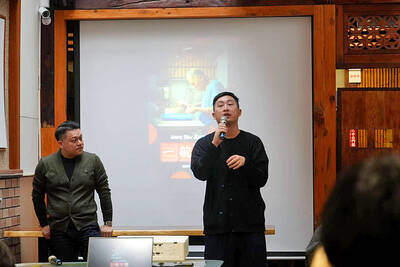
Taiwan Travelogue (臺灣漫遊錄), which earlier this week became the first Taiwanese novel to win the International Booker Prize, is to be adapted into a television series through a Taiwan-Japan coproduction, producer Chang Chen-yu (張辰漁) said yesterday. Chang, a producer at World Softest Production Film Co, wrote on Facebook that the company had been searching for projects with international appeal that retain a strong Taiwanese identity after colleagues and Japanese partners strongly recommended the novel. After reading the book, Chang said he immediately decided to pursue the screen rights. “A great story has the power to transcend time and borders, and connect countless people,”


 RSS
RSS