


The US' preoccupation with the war on Iraq, coupled with the "hyper economic interdependence" between China and the US, has left the US government with less latitude to alter China's behavior, a former top-ranking US official in charge of US-China-Taiwan relations said yesterday.
Randall Schriver, former US deputy assistant secretary of state for East Asian and Pacific affairs said that China's ability to finance US debts in a significant way had limited the US' options in influencing Chinese behavior and had also impacted on decision-making in security matters.
Schriver's comments were part of a luncheon speech to Taiwanese officials and media in a forum for Taiwan-US-Japan Strategic Talks hosted by the Taiwan Thinktank in Taipei. Among those attending were Mainland Affairs Council Chairman Joseph Wu (
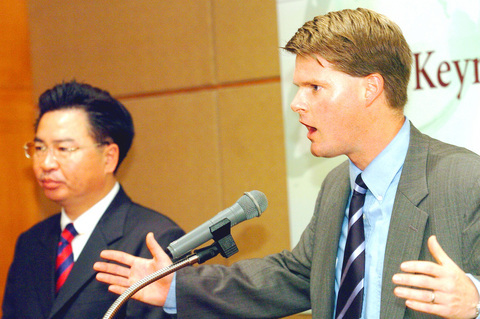
PHOTO: CHIEN JUNG-FONG, TAIPEI TIMES
Citing US Deputy Secretary of State Robert Zoellick's description of Sino-US economic relations as "an economic version of mutually assured destruction," Schriver said the US was increasingly losing the leverage to move China in directions that it otherwise would not do, such as making improvements in human rights.
"The success of our economy is so closely linked to China in a very fundamental way that didn't exist a decade ago," Schriver said.
This was particularly the case as "China is financing our debt because they are allowing us to do this deficit spending, allowing us to finance the world without raising taxes."
"When people talk about trying to alter or influence China's behavior, I think certain things have been taken off the table now in a way that wasn't like this a decade ago," Schriver said.
Although recognizing changes in US-China dynamics would impact on the US' decision-making in security matters, Schriver, who is now working with Armitage Assoc-iates, said how this would work would depend on the scenario and would not alter the US' overall commitment to Taiwan.
Schriver also said that the political division between the pan-blue and pan-green camps has seriously undermined the country's ability to uphold nat-ional security, in reference to the long-stalled arms-procurement bill which has been rejected 33 times by the pan-blue dominated Procedure Committee.
"I can't think of another country that has the fundamental division that results in such disputes over what is the primary security threat to the country, and the problem associated with this is the decision to not invest fully in military capability because of a political paralysis," he said.
Schriver said he was not so worried about the expressions of robust democracy and disagreement between parties, which are present everywhere, but about the fact that the resulting paralysis could lead to a tipping point where China might develop the military capability to attack Taiwan without the US being able to defend it.
The former US official also encouraged Taiwan to move beyond its traditional approach to diplomacy by securing a number of diplomatic allies or cultivating ties with US and Japan, to focusing on promoting good global citizenship and regional citizenship as a way to challenge China's growing clout.
"I am afraid the diplomacy of Taiwan has not been sufficiently reoriented given the challenge posed by [China]. The scorecard approach to who has formal diplomatic relations with who and what kind of treatment our friends in Taiwan can get from capitals around the world is the wrong kind of approach for diplomacy in Taiwan," he said.
"There are opportunities to do more of that and again this is a reorientation to deal with what I think is inevitably a losing battle considering [China's] growing clout," he said.

ANOTHER EMERGES: The CWA yesterday said this year’s fourth storm of the typhoon season had formed in the South China Sea, but was not expected to affect Taiwan Tropical Storm Gaemi has intensified slightly as it heads toward Taiwan, where it is expected to affect the country in the coming days, the Central Weather Administration (CWA) said yesterday. As of 8am yesterday, the 120km-radius storm was 800km southeast of Oluanpi (鵝鑾鼻), Taiwan’s southernmost tip, moving at 9kph northwest, the agency said. A sea warning for Gaemi could be issued tonight at the earliest, it said, adding that the storm is projected to be closest to Taiwan on Wednesday or Thursday. Gaemi’s potential effect on Taiwan remains unclear, as that would depend on its direction, radius and intensity, forecasters said. Former Weather Forecast

As COVID-19 cases in Japan have been increasing for 10 consecutive weeks, people should get vaccinated before visiting the nation, the Centers for Disease Control (CDC) said. The centers reported 773 hospitalizations and 124 deaths related to COVID-19 in Taiwan last week. CDC Epidemic Intelligence Center Director Guo Hung-wei (郭宏偉) on Tuesday said the number of weekly COVID-19 cases reported in Japan has been increasing since mid-May and surpassed 55,000 cases from July 8 to July 14. The average number of COVID-19 patients at Japan’s healthcare facilities that week was also 1.39 times that of the week before and KP.3 is the dominant

The Chinese Communist Party’s (CCP) working group for Taiwan-related policies is likely to be upgraded to a committee-level body, a report commissioned by the Mainland Affairs Council (MAC) said. As Chinese President Xi Jinping (習近平) is increasingly likely to upgrade the CCP’s Central Leading Group for Taiwan Affairs, Taiwanese authorities should prepare by researching Xi and the CCP, the report said. At the third plenary session of the 20th Central Committee of the CCP, which ended on Thursday last week, the party set a target of 2029 for the completion of some tasks, meaning that Xi is likely preparing to

US-CHINA TRADE DISPUTE: Despite Beijing’s offer of preferential treatment, the lure of China has dimmed as Taiwanese and international investors move out Japan and the US have become the favored destinations for Taiwanese graduates as China’s attraction has waned over the years, the Ministry of Labor said. According to the ministry’s latest income and employment advisory published this month, 3,215 Taiwanese university graduates from the class of 2020 went to Japan, surpassing for the first time the 2,881 graduates who went to China. A total of 2,300 graduates from the class of 2021 went to the US, compared with the 2,262 who went to China, the document showed. The trend continued for the class of 2023, of whom 1,460 went to Japan, 1,334 went to


 RSS
RSS