


A government-sponsored research project on savant syndrome resulted in a production of a documentary, which shows not only how Taiwanese who are blind or autistic have pursued their dreams, but also the urgency of creating a supportive environment for special people with multiple disabilities.
The documentary, Capturing Dreams in the Dark (黑暗中追夢), released yesterday was directed by Wan Ming-mei (萬明美), a special education professor at National Changhua University of Education.
Wan spent two years on the film with the assistance of her son, Lin Hwai-sheng (林懷生), the film's producer, editor and cinematographer.
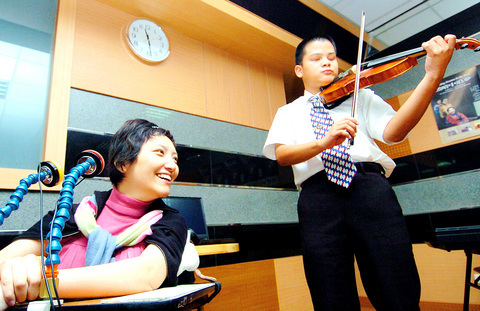
PHOTO: SUNG CHIH-YUAN, TAIPEI TIMESN
"Everyone, no matter how severely disabled, must have his or her own special talents and different ways of communication," Wan said yesterday at a preview of the film held in Taipei.
Savant syndrome is a rare condition in which people suffering from mental retardation, autism or schizophrenia nonetheless possess an unusual ability in a single field, one most often related to music, art or numbers.
Taking Lu Wen-kuei (呂文貴), 21, one of the film's subjects for example, Wan said that the totally blind and mentally retarded Paiwan Aboriginal was once socially isolated when he was nursed and cared for by a low-income family in Santimen, Pingtung County. Teachers did not recognize Lu's musical talent and perfect pitch until he first touched a piano at age 12, when he played all the songs he had ever heard with no difficulty.
Later, teachers found that Lu could play many kinds of musical instruments and use them to play whatever he had ever heard, even though he could not even solve the simplest arithmetic problems, such as three plus five.
In the film, Lin Wei-chih (
In the first seven years in his life, he was misunderstood as a mute. Now, only using the sense of hearing, Lin can easily recognize types of trains passing by.
"I wish I could see a train timetable, buy tickets, and go up and down stairs at train stations," Lin, a railroad enthusiast, said in the film.
Chuan Fu-hua (莊馥華), 21, has suffered from visual impairment, paraplegia and communication disorder since she got hurt in a fire at the age of 10.
By using a special tool for typing and wagging her head to express her thought in phonetic symbols and Morse code, Chuan has written more than 200 poems. Some of her pieces have been published in mainstream newspapers and magazines. Her persistence won her the Presidents' Award of Education in 2004.
However, Taiwan's existing educational system cannot offer her an opportunity to go to college.
At the preview yesterday, three subjects smiled and laughed when they were introduced to viewers, many of whom shed tears after being touched by the persistence of the three young people's hearts.
Hsiao Yeh (
"In the film, Wen-kuei said three plus five equals to ten. It's possible. Life is not like mathematics. The documentary can even inspire normal children, who also suffer setbacks in daily life," Hsiao Yeh said.
Wan said that all proceeds earned by the program will be donated to the private Huei-ming School and Home for Blind Children. Currently, the DVD is available by ordering through the school.
"So far, we have not planned to have the film shown in public. But we hope people know that special ways of communication for many other kids are just waiting to be discovered," Chen Li-yu (
Officials of both the National Science Council and the Ministry of Education said that more investment has to be made, not only to encourage related research but also "to create friendly environment in society."
"Today kids like this rely on families more than the society. Parents devote themselves. If I were in their shoes, I'm not sure I could've done better," Deputy Minister of the National Science Council Shieh Ching-jyh (

Taipei has once again made it to the top 100 in Oxford Economics’ Global Cities Index 2025 report, moving up five places from last year to 60. The annual index, which was published last month, evaluated 1,000 of the most populated metropolises based on five indices — economics, human capital, quality of life, environment and governance. New York maintained its top spot this year, placing first in the economics index thanks to the strength of its vibrant financial industry and economic stability. Taipei ranked 263rd in economics, 44th in human capital, 15th in quality of life, 284th for environment and 75th in governance,

The Sports Administration yesterday demanded an apology from the national table tennis association for barring 17-year-old Yeh Yi-tian (葉伊恬) from competing in the upcoming World Table Tennis (WTT) United States Smash tournament in Las Vegas this July. The sports agency said in a statement that the Chinese Taipei Table Tennis Association (CTTTA) must explain to the public why it withdrew Yeh from the WTT tournament in Las Vegas. The sports agency said it contacted the association to express its disapproval of the decision-making process after receiving a complaint from Yeh’s coach, Chuang
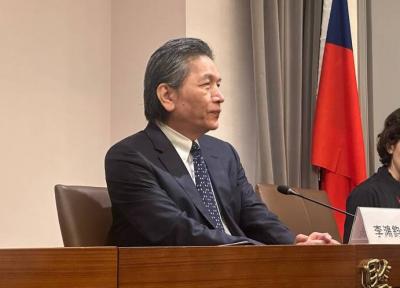
Control Yuan Secretary-General Lee Chun-yi (李俊俋) tendered his resignation last night, admitting that he had misused a government vehicle, as reported by media. His resignation was immediately accepted by the Control Yuan. In a statement explaining why he had resigned, Lee apologized for using a Control Yuan vehicle to transport his dog to a pet grooming salon on May 20. The issue first came to light late last month, when TVBS News reported that Lee had instructed his driver to take the dog to the salon. The news channel broadcast photos that it said were taken by an unnamed whistle-blower, which purportedly showed the
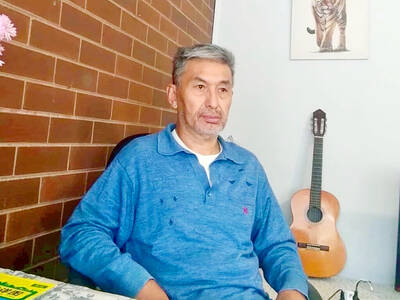
A former officer in China’s People’s Liberation Army (PLA) who witnessed the aftermath of the 1989 Tiananmen Square massacre has warned that Taiwan could face a similar fate if China attempts to unify the country by force. Li Xiaoming (李曉明), who was deployed to Beijing as a junior officer during the crackdown, said Taiwanese people should study the massacre carefully, because it offers a glimpse of what Beijing is willing to do to suppress dissent. “What happened in Tiananmen Square could happen in Taiwan too,” Li told CNA in a May 22 interview, ahead of the massacre’s 36th anniversary. “If Taiwanese students or


 RSS
RSS