


■ Religion
Pope gives money to Taiwan
The Holy See has donated US$500,000 to the Catholic Diocese of Kaohsiung to show its concern over the Catholic community's development in Taiwan and to demonstrate Pope John Paul II's friendship toward the people of Taiwan. Well-placed sources in the Vatican said yesterday that the donation has already been given by the Holy See's envoy in Taipei to His Eminence Cardinal Paul Shan (單國璽), who is also bishop of the Diocese of Kaohsiung. The money will be used for charity work in the diocese. Saying that the pope has always been concerned about poor people, refugees and minority groups around the world, the sources said that the donation illustrates that the head of the Holy See has not forgotten such people in Taiwan. Taiwan donated US$500,000 to the Vatican in October in celebration of the 25th anniversary of the pope.
■ Communication
Broadcast act passed
Lawmakers passed the draft Act on Communications and Distribution (通訊傳播基本法) yesterday, providing a legal foundation for the planned National Communications Commission (國家通訊傳播委 員會, NCC) under the Executive Yuan. "The NCC should be established to integrate management of industries of telecom-munications, cable television, satellite and wireless broadcasting in this country. The government surveillance of broadcasting content should be open, while media industries are required to have high standards of self-discipline," the act states. The act also stipulates that the government should provide incentives to develop new media technology while helping to protect the interests of audiences by monitoring the service of media industries.
■ Cross-strait ties
Premier responds to Hu
Speaking at an inauguration ceremony for an anti-human-smuggling task force in Keelung yesterday, Premier Yu Shyi-kun outlined four demands for Beijing at the inauguration campaign yesterday. First, he asked Beijing to carry out direct charter-flights during the Lunar New Year. Second, he wants the Straits Exchange Foundation to be allowed to establish branch offices in Guangzhou, Shanghai and Beijing. Thirdly, he wants to re-establish the cross-strait dialog as soon as possible. Finally, he requested that the nearly 500 DF-11 and DF-12 missiles targeting Taiwan be dismantled immediately. Yu made the comments in response to a speech given by Chinese President Hu Jintao (胡錦濤) to Taiwanese business leaders in Beijing on Thursday.
■ Cross-strait ties
China urged to seek peace
The government is happy to see that both sides of the Taiwan Strait think highly of Taiwan businessmen, but hopes that China will take substantive action to maintain peace in the Taiwan Strait, Presidential Office Secretary-General Chiou I-jen (邱義仁) said yesterday. Chiou was responding to Chinese President Hu Jintao's (胡錦濤) remarks the previous day when he received the presidents of Taiwanese businessmen's associations in China and told them he will make every effort to achieve the peaceful unification of China. "Our cross-strait policy remains steady," Chiou said, adding that President Chen Shui-bian (陳水扁) has said repeatedly that his advocacy of "one country on each side of Taiwan Strait," and "defensive referendum" are not attempts to change the status quo and have nothing to do with Taiwan independence, nor are they provocations. They are intended to strengthen Taiwan's democracy and maintain peace in the region, Chiou said, which is "our basic stance," although China might have a different interpretation.
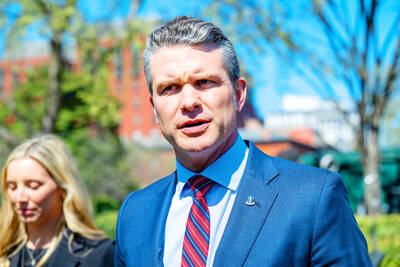
‘DENIAL DEFENSE’: The US would increase its military presence with uncrewed ships, and submarines, while boosting defense in the Indo-Pacific, a Pete Hegseth memo said The US is reorienting its military strategy to focus primarily on deterring a potential Chinese invasion of Taiwan, a memo signed by US Secretary of Defense Pete Hegseth showed. The memo also called on Taiwan to increase its defense spending. The document, known as the “Interim National Defense Strategic Guidance,” was distributed this month and detailed the national defense plans of US President Donald Trump’s administration, an article in the Washington Post said on Saturday. It outlines how the US can prepare for a potential war with China and defend itself from threats in the “near abroad,” including Greenland and the Panama
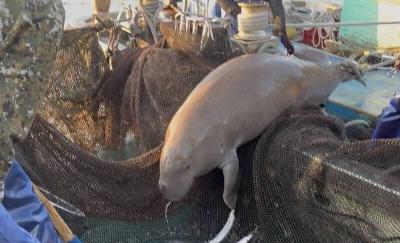
A wild live dugong was found in Taiwan for the first time in 88 years, after it was accidentally caught by a fisher’s net on Tuesday in Yilan County’s Fenniaolin (粉鳥林). This is the first sighting of the species in Taiwan since 1937, having already been considered “extinct” in the country and considered as “vulnerable” by the International Union for Conservation of Nature. A fisher surnamed Chen (陳) went to Fenniaolin to collect the fish in his netting, but instead caught a 3m long, 500kg dugong. The fisher released the animal back into the wild, not realizing it was an endangered species at

The High Prosecutors’ Office yesterday withdrew an appeal against the acquittal of a former bank manager 22 years after his death, marking Taiwan’s first instance of prosecutors rendering posthumous justice to a wrongfully convicted defendant. Chu Ching-en (諸慶恩) — formerly a manager at the Taipei branch of BNP Paribas — was in 1999 accused by Weng Mao-chung (翁茂鍾), then-president of Chia Her Industrial Co, of forging a request for a fixed deposit of US$10 million by I-Hwa Industrial Co, a subsidiary of Chia Her, which was used as collateral. Chu was ruled not guilty in the first trial, but was found guilty
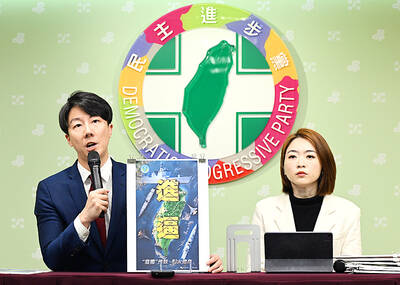
The Chinese Nationalist Party (KMT) is maintaining close ties with Beijing, the Democratic Progressive Party (DPP) said yesterday, hours after a new round of Chinese military drills in the Taiwan Strait began. Political parties in a democracy have a responsibility to be loyal to the nation and defend its sovereignty, DPP spokesman Justin Wu (吳崢) told a news conference in Taipei. His comments came hours after Beijing announced via Chinese state media that the Chinese People’s Liberation Army’s Eastern Theater Command was holding large-scale drills simulating a multi-pronged attack on Taiwan. Contrary to the KMT’s claims that it is staunchly anti-communist, KMT Deputy


 RSS
RSS