


The decision by specialist bookstore Fembooks to close its doors after nine years in the business and concentrate solely on publishing has created a stir in the nation's literary circles.
"It was not an easy decision," said Fembooks founder Su Chien-ling (蘇芊玲). "After all, I am emotionally attached to the store. It has been my mission to run this business and I wanted to do much more."
The loss of the bookstore will be sorely felt.
Young female college students wanting to learn more about women's literature usually make their way to the tiny women's bookstore above the Witches House in a small lane off Shinsheng South Road.
Walking into Fembooks, customers are greeted with the most complete collection of women's publications, straight or gay, available in Taiwan. Browsers can also sit down with a cup of coffee in the small cafe connected to the bookshop, register in gender seminars or discuss women's issues.
When it opened in 1994, Fembooks was the first of its kind in Taiwan.
"Originally, we served three main functions: bookstore, public activities and publication. Now we will give up the first two and concentrate on the last section," Su said.
"We will stop displaying books from other publishers and only exhibit our own publications and those from some minority groups. We may also give up holding activities since now many other groups are doing the same thing. Meanwhile, we will continue with our publication business," Su said.
The decision to pare back services followed an investors' meeting earlier this month. Fembooks is supported by a number of small investors, mostly academics and students, who donate small amounts of money to further the bookstore's cause.
When Fembooks was established, gender issues were still not widely discussed. The bookstore aimed to provide a space where the public could get in touch with women's writing, hear women's voices and exchange women's experiences. It has played an important role in the local women's movement ever since, and provided curious students and citizens with important introductory materials, including the self-published Feminism Theories and Sects (女性主義理論與流派).
Su said that chain bookstores have had a large impact on Fembooks' business, especially since Eslite set up a special gender studies section. Su said it was difficult to compete with the big stores since they can usually squeeze better prices out of publishers.
"The famous Sisterhood bookstore, close to the University of California and Los Angeles, also failed to survive after a Borders branch opened in the area," Su said.
Fembooks is close to National Taiwan University, yet a branch of Eslite stands opposite its front gates.
Since Eslite moved into Kungkuan, the area the university is situated in, many independent bookstores around the university have felt the impact.
"Now customers visit Eslite first and see whether it has got the books they want. Unless they cannot find the books they want there, they don't come to our shop, " said Huang Miao-ling (
"Sometimes when customers pay for their books, they say to me, `I simply could not find the book at Eslite.'"
Fembooks investor Professor Bih Herng-dar (畢恆達) puts it more bluntly.
"Those who care about Fembooks are those without money," said Bih, who teaches at National Taiwan University Graduate Institute of Building and Planning.
He said that it was a pity to close the bookstore, but the idea had been toyed around with for a few years now. With Internet bookstores and chain stores controlling the market, the public is less likely to visit a bookstore like Fembooks.
When asked why Gin Gin's, a gay specialist bookstore in the area, could survive and prosper while Fembooks could not, Bih said that it was down to how the stores were run.
"Gin Gin's has [founder and proprietor] Lai Jeng-jer (賴正哲), who devotes all his time to the bookstore and the business. Fembooks does not have such a person. All its investors and board members have full-time jobs and we cannot manage to find someone who knows the field well enough to stay and manage the bookstore," Bih said.

Taiwanese were praised for their composure after a video filmed by Taiwanese tourists capturing the moment a magnitude 7.5 earthquake struck Japan’s Aomori Prefecture went viral on social media. The video shows a hotel room shaking violently amid Monday’s quake, with objects falling to the ground. Two Taiwanese began filming with their mobile phones, while two others held the sides of a TV to prevent it from falling. When the shaking stopped, the pair calmly took down the TV and laid it flat on a tatami mat, the video shows. The video also captured the group talking about the safety of their companions bathing
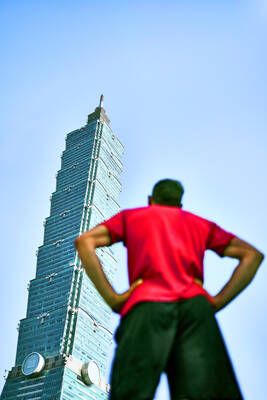
US climber Alex Honnold is to attempt to scale Taipei 101 without a rope and harness in a live Netflix special on Jan. 24, the streaming platform announced on Wednesday. Accounting for the time difference, the two-hour broadcast of Honnold’s climb, called Skyscraper Live, is to air on Jan. 23 in the US, Netflix said in a statement. Honnold, 40, was the first person ever to free solo climb the 900m El Capitan rock formation in Yosemite National Park — a feat that was recorded and later made into the 2018 documentary film Free Solo. Netflix previewed Skyscraper Live in October, after videos

Starting on Jan. 1, YouBike riders must have insurance to use the service, and a six-month trial of NT$5 coupons under certain conditions would be implemented to balance bike shortages, a joint statement from transportation departments across Taipei, New Taipei City and Taoyuan announced yesterday. The rental bike system operator said that coupons would be offered to riders to rent bikes from full stations, for riders who take out an electric-assisted bike from a full station, and for riders who return a bike to an empty station. All riders with YouBike accounts are automatically eligible for the program, and each membership account

A classified Pentagon-produced, multiyear assessment — the Overmatch brief — highlighted unreported Chinese capabilities to destroy US military assets and identified US supply chain choke points, painting a disturbing picture of waning US military might, a New York Times editorial published on Monday said. US Secretary of Defense Pete Hegseth’s comments in November last year that “we lose every time” in Pentagon-conducted war games pitting the US against China further highlighted the uncertainty about the US’ capability to intervene in the event of a Chinese invasion of Taiwan. “It shows the Pentagon’s overreliance on expensive, vulnerable weapons as adversaries field cheap, technologically


 RSS
RSS