


Picture books are usually just for kids. Most adult readers prefer complex plots and emotions explored through thousands of words in the pages of bulky novels.
But a local artist has become a big hit by luring office workers, housewives and other grown-ups back to the days when drawings outnumbered the words in the books they enjoyed.
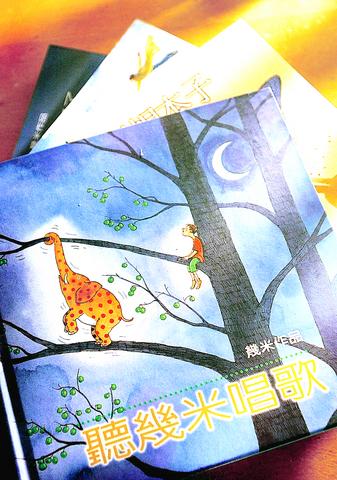
PHOTO: AP
He's Jimmy Liao (幾米), whose illustrated books with simple stories about people coping in the modern urban world have become hot sellers in Taipei, Tokyo, Seoul, Hong Kong, Shanghai and Singapore.
The picture books are popular because they touch on common feelings of being alienated, stressed out by work or fears about losing jobs and loved ones, readers say. Most of the pages in the paperback books -- usually the size of a cocktail napkin -- have one line of text and a clever, cute or whimsical cartoon-like drawing that advances the plot.
"Jimmy's drawing touches the hearts of urban youth. It relieves the fears and anxieties of urbanites, who are living amid struggle and pressure," China Youth Daily, a mass-market newspaper in China, said of the 44-year-old artist, who goes by his first name.
Jimmy's readers have even been known to decorate their bedrooms with the same trendy sofas and curtains used by characters in his books.
As she dug through a pile of the books at a Taipei bookstore, Judy Liang, an accountant in her 40s, explained why she was a fan of the author.
"I was first thinking of buying the picture books for my daughter, but then found the images really touching," Liang said.
Art student Huang Chiao-ting said other artists have tried to ride the trend of picture books but they can't match Jimmy. "Jimmy may not be a world-class master painter, but he is especially good at conveying feelings and moods."
In one of his most popular books, Turning Left, Turning Right, Jimmy tells the story of a romance between a lonely man and woman who never realized they were neighbors because one always turns left and the other right when they walk out of their apartment building.
One day, they meet by accident at a neighborhood park, but they lose contact again because rain soaks the slip of paper the woman used to scribble down her telephone number.
The author, who published his first work four years ago, said he tries to use cute images to portray the "desolate world" of a person facing a middle-age crisis.
"You don't have to use dreary images to depict cruel, dreary facts. "Readers can catch the desolateness behind beautiful images," he said, sipping a soda at a Taipei coffee shop.
In his book The Moments, which describes the childhood hopes and dreams of adults, one drawing shows a dolphin sound asleep on a white pillow next to a sleeping boy. The caption asks, "How come my childhood yearnings can only come true in dreams?"
Jimmy often shows his sense of humor against a backdrop of grievance.
Another drawing in The Moments shows a boy standing in a classroom corner and peeking through a crack to see a world of butterflies, unicorns and comets. "Dear teacher, you'll never know there is a tiny hole in the corner ... I'll never let you know about the sights I see," the caption says.
After an illness in 1998, Jimmy ended his 12-year-career as an illustrator at an advertising firm and began his own creative works.
He said he gets inspiration from the simple life he leads with his wife, 5-year-old daughter and two cats in a 13th floor apartment on the outskirts of Taipei.
"I let my imagination run wild to create a freewheeling world," he said. "I draw with an instinct, not from keen observations," he added, noting he does not stroll in the street or mix with people a lot.
When creating his Turning Left, Turning Right book, Jimmy said he got the story idea when pondering about his next door neighbor, whom he had never met.
With his increasing fame, Jimmy has faced questions about the Western-style of his drawings. His characters often live in Western-style cities.
"Chinese reporters asked why I have Catholic nuns in my books instead of Buddhist monks," he said.
He admits that he is not drawn to Oriental art. He likes Italian food and his closets have only Western suits.
"Let artists do what they are best at, be it Oriental or European," he said.
On the Net: Jimmy's Web site: http://www.Jimmyspa.com

ANOTHER EMERGES: The CWA yesterday said this year’s fourth storm of the typhoon season had formed in the South China Sea, but was not expected to affect Taiwan Tropical Storm Gaemi has intensified slightly as it heads toward Taiwan, where it is expected to affect the country in the coming days, the Central Weather Administration (CWA) said yesterday. As of 8am yesterday, the 120km-radius storm was 800km southeast of Oluanpi (鵝鑾鼻), Taiwan’s southernmost tip, moving at 9kph northwest, the agency said. A sea warning for Gaemi could be issued tonight at the earliest, it said, adding that the storm is projected to be closest to Taiwan on Wednesday or Thursday. Gaemi’s potential effect on Taiwan remains unclear, as that would depend on its direction, radius and intensity, forecasters said. Former Weather Forecast

As COVID-19 cases in Japan have been increasing for 10 consecutive weeks, people should get vaccinated before visiting the nation, the Centers for Disease Control (CDC) said. The centers reported 773 hospitalizations and 124 deaths related to COVID-19 in Taiwan last week. CDC Epidemic Intelligence Center Director Guo Hung-wei (郭宏偉) on Tuesday said the number of weekly COVID-19 cases reported in Japan has been increasing since mid-May and surpassed 55,000 cases from July 8 to July 14. The average number of COVID-19 patients at Japan’s healthcare facilities that week was also 1.39 times that of the week before and KP.3 is the dominant

The Chinese Communist Party’s (CCP) working group for Taiwan-related policies is likely to be upgraded to a committee-level body, a report commissioned by the Mainland Affairs Council (MAC) said. As Chinese President Xi Jinping (習近平) is increasingly likely to upgrade the CCP’s Central Leading Group for Taiwan Affairs, Taiwanese authorities should prepare by researching Xi and the CCP, the report said. At the third plenary session of the 20th Central Committee of the CCP, which ended on Thursday last week, the party set a target of 2029 for the completion of some tasks, meaning that Xi is likely preparing to

US-CHINA TRADE DISPUTE: Despite Beijing’s offer of preferential treatment, the lure of China has dimmed as Taiwanese and international investors move out Japan and the US have become the favored destinations for Taiwanese graduates as China’s attraction has waned over the years, the Ministry of Labor said. According to the ministry’s latest income and employment advisory published this month, 3,215 Taiwanese university graduates from the class of 2020 went to Japan, surpassing for the first time the 2,881 graduates who went to China. A total of 2,300 graduates from the class of 2021 went to the US, compared with the 2,262 who went to China, the document showed. The trend continued for the class of 2023, of whom 1,460 went to Japan, 1,334 went to


 RSS
RSS