


The navy's underwater demolition unit, modeled after the US Navy Seals, yesterday made public part of its training program for recruits at its base in Kaohsiung's Tsoying military port.
The unit is launching a one-week intensive physical-conditioning test for its recruits. The test is called Hell Week.
During Hell Week, trainees are not allowed to sleep and have to spend their time swimming, running and going through obstacle courses.
The trainees, divided into separate teams, can earn one hour of sleep each day if their team gets the highest combined score in that day's tests. The losing teams have to continue their training without sleep.
Yesterday, under a scorching sun at a beach at the Tsoying military port, the navy revealed details of the Hell Week training program. Participants, including officers, non-commissioned officers and soldiers, were seen nearing physical exhaustion as they labored to pass the required tests.
Hell Week training, modeled on that of the US Navy Seals, is aimed at testing the limits of trainees' physical and mental endurance. All trainees, regardless of rank, receive the same treatment during the training.
Yesterday marked the fifth day of Hell Week, with the training course to conclude tomorrow with a final and ultimate test -- the "Road to Paradise."
In the Road to Paradise test, each trainee has to crawl his way through a 15m-long road paved with coral, sharp stones and other objects painful to the touch. The test is also used by the marines.
The test is not difficult to pass as long as the trainee can endure the physical pain.
Hell Week is the last part of the first phase of the basic training program that the underwater demolition unit requires of its recruits. The first phase lasts 10 weeks.
The first phase began with 54 trainees, but the number dropped to 32 prior to Hell Week.
A Singaporean non-commissioned officer, identified only by his surname, Chen, is among the 32 survivors. He is the only foreigner among the trainees.
The second phase of the basic training program will also last 10 weeks, during which the recruits will undergo advanced and specialized training in fields ranging from mine demolition, combat scuba diving, coastal reconnaissance, survival skills in the wild, parachuting, urban combat and maneuvers in mountainous regions.
With training covering air, sea and land operations, the underwater demolition unit is considered among the best of its kind in the three services.
In times of war its task is to infiltrate and raid enemy territory to pave the way for the landing of marines.
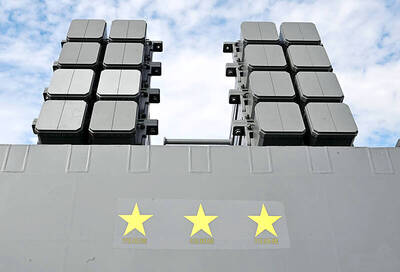
UPGRADE: The Kang Ding-class frigate is replacing its Chaparall missiles with Tien Chien II and Hua Yang VLS, which would provide it with long-range, 360° air defense Taiwan plans to produce 1,200 to 1,376 Hai Chien II missiles (海劍二, Sea Sword II) — also known as TC-2N — to serve as the standard air defense system of the navy’s surface combatant fleet, a source said yesterday. Last week, the Hai Chien II, the naval version of the Tien Kung II missile (天劍二, Sky Sword II), completed a live-fire test in waters off the National Chungshan Institute of Science and Technology’s Jiupeng facility (九鵬) in Pingtung County’s Manjhou Township (滿州). The MIM72 Chaparral and other dated air defense missiles that currently arm Taiwanese ships have inadequate range to combat Chinese

REASONS FOR TRAVEL: An assistant professor said that proposed amendments to penalize drivers if they used drugs overseas would not deter people from traveling People who operate a motor vehicle under the influence of marijuana would have their driver’s license revoked, even if they used the substance while overseas, the Ministry of Transportation and Communications said yesterday, citing proposed amendments to the Road Traffic Management and Penalty Act (道路交通管理處罰條例). The amendments would also authorize the government to revoke the licenses of people determined to have used Category 1 or Category 2 narcotics, even if they were not operating a vehicle while under the influence of drugs, as well as ban them from taking the license test for three years, the ministry said. People aged 18 or
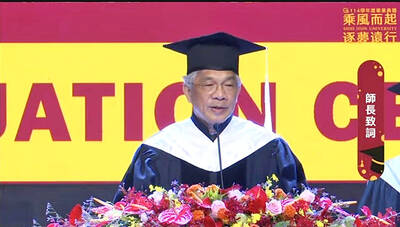
Shih Hsin University President Chen Ching-he (陳清河) yesterday issued a public apology for comments made in his commencement speech last week, stating that he has asked the school to suspend his duties and halt his wages for two months as a show of contrition. At the commencement ceremony on May 30, Chen said, “If you don’t manage your time well, or your own emotions, or your health, then I am telling every one of you — put a quick end to ‘you,’ because the world has no need for ‘you.’” The comments have sparked significant controversy online, and Chen through an open
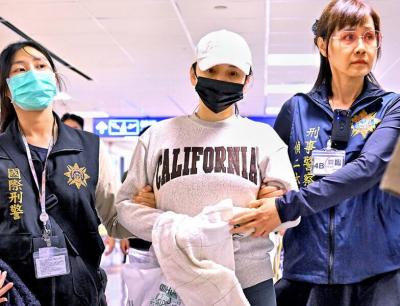
Johanne Liou (劉喬安), a Taiwanese woman who shot to unwanted fame during the Sunflower movement protests in 2014, returned to Taiwan last night after being deported from the US. She is to stand trial in Taiwan for charges involving embezzlement, fraud and drug crimes. The Criminal Investigation Bureau (CIB) said it took her into custody at Taiwan Taoyuan International Airport and would first question her before transferring her to the New Taipei District Prosecutors’ Office. She was arrested upon disembarking a flight from San Francisco that landed shortly before 7pm. Liou absconded to the US in 2019 after jumping bail


 RSS
RSS