


The SEZ Group, its local subsidiary being Austria's biggest company in Taiwan, is a leading supplier of semiconductor equipment to the global chip manufacturing industry. SEZ reported exceptionally strong numbers for the first half of 2001 compared to the rest of the semiconductor industry, with seven month year to date sales growth of 87 percent in dollar terms compared to 2 percent for the recently reported SEMI (North American semiconductor equipment company trade association) group of companies. In light of the current market situation and the recent world events, the industry is currently expecting to see a 28 percent decrease in sales compared to 2000. Against the industry trend, SEZ is experiencing exceptional growth even for the whole of 2001.
Due to its proprietary technology and strategic focus on the most advanced industry developments (300mm and Copper technologies) SEZ still expects an increase of 28 to 33 percent in net sales over last year. As the semiconductor industry is approaching geometries beyond 0.1 microns, SEZ's solutions for wafer surface conditioning have become a yield enhancing "must-have" for state of the art 200mm and 300mm fabs. SEZ's applications are developed around the group's proprietary spin etching technology which is based on single wafer processing (in contrast to batch processing which used to be the standard for all wet chemical processes) pioneered by SEZ in the 1990s and now adapted by most of SEZ's competitors. SEZ has patented its design and with 15 years of experience in equipment and process development has considerable technological advantage over its competitors.

CHAMPIONS: President Lai congratulated the players’ outstanding performance, cheering them for marking a new milestone in the nation’s baseball history Taiwan on Sunday won their first Little League Baseball World Series (LLBWS) title in 29 years, as Taipei’s Dong Yuan Elementary School defeated a team from Las Vegas 7-0 in the championship game in South Williamsport, Pennsylvania. It was Taiwan’s first championship in the annual tournament since 1996, ending a nearly three-decade drought. “It has been a very long time ... and we finally made it,” Taiwan manager Lai Min-nan (賴敏男) said after the game. Lai said he last managed a Dong Yuan team in at the South Williamsport in 2015, when they were eliminated after four games. “There is
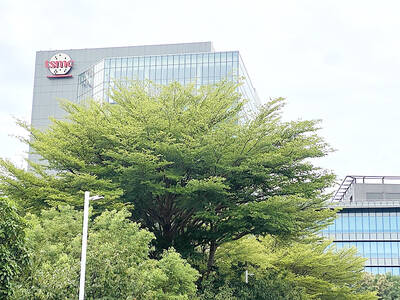
Taiwan Semiconductor Manufacturing Co (TSMC, 台積電) is expected to start construction of its 1.4-nanometer chip manufacturing facilities at the Central Taiwan Science Park (CTSP, 中部科學園區) as early as October, the Chinese-language Liberty Times (the Taipei Times’ sister newspaper) reported yesterday, citing the park administration. TSMC acquired land for the second phase of the park’s expansion in Taichung in June. Large cement, construction and facility engineering companies in central Taiwan have reportedly been receiving bids for TSMC-related projects, the report said. Supply-chain firms estimated that the business opportunities for engineering, equipment and materials supply, and back-end packaging and testing could reach as high as
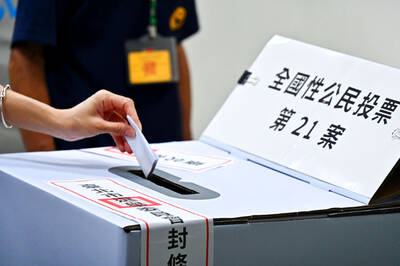
POWER PLANT POLL: The TPP said the number of ‘yes’ votes showed that the energy policy should be corrected, and the KMT said the result was a win for the people’s voice The government does not rule out advanced nuclear energy generation if it meets the government’s three prerequisites, President William Lai (賴清德) said last night after the number of votes in favor of restarting a nuclear power plant outnumbered the “no” votes in a referendum yesterday. The referendum failed to pass, despite getting more “yes” votes, as the Referendum Act (公民投票法) states that the vote would only pass if the votes in favor account for more than one-fourth of the total number of eligible voters and outnumber the opposing votes. Yesterday’s referendum question was: “Do you agree that the Ma-anshan Nuclear Power Plant
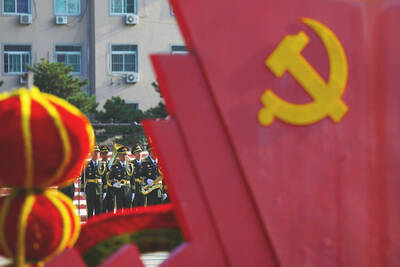
Democratic nations should refrain from attending China’s upcoming large-scale military parade, which Beijing could use to sow discord among democracies, Mainland Affairs Council Deputy Minister Shen You-chung (沈有忠) said. China is scheduled to stage the parade on Wednesday next week to mark the 80th anniversary of Japan’s surrender in World War II. The event is expected to mobilize tens of thousands of participants and prominently showcase China’s military hardware. Speaking at a symposium in Taichung on Thursday, Shen said that Chinese Minister of Foreign Affairs Wang Yi (王毅) recently met with Indian Prime Minister Narendra Modi during a visit to New Delhi.


 RSS
RSS