

For those who have competed — or nearly competed — under the Olympic rings, the fear of missing out the next time the Games beckon is real, regardless of the venue, regardless of the sport.
Athletes who try to run it back following a lengthy sabbatical or retirement is hardly new. The list is filled with famous names, from Mark Spitz to Michael Phelps, from Lindsey Vonn to Simone Biles.
Still, the steady drip is becoming more of a torrential flow as Los Angeles 2028 approaches. The pull of the Games combined with the chance to compete at home on the world stage under the white-hot spotlight only the Olympics provide is already proving too tempting to ignore for a generation of American stars who have won medal after medal on seemingly every other continent but their own.
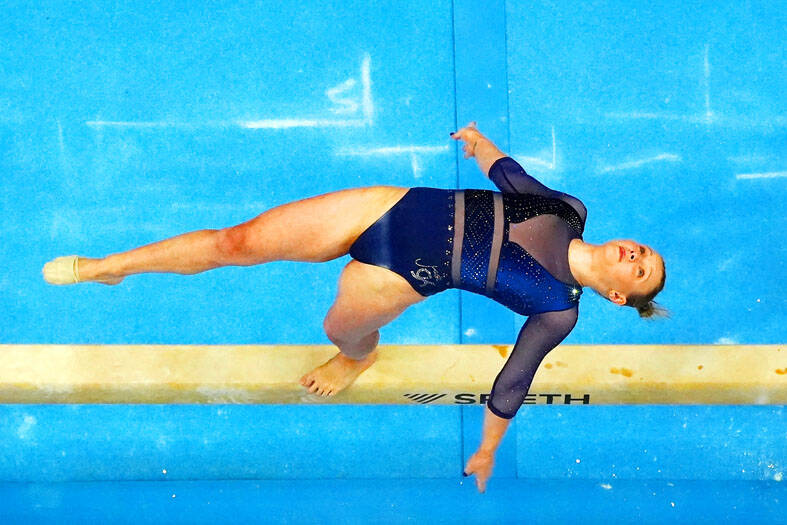
Photo: AP
Track icon Allyson Felix is mounting a return in her early 40s. Six-time Olympic medalist and 2020 Olympic gymnastics all-around champion Suni Lee announced last month she has started training for a shot at her third Games. Two-time Olympic gold medalist Jade Carey is back, winning the vault and finishing fifth in the all-around at the US championships over the weekend.
Asked how much of a factor the chance to compete on American soil played into her decision, Carey just smiled.
“I probably would have gone for it regardless,” said Carey, who will be 28 when the flame is lit at the Coliseum in Los Angeles, “but it does make it a little extra special that it’s in the US.”
Or maybe a lot more special. Oh, and conceivably a lot more lucrative too.
Olympic success at home can be life-changing
The media landscape has shifted dramatically since the 1996 Games in Atlanta. The rise of social media allows athletes to easily tell their stories directly to new audiences, and the ability to create and curate their own brand opens sponsorship opportunities that did not exist a generation ago.
Finding your way onto the medal stand at the Olympics anywhere in the world can make you a hero. Doing it in the US could turn you into a legend. Mary Lou Retton, Mike Eruzione and Kerri Strug know how that goes.
Longtime agent Sheryl Shade, whose list of clients over the last 30 years has included a “who’s who” of Olympians, from gymnasts Nastia Liukin and Shawn Johnson to soccer pioneer Mia Hamm and figure skater Tara Lipinski, called the opportunities for athletes to capitalize on success in Los Angeles “exponentially” greater than any Games that have come before.
“It’s going to be long-range too,” Shade said. “Because now it doesn’t end at the Olympic Games. That’s why LA is so important. This is about legacy.”
Look to “The Magnificent Seven” for proof. Three decades ago, the members of the 1996 US women’s Olympic gymnastics team walked onto the floor of the Georgia Dome for the team final as underdogs. They walked off it with gold medals around their necks, their lives forever altered.
“I mean, we all knew that was going to be special,” team captain Amanda Borden said.
Even if they had no idea how special at the time. While the group, all teenagers that summer, eventually retired and went on with their lives, to this day they get stopped by fans who remember where they were that memorable July night when the injured Strug gingerly stuck her vault landing to secure gold for the US.
They have lived the dream. In some ways, they are still living it. So no, they are not surprised that so many who have “already been there, done that” want to give it another shot.
“I can promise [for] every athlete that makes the team, this Olympics will be one of the greatest moments of their careers,” seven-time Olympic medalist Shannon Miller said.
Her advice to anyone considering it: go for it, even if things do not work out exactly as you planned.
Miller decided less than a year before the 2000 Games in Sydney to give it one final shot at age 23 — considered ancient for a gymnast at the time, although less so now. An injury at the Olympic trials ended that dream. Miller has no regrets, and a quarter century later it is considered a footnote for the most-decorated American women’s gymnast after Biles.
The attempt comes with considerable risk to mental and physical health. For every athlete that makes it, there are countless others that will not. And for those that do, the burden to succeed is ratcheted up to a level they have likely never experienced.
Dominique Moceanu, the youngest member of the Magnificent Seven, described it as a “double-edged sword.”
“You have to understand that it will be probably the biggest moment of your life,” Moceanu said. “Whether it’s because you put it on yourself or you feel the enormity of the weight of the country and the expectations. That does something to people, right?”
It does. Biles brought the discussion around mental health to the forefront of the Games in Tokyo when she removed herself from multiple nights of competition to protect herself while dealing with “the twisties.”
She took time off before returning in 2023, capping the perhaps final chapter of her career — Biles remains noncommittal about her future — by winning a second all-around gold in Paris a year later.
Skye Blakely watched Biles’ triumph from afar after her bid to make the 2024 Olympic team ended when she tore her right Achilles while training at the Olympic trials, three years after her outside shot at making the 2021 squad ended with an elbow injury at the same meet.
That has not stopped her from throwing herself into the mix once again. When describing why she continues to press on, Blakely sounds like so many American athletes across the spectrum — regardless of their resume — who feel the Games’ unique gravitational pull.
“Having a dream is always a risk if you’re going to go after it,” she said before finishing seventh in the all-around at the US championships, her first elite all-around meet in two years. “And I feel like the want for that dream has to be more than being afraid of that risk. And for me it is.”

ON TILT: Four time Grand Slam winner Aryna Sabalenka dropped the first set in a tiebreak against Russian player Ekaterina Alexandrova, who won five of the last six points Taiwan’s Hsieh Su-wei (謝淑薇) on Saturday advanced to the women’s doubles quarter-finals of the Toronto Masters with Latvian partner Jelena Ostapenko, while in the women’s singles world No. 1 Aryna Sabalenka and Jessica Pegula were upset in fourth-round matches. Hsieh and Ostapenko defeated Norway’s Ulrikke Eikeri and Quinn Gleason of the US in straight sets 6-4, 7-6 (7/1), while Taiwan’s Wu Fang-hsien (吳芳嫺) and Chan Hao-ching (詹皓晴) were knocked out in the round of 16. Hsieh and Ostapenko are scheduled to play Ann Li of the US and Denmark’s Clara Tauson today. Four-time Grand Slam winner Sabalenka suffered a blow to her

After bird droppings, stray animals and air-quality concerns overshadowed badminton’s India Open in New Delhi earlier this year, organizers of the flagship World Championships on Tuesday said the city was ready to deliver a smoother spectacle. The Aug. 17 to 23 tournament is to be held at the Indira Gandhi Indoor Stadium, with the draw taking place on Wednesday. The Badminton World Federation (BWF) and local organizers, Badminton Association of India (BAI), said preparations were on track. “Following the India Open in January, BAI acted swiftly to address feedback relating to venue cleanliness and environmental conditions,” BWF secretary-general Thomas Lund

Surfing’s 11-time world champion Kelly Slater showed he still has what it takes to foot it with the best at the Tahiti Pro on Saturday, scoring the highest heat total of the first day in huge and wild waves. The 54-year-old, who retired from full-time competition in 2024, clocked up an excellent two-wave total of 16.23 out of 20 to advance to the second round and into a mouth-watering match-up with Brazil’s three-time uworld champion, Gabriel Medina. “It’s sort of like riding a bike, but you forget how gnarly Teahupo’o is,” said Slater, who has won the event five times in 20

Police yesterday raided South Korea’s soccer association as part of an investigation into the appointment of the coach in charge during their dismal FIFA World Cup campaign. Police conducted “search and seizure operations” at the Korea Football Association (KFA) offices, probing allegations of “obstruction of business” in the recruitment of former coach Hong Myung-bo, a police spokesman said. The 57-year-old resigned in June after South Korea were knocked out at the group stage of the 48-team showpiece in the US, Mexico and Canada following a shock 1-0 defeat to South Africa. Questions were already dogging the association over the 2024


 RSS