


The Confederation of African Football’s (CAF) decision to change the Africa Cup of Nations (AFCON) from a biennial competition to a tournament held every four years has been met with a mixed reaction on the continent with some seeing it as simply caving in to pressure from European clubs and FIFA.
CAF president Patrice Motsepe made the landmark announcement following a meeting with FIFA executives in Rabat on the eve of this year’s Cup of Nations in Morocco.
The next edition is set for Kenya, Uganda and Tanzania in 2027, and Motsepe said another tournament would take place in 2028, after which the AFCON would be held in four-year cycles.
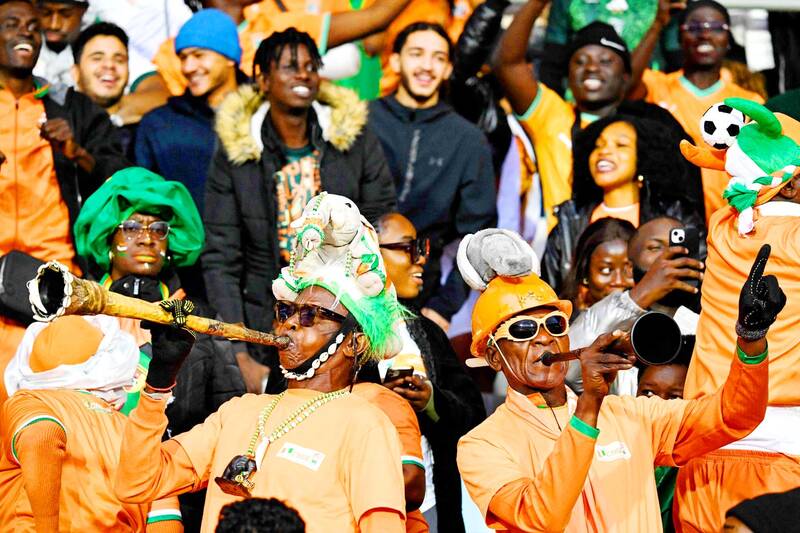
Photo: AFP
It is a radical shift for a competition regularly held at two-year intervals since the first edition in 1957, and the money generated by the Cup of Nations is crucial to the finances of national federations.
To that end, the creation of a new African Nations League — modeled on the UEFA Nations League — is seen as a way of boosting coffers instead. It is set to take place annually from 2029.
Motsepe’s announcement has generated controversy even within CAF.
Many inside African soccer’s governing body believe the change simply grants European clubs what they have long demanded — something previously opposed by former CAF presidents Issa Hayatou of Cameroon and Ahmad Ahmad of Madagascar.
A source within the CAF’s competitions department said that they were taken by surprise.
“Organizing two editions of the Africa Cup of Nations in consecutive years is extremely difficult, especially since the 2027 tournament will be held in the [northern hemisphere] summer,” the source said.
There would be little time to stage qualifiers for 2028, and it would be difficult to find a suitable space in the calendar for that tournament — Euro 2028 would dominate attention in June and July that year and would be immediately followed by the Los Angeles Olympics.
The source acknowledged that the Cup of Nations was held in consecutive years in 2012 and 2013.
However, “back then, the tournament only included 16 teams, not 24, and the qualifiers were based on head-to-head matches, not group stages, which is difficult to replicate now,” they said.
South African Motsepe acknowledged the move was made at least partly due to pressure from Europe, where so many African stars play.
Major European clubs have long complained about having to release African players every two years in the middle of their season to participate in the Cup of Nations.
“Dates are secondary and won’t change the level of African football or its contribution to Europe by providing many talented players,” hit back Tunisia coach Sami Trabelsi.
Meanwhile Tom Saintfiet, Mali’s Belgian coach, said the move was “abnormal,” adding that “Africa must be respected.”
Paul Put, another veteran Belgian coach who is at the ongoing AFCON in charge of Uganda, said that African soccer was being squeezed from all sides by FIFA’s taste for expanding competitions.
“I honestly don’t understand CAF’s decision, and we are unfortunately not happy. That’s my initial feeling. Perhaps the problem lies with the World Cup and the Club World Cup,” he said.
Lesser lights like his team would have fewer opportunities to impress on the continental stage, while Walid Regragui, coach of Morocco, sees the positives and negatives.
“Having it every two years helped a lot of teams develop and progress, and it is going to be even harder to win it now,” he said. “Football is changing. I don’t necessarily agree with the changes, but we need to adapt.”
“I think this competition is as strong as the Euros. In the next 15 to 20 years this competition will be followed by even more people and an AFCON every four years will be an event nobody wants to miss,” he said.
“I think it will make the competition more attractive,” said Algeria captain Riyad Mahrez, currently appearing at his sixth AFCON. “There won’t be so many players who have played in as many tournaments.”

NO HARD FEELINGS: Taiwan’s Lin Hsiang-ti and Indonesia’s Dhinda Amartya Pratiwi embraced after fighting to a tense and rare 30-29 final game in their Uber Cup match The Taiwanese men’s team on Wednesday fought back from the brink of elimination to defeat Denmark in Group C and advance to the quarter-finals of the Thomas Cup, while the women’s team were to face South Korea after press time last night in the Uber Cup quarter-finals in Horsens, Denmark. In the first match, Taiwan’s top shuttler Chou Tien-chen faced a familiar opponent in world No. 3 Anders Antonsen. It was their 16th head-to-head matchup, with the Dane taking his fourth victory in a row against former world No. 2 Chou, winning 21-14, 13-21, 21-15 in 1 hour, 22 minutes. The

Marta Kostyuk’s maiden WTA 1000 title in Madrid came on Saturday thanks to her power, poise and a pair of unexpected lucky shorts. The world No. 23 beat eighth-ranked Mirra Andreeva 6-3, 7-5 in under 90 minutes to secure the most prestigious trophy of her career, her third professional singles title and second in less than a month after Rouen. Yet as the 23-year-old Ukrainian posed for photographs at the Caja Magica, it was not just the silverware that caught the eye. Held alongside her team and her two dogs, Kostyuk showed off a piece of black men’s underwear, prompting

Throwing more than US$5 billion at a divisive new tour and walking away after five seasons does not look like good business, but LIV Golf was not all bad news for Saudi Arabia. Oil-funded LIV, which poached top stars and sent golf’s establishment into a tailspin, helped push the conservative kingdom into global view — one of its key aims, experts said. The exit, confirmed on Thursday after weeks of speculation, does not signal a flight of Saudi money from sport, even after the Middle East war that sparked Iranian attacks around the Gulf, they said. “Saudi Arabia is not
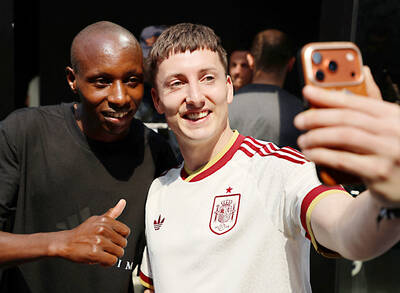
Kite-surfing fabrics, car tires and shortened shoelaces helped Kenyan Sabastian Sawe and Adidas crack the two-hour marathon barrier. When Sawe on Sunday shattered one of athletics’ most elusive barriers in storming to victory at the London Marathon in 1 hour, 59 minutes, 30 seconds, it did not come from just physiology and grit, but from design choices drawn from far beyond the course. Sawe debuted Adidas’ lightest-ever racing shoe, the Adizero Adios Pro Evo 3. “It starts with the mentality of the athlete, the coach, and the team behind the product, which is: What can we do better? What is the 1 percent


 RSS
RSS