


In north central Nigeria’s Muslim-majority state of Kwara, where religious traditions shape daily life, a group of girls are challenging cultural norms by playing soccer.
They have embraced the game’s team spirit, competitive thrill, plus the highs and lows of winning and losing, while trying to ignore the disapproval of those who consider it unsuitable for women who choose to dress modestly.
As Maryam Muhammed laces up her boots and heads to soccer training at a local school in Ilorin, she feels the sweltering heat — made worse by her hijab and leggings — as well as the scorn from some in the local community.
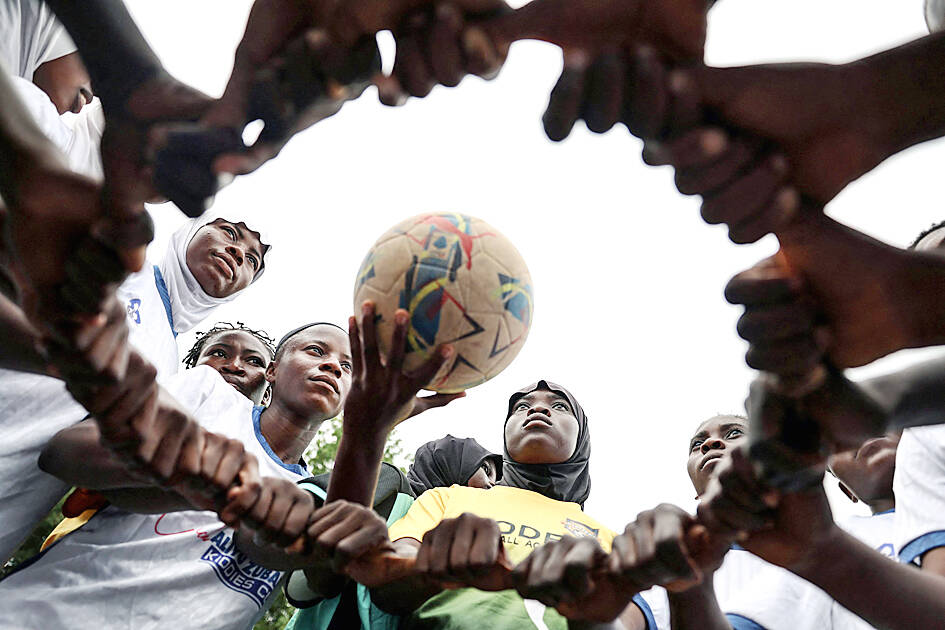
Photo: Reuters
Muhammed, 17, regularly hears taunts as she walks to her training sessions with the Model Queens Football Academy.
“They tell me I won’t achieve anything, but I believe I will achieve something big,” she said.
Despite the discomfort, it is important to her to cover up when she plays rather than wear shorts and a T-shirt.
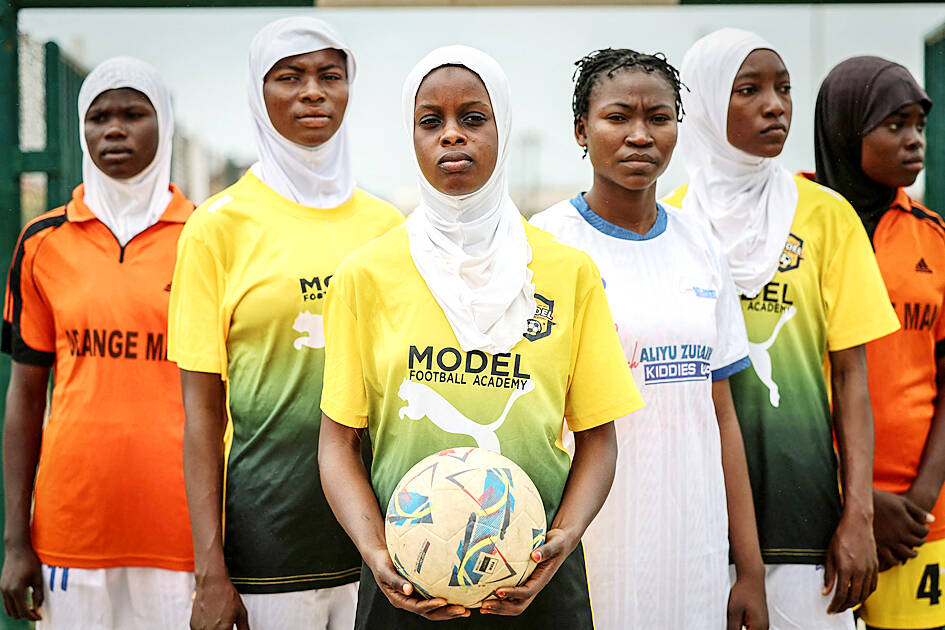
Photo: Reuters
“Sometimes it feels like I want to open the hijab, but I must not expose my hair,” she said. “I have to put it on as a good Muslim.”
Hijabs, which cover the head and neck, were barred by soccer’s world governing body FIFA on safety grounds in 2007, a move which led to the Iranian women’s team being banned from a qualifying match for the 2012 Olympics. The ban was relaxed in 2012, and the hijab fully permitted in 2014.
Nouhaila Benzina of Morocco became the first player to wear a hijab at a FIFA Women’s World Cup in 2023.
Muhammed’s mother, Kehinde Muhammed, has faced criticism for allowing her daughter to play.
“So many people discouraged me,” she said. “But I respect my children’s decisions. I support her and keep praying for her.”
She sews hijabs to match team jerseys.
“I counsel her that this is the normal way you’re supposed to be dressed as a Muslim,” she said.
Model Queens coach Muyhideen Abdulwahab is trying to change perceptions.
“We go out to meet parents, to tell them there are laws in place for modest dressing,” he said. “Despite that, some still say ‘no.’”
Team member Bashirat Omotosho, 19, is passionate about the sport, but cannot always attend training, because she has to help her mother sell puff puff, a fried dough snack, at a roadside stall for the family to make enough money.
Sometimes the team jog past the stall as part of their training, which is frustrating for her.
“Training is often in the morning, but I have to be here,” she said, handing snacks to customers. “I can’t leave my mom — this is how I earn money.”
Her mother, Titilayo Omotosho, was initially hostile to the teenager’s sporting ambition.
“Why would a lady choose football?” she asked.
However, after her husband gave his blessing, the mother relented.
“Seeing other Muslim girls succeed, like Asisat, encouraged us to let her play,” she said, referring to Nigeria star Asisat Oshoala, the record six-time African Women’s Footballer of the Year. Oshoala, who does not wear a hijab on the pitch, comes from Lagos, in southwest Nigeria, where Islam is less conservative.
Despite growing interest, female participation in soccer remains low in Ilorin, local soccer administrator Ambali Abdulrazak said.
The Nigerian Women’s Football League (NWFL) is among Africa’s strongest, led by southern clubs from cities such as Lagos and Port Harcourt, where infrastructure and societal support are robust.
In contrast, northern and central regions face cultural and religious barriers, but grassroots efforts are expanding.
Nationwide, the sport’s popularity is rising, driven by the success of the national women’s team, the Super Falcons, as well as increased sponsorships and grassroots programs.
NWFL viewership has grown by 40 percent since 2020, with match attendance up 35 percent last year, according to Nigerian media company iTelemedia, which tracks audience trends across local leagues.
As the sun dipped, Maryam Muhammed and her teammates jogged across a sandy pitch at the local school during one of their training sessions, their voices rising between bursts of a muezzin’s call to prayer from a nearby mosque.
On Aug. 29, Maryam Muhammed captained the Model Queens in a youth tournament final. They lost. At the whistle, she high-fived teammates and cheered as they received runners-up medals. Later, alone in her room, she broke down in tears over the defeat.
However, the support of her family and her faith have kept her going.
“I really love this sport. I have passion for it,” she said. “Since my parents support me, there is nothing stopping me. Football is my dream.”

Greek swimmer Kristian Gkolomeev was the only athlete to “beat” a world record on Sunday at the Enhanced Games, winning the men’s 50m freestyle at the divisive competition where athletes were free to take performance-enhancing substances. His time of 20.81 seconds — which is not considered official — came in the final event of the night in Las Vegas, sparing the blushes of organizers who made claims that multiple world records would be surpassed due to a sophisticated doping regime. Gkolomeev, who was wearing a synthetic “supersuit” long banned at events such as the Olympics, outpaced Australia’s Cameron McEvoy’s 20.88 set in

Fred Kerley is competing unaugmented against drug-fuelled athletes at this weekend’s Enhanced Games and still hopes to race in the 2028 Olympics, the suspended former 100m world champion said on Friday. Arguably the biggest name at the divisive event in Las Vegas, where doping is permitted, the US sprinter said he had chosen not to take any of the banned substances including testosterone and steroids that his competitors have been using. “I don’t need it. God gave me fast feet for a reason. And I’m here to showcase my talent,” Kerley said. Kerley last September became the first US competitor and first track
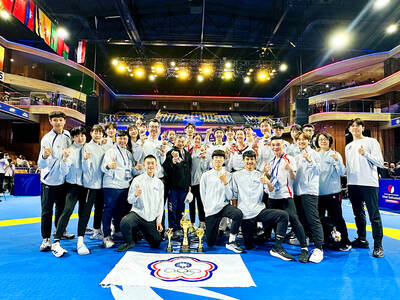
VICTORY ABROAD: The team took home a fistful of medals and secured spots for the autumn’s Asian Games, scheduled for September in Nagoya Taiwan’s women’s team captured the overall title at the Asian Taekwondo Championships in Mongolia on Sunday, finishing with two golds, one silver and one bronze medal. The strong showing, led by gold medalists Wang Chieh-ling and Chang Jui-en secured the full quota of available spots for Taiwan at the Asian Games in Nagoya, Japan, in September. Wang opened Taiwan’s medal run by winning gold in the women’s under-46kg class on Thursday, the first day of competition. Liu Yu-yun later earned a silver in the under-49kg class. On the final day on Sunday, Chang won Taiwan’s second gold medal in the under-62kg event, and

The manager of the Yomiuri Giants, one of Japan’s most popular baseball teams, resigned yesterday after he was arrested for allegedly physically attacking his teenage daughter. Shinnosuke Abe allegedly grabbed the 18-year-old and forced her to the floor at their home in central Tokyo on Monday evening, reported national broadcaster NHK and Kyodo News, citing unnamed police sources. “Leaving like this really means I’m causing you a lot of trouble, and I feel truly sorry about that,” Abe told a hastily arranged news conference, his eyes red with tears. The former star catcher, who is among baseball-obsessed Japan’s most recognized sports figures,


 RSS
RSS