


Kenyan athletes might have shone at the World Athletics Championships in Tokyo last week, winning seven golds, but persistent allegations of doping still cast a shadow as the global anti-doping agency threatens to sanction the east African country.
The warning is anything but trivial for a nation whose runners embody Kenyans’ hopes for lifting families out of poverty, a desperate desire that can drive some over the line.
Over the years, and following numerous scandals, Kenya has repeatedly promised and invested millions to clear up the issue — but it remains high up on the World Anti-Doping Agency (WADA) watchlist.
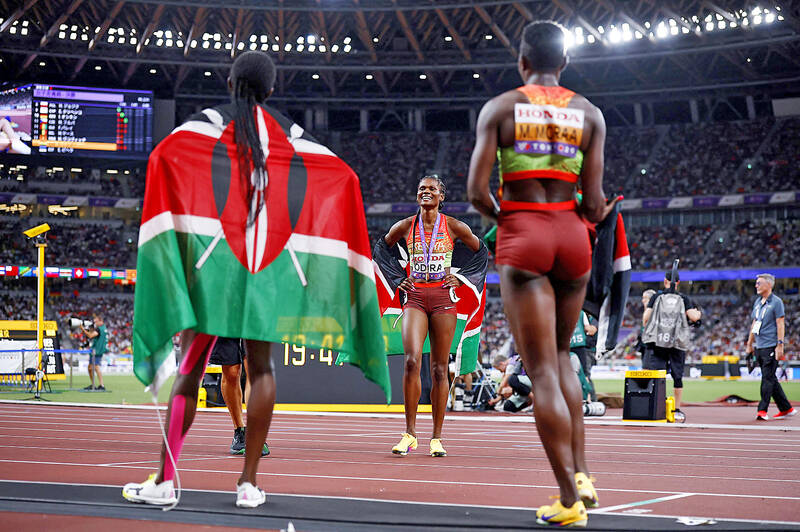
Photo: Reuters
“Most of our athletes are running to escape poverty and support their families, and they, as a result, will use all manner of things, including doping,” said Kenya’s three-time Boston Marathon winner Ibrahim Hussein Kipkemtboi.
“Winning is a lifetime chance,” he said.
About 140 Kenyan athletes, mainly long-distance runners, have been suspended by the Athletics Integrity Unit (AIU) since 2017 — more than any other nation.
Among them are figures such as 2016 Olympic marathon champion Jemima Sumgong, marathon world record holder Ruth Chepngetich — provisionally suspended in July by the AIU after testing positive for a diuretic — and Benard Kibet Koech, fifth in the 10,000m at the Paris Olympics, who the AIU suspended in June.
“This thing has got out of hand, and we are not doing enough,” Kenyan sports journalist Peter Njenga said, describing the situation as “an emergency.”
“Doping needs to be fought the same way Kenya campaigned against HIV,” he said.
Earlier this month, just before the start of the world championships, WADA threatened to sanction the Anti-Doping Agency of Kenya (ADAK) for non-compliance, giving the country three weeks to comply with international codes.
Should WADA make good on its warning, Kenyan athletes could be banned from international competition.
“There’s a big danger that we may not host any event until the recommendations are fully met,” Barnaba Korir, a member of the executive committee of Athletics Kenya said, describing the warning simply as “bad news.”
The country’s potential bids for the 2029 or 2031 world athletics championships would fail, Korir said.
The Kenyan government has promised to act, investing about US$25 million over five years to combat the problem.
The ADAK — created in 2016, under pressure from the International Olympic Committee — pointed to its increased out-of-competition tests, from 400 to 4,000 annually, as an example.
However, Kenya remains on WADA’s watchlist.
“We are very happy with our work in testing, education and creating awareness that in the last three years no Kenyan athlete has been returned home from the Olympic and world championships for failing a test,” ADAK acting director Peninah Wahome said.
Her agency, in partnership with the Kenyan Ministry of Sports, Culture and Heritage, is working “very hard” to follow WADA’s recommendations, she said.
However, while the ADAK has seen some progress over the past few years, the country’s level of compliance with international standards remains “not good enough,” AIU head Brett Clothier said.
“We need the anti-doping agency to be at the same elite level as the athletes,” he told reporters in Tokyo.
At the world championships in Tokyo, Kenya finished in second place behind the US in the overall standings — with seven golds, two silvers and two bronzes. Women dominated the haul.
“The question we should be asking is: Is it the training, doping or the attitude of the athletes that’s causing this,” Njenga said. “Doping has eaten into the roots of Kenyan athletics.”

NO HARD FEELINGS: Taiwan’s Lin Hsiang-ti and Indonesia’s Dhinda Amartya Pratiwi embraced after fighting to a tense and rare 30-29 final game in their Uber Cup match The Taiwanese men’s team on Wednesday fought back from the brink of elimination to defeat Denmark in Group C and advance to the quarter-finals of the Thomas Cup, while the women’s team were to face South Korea after press time last night in the Uber Cup quarter-finals in Horsens, Denmark. In the first match, Taiwan’s top shuttler Chou Tien-chen faced a familiar opponent in world No. 3 Anders Antonsen. It was their 16th head-to-head matchup, with the Dane taking his fourth victory in a row against former world No. 2 Chou, winning 21-14, 13-21, 21-15 in 1 hour, 22 minutes. The

Jannik Sinner continued his quest to become the first man in history to win five Masters 1000 tournaments in a row with a 6-2, 6-3 victory over Danish qualifier Elmer Moller at the Madrid Open on Sunday. The world leader extended his winning streak to 19 matches, a run that began early March in Indian Wells, and he has captured 24 consecutive victories at the Masters 1000 level, dating back to the Paris Masters last October. Searching for a maiden title at this level on clay, Sinner advanced to the round of 16 at the Caja Magica with a 77-minute performance against

When Paddy Dwyer arrived in China in 1976, crowds jostled to catch a glimpse of him and his companions — the first Western soccer team to play in the country. China was emerging from the chaos of the Cultural Revolution, and on the brink of market reforms that would take the country from economic stagnation to explosive growth. “All we could see was lines of people running beside our bus, trying to look in the windows, to see their first visual of a white person,” he said. “It was all bicycles,” he said. “There were very few cars to be seen.” Dwyer,

Tennis players are facing an unexpected opponent at the Madrid Open. A stomach virus or food poisoning has affected Iga Swiatek, Coco Gauff, Marin Cilic and others, raising concerns. World No. 1 Aryna Sabalenka avoided an upset by Naomi Osaka on the court on Monday and said she is trying to avoid illness by sticking to a diet of chicken breasts, rice and salad. The rumor among the players was bad shrimp tacos were to blame. Sabalenka knocked on wood for luck and said, “So far, so good. I heard that I have to avoid those tacos,” she laughed, adding “I stick to the


 RSS
RSS