


A buzz of excitement crackled through the hushed arena as the rider gripped the reins of her stuffed steed.
Welcome to the strangely exacting world of hobby-horsing, the Finnish sport guaranteed to put a smile on your face.
Immaculately coiffed equestrians leap athletically over fences just like in horse jumping, going as fast as they can against the clock straddling their stick steeds.
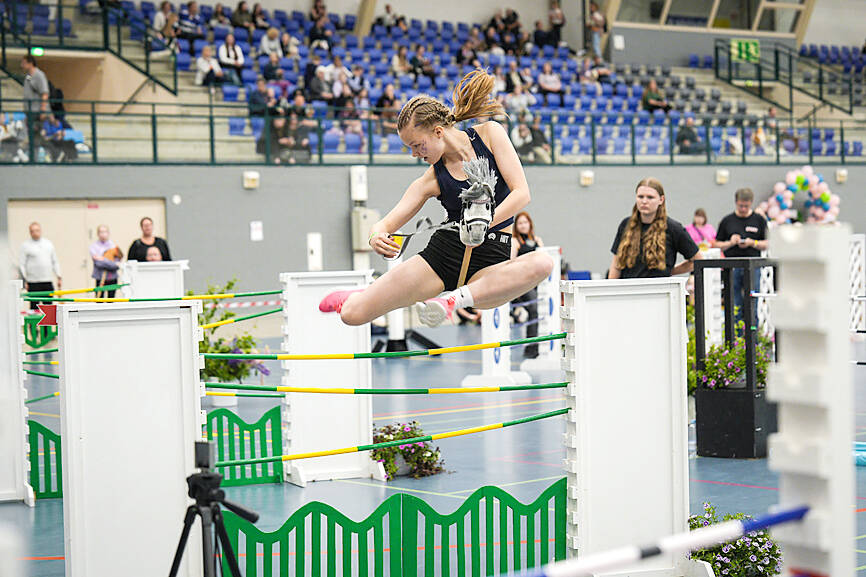
Photo: AFP
Things are more stately in the dressage, with riders trotting their stick horses with intricately decorated stuffed heads before the discerning eyes of the judges.
About 260 riders from 22 countries — most women and girls aged 10 to 20 — turned up to compete at the 11th annual Finnish Hobbyhorse Championships in Seinajoki.
Despite its vast international reach, from the arctic to Argentina, hobby-horsing is a sport that dares not speak its name.
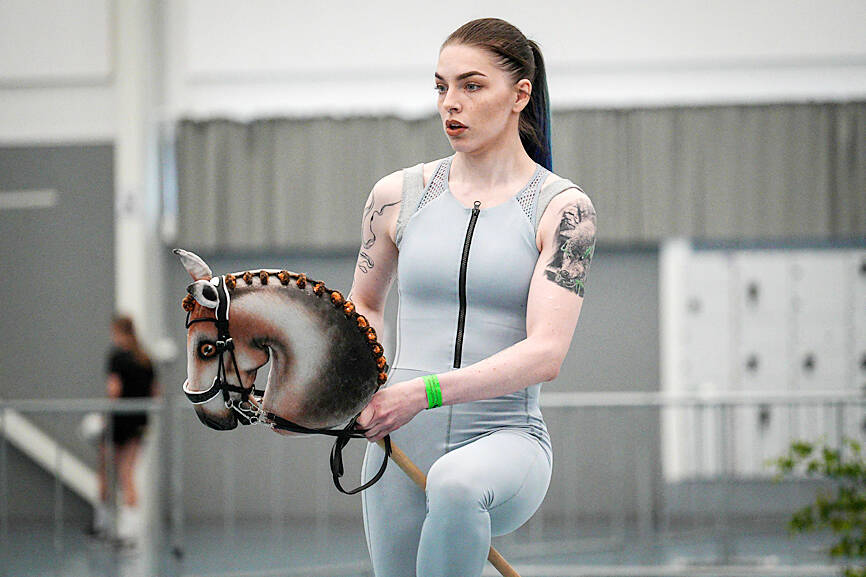
Photo: AFP
Despite its soaring popularity, it is not officially recognized as a proper sport in its birthplace.
“We have faced so much bullying and judgement,” rider Nara Arlin, 24, said. “We know what everyone in the hobby-horsing has been through... I think that is the main thing that pulls us together.”
First invented in Finland more than a decade ago, hobby-horsing has taken off at a gallop across the globe.
“It is growing every year,” said Julia Mikkonen, the chair of the Finnish Hobbyhorse Association.
This year’s championship was “the biggest we have had so far,” she said.
Beyond the whimsy, great strength and skill are required to jump the obstacles while holding the hobbyhorse.
Some top competitors could give elite hurdlers or gymnasts a run for their money.
“If you jump over obstacles your hip mobility has to be absolutely insane,” Mikkonen, 20, said.
Some fences are up to 110cm tall.
“Of course we are all dreaming of having a world championship one day,” said Mikkonen, who estimates there are about 10,000 hobby-horsers globally.
“I am still a bit breathless, but I am happy with my performance,” 19-year-old Jojo Hanninen said, as she sat down after her dressage event.
To succeed in the sport you have to channel your inner centaur, she said.
“In hobby-horsing, my legs are the horse... I am both horse and human,” she said.
Hanninen’s hobbyhorse is a gray called Toope, with glittery reins and pink ribbons adorning its white mane.
Competitors go to great lengths with their horses — which are also exhibited and judged — modeling and sewing the heads and adorning them with decorations.
“Hobbyhorses are art,” said Arlin, who makes her own.
With the cheers of the crowd still ringing in her ears after an impressive show jumping round, she hailed the sport as “the best hobby ever.”
“You are doing so many things with your hands, brain and the whole body,” she said.
Like many of her peers, Arlin found hobby-horsing through play as a child.
“But the older I became, it became more serious,” said the rider, who trains by riding real horses, working out in the gym and doing pole dancing.”
Rainbow flags in the arena reflected the tolerant values underpinning the community.
“Horses are mostly seen as a girls’ sport, but that is not correct. Anyone can come no matter what gender,” Mikkonen said.
Enthusiast praise the welcoming community that kept them devoted to hobby-horsing, despite the scornful attitudes they encountered at some point.
“We have each other’s backs,” Arlin said.

Greek swimmer Kristian Gkolomeev was the only athlete to “beat” a world record on Sunday at the Enhanced Games, winning the men’s 50m freestyle at the divisive competition where athletes were free to take performance-enhancing substances. His time of 20.81 seconds — which is not considered official — came in the final event of the night in Las Vegas, sparing the blushes of organizers who made claims that multiple world records would be surpassed due to a sophisticated doping regime. Gkolomeev, who was wearing a synthetic “supersuit” long banned at events such as the Olympics, outpaced Australia’s Cameron McEvoy’s 20.88 set in

Fred Kerley is competing unaugmented against drug-fuelled athletes at this weekend’s Enhanced Games and still hopes to race in the 2028 Olympics, the suspended former 100m world champion said on Friday. Arguably the biggest name at the divisive event in Las Vegas, where doping is permitted, the US sprinter said he had chosen not to take any of the banned substances including testosterone and steroids that his competitors have been using. “I don’t need it. God gave me fast feet for a reason. And I’m here to showcase my talent,” Kerley said. Kerley last September became the first US competitor and first track

The manager of the Yomiuri Giants, one of Japan’s most popular baseball teams, resigned yesterday after he was arrested for allegedly physically attacking his teenage daughter. Shinnosuke Abe allegedly grabbed the 18-year-old and forced her to the floor at their home in central Tokyo on Monday evening, reported national broadcaster NHK and Kyodo News, citing unnamed police sources. “Leaving like this really means I’m causing you a lot of trouble, and I feel truly sorry about that,” Abe told a hastily arranged news conference, his eyes red with tears. The former star catcher, who is among baseball-obsessed Japan’s most recognized sports figures,
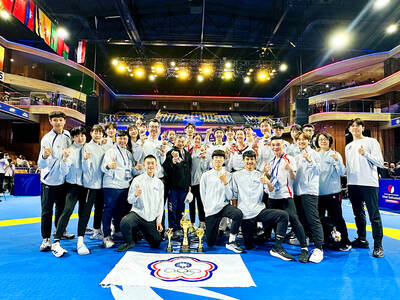
VICTORY ABROAD: The team took home a fistful of medals and secured spots for the autumn’s Asian Games, scheduled for September in Nagoya Taiwan’s women’s team captured the overall title at the Asian Taekwondo Championships in Mongolia on Sunday, finishing with two golds, one silver and one bronze medal. The strong showing, led by gold medalists Wang Chieh-ling and Chang Jui-en secured the full quota of available spots for Taiwan at the Asian Games in Nagoya, Japan, in September. Wang opened Taiwan’s medal run by winning gold in the women’s under-46kg class on Thursday, the first day of competition. Liu Yu-yun later earned a silver in the under-49kg class. On the final day on Sunday, Chang won Taiwan’s second gold medal in the under-62kg event, and


 RSS
RSS