


Indonesian gymnast Rifda Irfanaluthfi’s palms are covered in chalk as she swings between two uneven bars during intensive training just weeks before she makes history at the Paris Olympics.
The 24-year-old is the first Indonesian gymnast to qualify for the Olympics, let alone the first woman, and her mind is set on reaching Paris fully fit so she can etch her name into gymnastics legend at home.
“There is a feeling of excitement. I hope that by qualifying for the Olympics, the world will get to know Indonesia better,” she said. “I am also feeling worried because of injuries, it made me have insomnia for the last five days.”

Photo: AFP
Her feat is even more impressive considering Indonesia does not yet have a national training center for gymnastics and that conservative Indonesian society, including its top sports, remains dominated by men.
The archipelago’s enthusiasm is largely focused on football and badminton, the latter the only sport in which it has won Olympic gold.
So talent alone was not enough for Rifda to make it as a gymnast. A level of dedication to overcome a series of hurdles, including a lack of support, was also required.
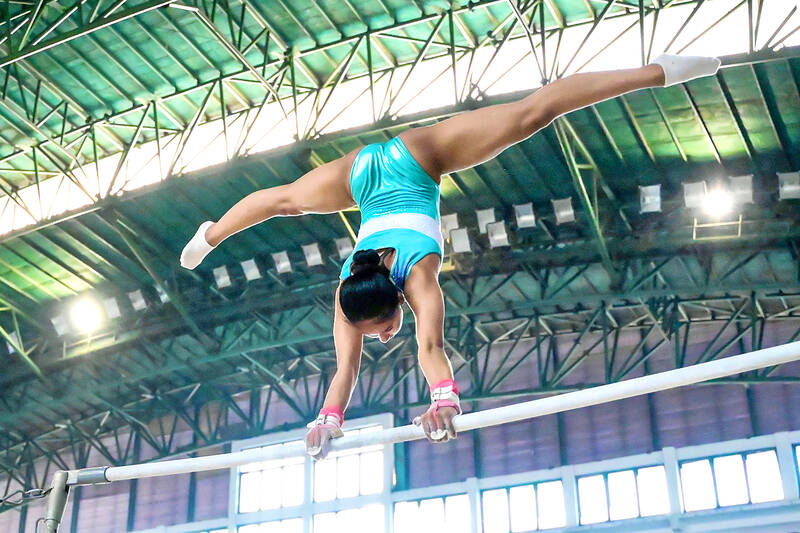
Photo: AFP
“I continue to practice, and I prove that with limited facilities I can be a successful athlete,” she said. “People still underestimated us.”
Rifda’s family had struggled to find a school that would recognize and support something unknown to them such as gymnastics.
Her luck changed when she was admitted to an athletes’ school in Jakarta that took her one step closer to her Olympic dream.
Rifda started swimming as a child before trying her hand at diving, sport climbing, rhythmic gymnastics and artistic gymnastics.
Her mother, Yulies Andriana, said Rifda attracted attention as a talented gymnast and won her first medal at a junior championship in Singapore as an eight-year-old.
Rifda qualified for the Olympics at the World Artistic Gymnastics Championships in Belgium last year, with an all-round performance on the vault, floor, uneven bars and balance beam.
“Her desire to be a champion is amazing,” Yulies said.
Rifda hopes her Olympic exploits can inspire other young Indonesians to follow their dreams, competing against gymnastic juggernauts such as the US and nations from the former Soviet Union.
“Maybe athletes of my age who have never qualified for the Olympics will become passionate to dream higher,” she said.
The sport is set to grow in Indonesia after it was handed the hosting rights to the World Gymnastics Championships for the first time next year, although it still has a long way to go.
“Gymnastics needs to be improved comprehensively,” Indonesian National Olympic Committee chairman Raja Sapta Oktohari said.
However, he said that “the opportunity for women is pretty big” now as the sport gains more attention.
Indonesia’s Olympic medal tally is slight but has been influenced by women who came before Rifda.
Its first medal was a silver at Seoul 1988 by a team of female archers, and two of its eight badminton golds were won by a female shuttler at Barcelona 1992 and a women’s doubles pair at Tokyo 2020.
Indonesia’s new gymnastics queen hopes to join that special list, but she still needs therapy for her injured knee.
She wants to recover in time to perform well in Paris despite that setback, make the history books and then return home for a well-deserved sweet treat.
“Ice cream, strawberry flavor,” she said with a smile.


“I don’t remember the moment, but ever since I was a kid, that’s the first thing I loved,” two-time NBA All-Star Isaiah Thomas said of his lifelong romance with basketball. However, that journey unfolded against the limitations of his size in a game where height often dictates opportunity — a reality he confronted throughout his career. At 175cm, Thomas is less than 2cm taller than the average Taiwanese adult male, while NBA players during his career stood at about 200cm on average. Compared with the NBA’s average career length of less than five years, Thomas’ 13-season career stands out as

Dakar and Rabat have longstanding ties, but relations have been strained since the Africa Cup of Nations (AFCON) final, which Senegal won in mid-January before being stripped of the title, which was transferred to Morocco. Now, the AFCON trophy is something of a thorn in the two countries’ sides. On Rue Mohamed V, the street where Moroccan vendors are based in the Senegalese capital, a police van is parked. “The police have been on high alert since the Confederation of African Football [CAF] decided to award the title to Morocco, but there have been no incidents,” a local resident said.

Top seeded Jessica Pegula on Friday once again fought back from a set down to reach the WTA Charleston Open semi-finals with a 3-6, 6-3, 6-2 win against Russia’s Diana Shnaider. Defending champion Pegula has lost the first set in all three of her matches at the tournament so far, but again dug deep to maintain her hopes of retaining the title. The world No. 5 from the US took 2 hours, 10 minutes to defeat 19th-ranked Shnaider, relying on a formidable service game that included eight aces. Shnaider battled well in the first two sets and broke early for a 2-0 lead

Cambridge on Saturday made it four wins in a row as they comprehensively defeated Oxford in the 171st University Boat Race on London’s River Thames. It was Cambridge’s seventh win in the past eight years of a rowing race between England’s two oldest universities first staged in 1829. A world-class Cambridge crew were heavy favorites for victory. However, four minutes into the race, the crews came close to a clash of oars which could have caused severe disruption, with Oxford repeatedly warned as both team chased faster conditions in the middle of the river. For the first time in the


 RSS
RSS