


Brazil’s Filipe Toledo and Caroline Marks of the US are looking to defend their crowns when surfing’s world championship tour begins in Hawaii this week, with the Paris Olympics in the pristine tubes of Tahiti also looming for top contenders.
The nine-stop tour is to start with a bang at Pipeline, where the powerful waves and shallow reef have often intimidated and occasionally injured some of the world’s top surfers.
“That’s like the arena of all arenas. If you can perform at Pipeline ... the respect and admiration you get from your peers, that’s what you want to achieve,” Olympic gold medalist and five-time world champion Carissa Moore said.

Photo: AFP
However, while this year’s tour has much to look forward to, including a crop of talented newcomers and the return of Fiji to the list of venues, some absent stars, criticism over competition changes and the lack of a permanent leader for the governing World Surf League (WSL) has prompted questions about where the professional sport is heading.
Moore this month announced that she was taking a break from competitive surfing after the Pipeline contest, but would still surf in the Olympics.
Days later, Australia’s eight-time world champion Stephanie Gilmore said she was taking a year off the tour to refresh herself and surf some new places.
“I’m still passionate and dedicated to competing, and I have goals and dreams that I’m still chasing — I’m excited for something fresh this year and I look forward to returning to competition in 2025,” Gilmore wrote on Instagram.
Surf historian Matt Warshaw said that while the WSL had done some good things, including introducing equal pay for women and improving the quality of its broadcasts, a number of missteps around formats, judging and venues had alienated many fans.
“It has gotten to the point where it’s harder and harder to laugh it off or ignore it,” Warshaw said. “People are sitting here waiting for whatever the next iteration of what the pro tour is going to be.”
Holding the one-day finals event for three years running in the gentle waves of Trestles in Southern California — where Toledo is almost unbeatable — rather than a wave of consequence like Pipeline, was the biggest “stick in the eye” for surf fans, he said.
“Continuing to keep deciding the world title at the same, B-grade surf break that is below what these surfers deserve ... gosh, there’s nothing to recommend that,” he said. “You want to decide the title in waves that are challenging for the surfers.”
The WSL said that the finals day at Trestles last year was the most watched day in professional surfing history with more than 10.7 million views, but it recognized that there was an ongoing debate about the format among fans and it welcomed the passionate discussions.
“We are committed to delivering an exciting and compelling experience for fans, while simultaneously cultivating a competitive and sustainable platform for our athletes,” it said.
The governing body, owned by billionaire Dirk Ziff and his wife, Natasha, for more than a decade, has been without a permanent chief executive officer since Erik Logan departed without explanation during an event in Brazil in June.
The search for a new CEO was ongoing, the WSL said.
Deciding an Olympic surfing champion this year is likely to be a different proposition than the WSL Finals at Trestles.
The heaving barrels of Teahupo’o in Tahiti, where the Olympic event it wo be held, are regarded as among the most dangerous and technically difficult in the world.
Favorites for the events are the top-flight WSL surfers, such as tube-riding experts like Hawaii’s John John Florence, and Australians Jack Robinson and Molly Picklum, while local Tahitian qualifiers Vahine Fierro and Kauli Vaast are also likely to be among those in the medal hunt.


Freddie Freeman homered and drove in four runs, Shohei Ohtani also went deep and Roki Sasaki earned his first major league win as the Los Angeles Dodgers beat the Atlanta Braves 10-3 on Saturday night for their seventh straight victory. The Dodgers have won the first two games of the series to improve to 5-0 against Atlanta this year. Los Angeles’ three-game sweep at home early in the season left the Braves 0-7. Sasaki allowed three runs and six hits over five innings. The 23-year-old right-hander gave up a home run to Ozzie Albies, but received plenty of offensive support in his
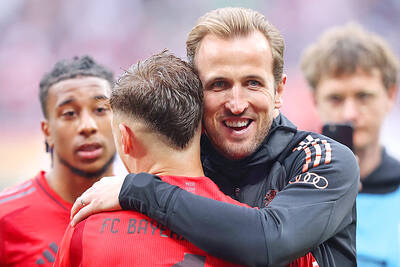
Bayern Munich on Sunday were crowned German champions for the 34th time, giving striker Harry Kane his first major trophy, after second-placed Bayer 04 Leverkusen drew 2-2 at SC Freiburg. Bayern’s 3-3 draw at RB Leipzig on Saturday, when the Bavarians came from two goals down to take the lead before conceding a stoppage-time equalizer, meant defending Bundesliga champions Leverkusen needed to win at Freiburg to delay the title party. Leverkusen were two goals down before scoring twice in the final 10 minutes, but Xabi Alonso’s side could not find a third, as Bayern reclaimed the title at the first attempt after
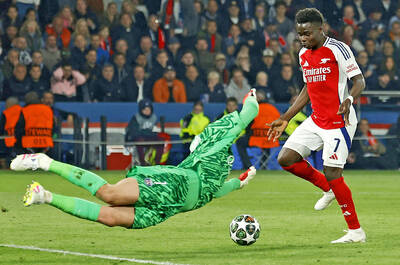
INTER AWAIT: Superb saves by PSG ’keeper Gianluigi Donnarumma inspired the victory, as Arsenal were punished for misses, including one by Bukayo Saka Arsenal on Wednesday fell short on the big stage again as their painful UEFA Champions League semi-final exit against Paris Saint-Germain left Mikel Arteta to rue his club’s failure to provide him with enough attacking options. Arteta’s side were unable to reach the Champions League final for the first time in 19 years as PSG clinched a tense 2-1 win at Parc des Princes. Trailing 1-0 from last week’s first leg in London, the Gunners made a blistering start to the second leg, but could not convert their chances as Gianluigi Donnarumma’s superb saves inspired PSG’s 3-1 aggregate victory. Arsenal were punished for
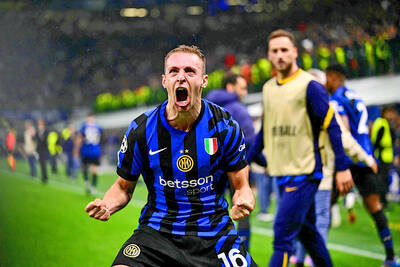
THRILLER: Raphinha gave Barca a 3-2 lead with two minutes remaining of regular time, but Francesco Acerbi equalized the game in the second minute of added time Davide Frattesi on Tuesday fired Inter into the UEFA Champions League final with an extra-time winner that gave the Italians a stunning 4-3 triumph over Barcelona, 7-6 on aggregate. Italy midfielder Frattesi won a tie for the ages under a downpour in Milan when he lashed home in the 99th minute, sending a packed and rocking San Siro wild with joy. Simone Inzaghi’s team will face either Arsenal or Paris Saint-Germain at the end of this month in Munich, Germany, where they would feel they have a great chance to be crowned kings of Europe for a fourth time after


 RSS
RSS