


Tokyo’s well-kept streets might not be the most obvious place to do it, but competitive litter-hunters yesterday sifted through the Japanese capital in their first world championship.
The Spogomi World Cup featured 21 countries battling it out to collect the most trash within a set time limit, scouring the streets in search of plastic, cigarette butts and other trash.
Spogomi founder Kenichi Mamitsuka started to pick up litter on his morning runs and realized that setting targets could turn it into a fun activity.
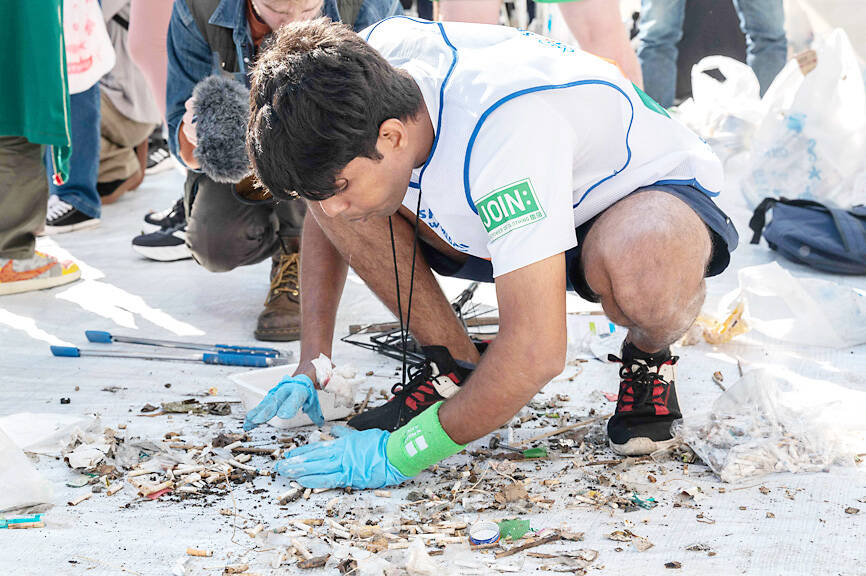
Photo: AFP
He organized his first competition 15 years ago, taking the title from the words “sport” and “gomi” — Japanese for garbage.
He said watching the event’s maiden world championship was “like a dream,” but he optimistically believes it can grow to an even bigger scale.
“If you form national spogomi associations, my ambition is that it could become an Olympic demonstration event,” he said in front of a portion of the almost 550kg of trash collected by participants.
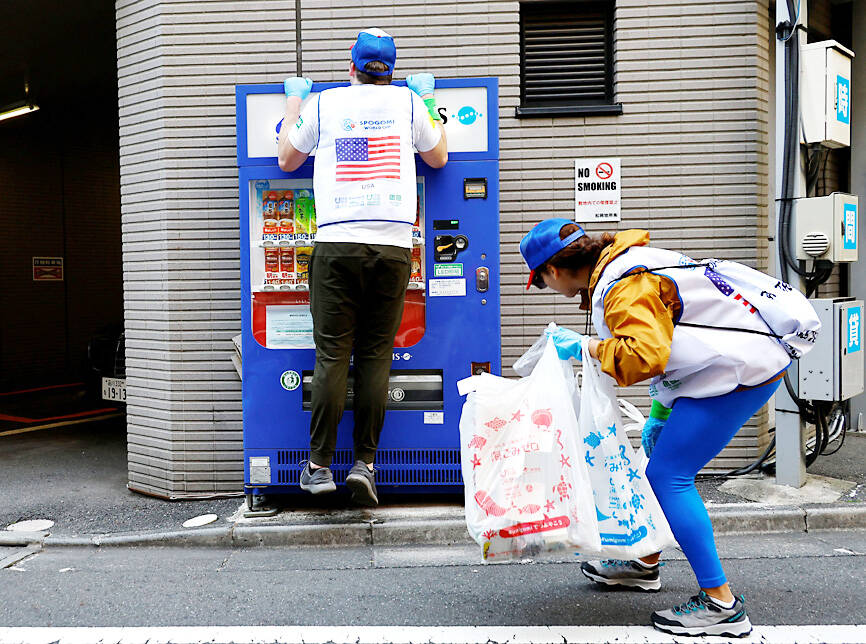
Photo: Reuters
Armed with gloves, metal tongs and plastic garbage bags, each team of three roamed an about 5km2 collection area in Tokyo’s bustling Shibuya District.
Running, ransacking existing trash bins and shadowing other teams were all forbidden, with each team followed by a referee to enforce the rules.
In the morning and afternoon sessions, they had 45 minutes to hunt out trash and another 20 to sort it into categories.

Photo: Reuters
Points were awarded based on volume and type, with small items such as cigarette ends scoring highly.
Australia’s Petrya Williams said that her team had “found some great spots that are like treasure maps.”
“I think we’ve got it for the next round, we know where to look,” she said, as she and her teammates waited to weigh their haul.
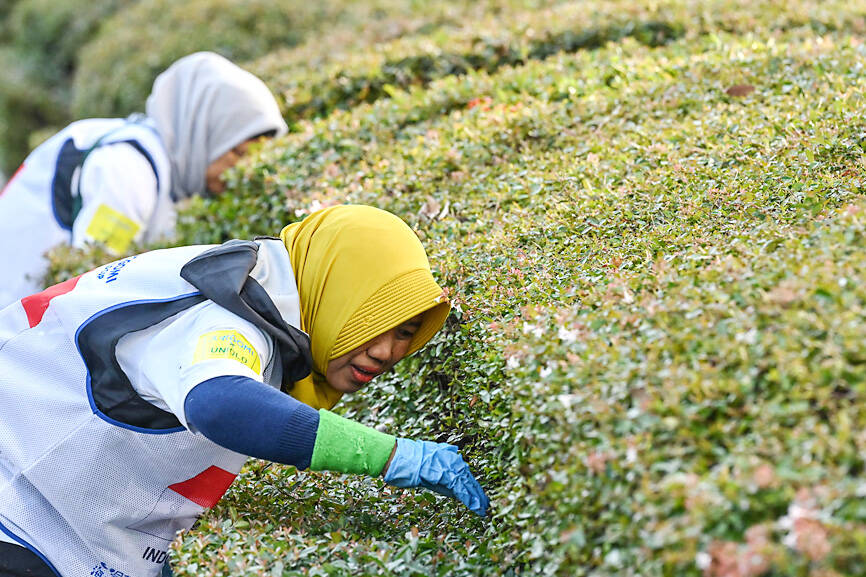
Photo: AFP
Each team had to earn the right to represent their country in Tokyo by winning national competitions.
Australia’s Jamie Gray said his team belonged to a meditation group and “cleanup is part of our philosophy.”
France’s team arrived with something of an advantage — all three members work in the refuse collection industry.
“We have a flair for it,” Usman Khan, 32, said.
At the end of the day, Britain were declared the winners after collecting 57kg of trash.
South Africa’s Philippe Louis de Froberville said Tokyo’s relatively clean streets made it “harder to find the rubbish than in the competition back home.”
However, he said he believes competitive collecting can “get really big,” and thinks schools are a good place to start.
“That’s where you’re going to get your people,” said the 33-year-old from Durban, who added that his passion for surfing and the ocean got him involved in collecting trash.
“If you start when you’re young, you’re going to want to do it when you’re older, and you’re going to want to look after your environment,” he said.
Mamitsuka said he believes changing the way people think about trash is key.
People thought he was “making fun of activities that contribute to society” at first, but then he began to hear stories about people getting involved and passing on good habits to their children, he said.
“It made me think that I should keep going,” he added. “Our target is to have spogomi events in 50 countries by 2030.”

NO HARD FEELINGS: Taiwan’s Lin Hsiang-ti and Indonesia’s Dhinda Amartya Pratiwi embraced after fighting to a tense and rare 30-29 final game in their Uber Cup match The Taiwanese men’s team on Wednesday fought back from the brink of elimination to defeat Denmark in Group C and advance to the quarter-finals of the Thomas Cup, while the women’s team were to face South Korea after press time last night in the Uber Cup quarter-finals in Horsens, Denmark. In the first match, Taiwan’s top shuttler Chou Tien-chen faced a familiar opponent in world No. 3 Anders Antonsen. It was their 16th head-to-head matchup, with the Dane taking his fourth victory in a row against former world No. 2 Chou, winning 21-14, 13-21, 21-15 in 1 hour, 22 minutes. The

Jannik Sinner continued his quest to become the first man in history to win five Masters 1000 tournaments in a row with a 6-2, 6-3 victory over Danish qualifier Elmer Moller at the Madrid Open on Sunday. The world leader extended his winning streak to 19 matches, a run that began early March in Indian Wells, and he has captured 24 consecutive victories at the Masters 1000 level, dating back to the Paris Masters last October. Searching for a maiden title at this level on clay, Sinner advanced to the round of 16 at the Caja Magica with a 77-minute performance against

Tennis players are facing an unexpected opponent at the Madrid Open. A stomach virus or food poisoning has affected Iga Swiatek, Coco Gauff, Marin Cilic and others, raising concerns. World No. 1 Aryna Sabalenka avoided an upset by Naomi Osaka on the court on Monday and said she is trying to avoid illness by sticking to a diet of chicken breasts, rice and salad. The rumor among the players was bad shrimp tacos were to blame. Sabalenka knocked on wood for luck and said, “So far, so good. I heard that I have to avoid those tacos,” she laughed, adding “I stick to the

Kite-surfing fabrics, car tires and shortened shoelaces helped Kenyan Sabastian Sawe and Adidas crack the two-hour marathon barrier. When Sawe on Sunday shattered one of athletics’ most elusive barriers in storming to victory at the London Marathon in 1 hour, 59 minutes, 30 seconds, it did not come from just physiology and grit, but from design choices drawn from far beyond the course. Sawe debuted Adidas’ lightest-ever racing shoe, the Adizero Adios Pro Evo 3. “It starts with the mentality of the athlete, the coach, and the team behind the product, which is: What can we do better? What is the 1 percent


 RSS
RSS