


China hopes to make a splash with the Asian Games, which officially open tomorrow, but nationwide excitement has been muted as the economy sputters and some question the cost of the sporting extravaganza.
Delayed a year by the COVID-19 pandemic, the quadrennial Games, kicking off in the eastern city of Hangzhou, will be China’s biggest sporting event in more than a decade, with more than 12,000 athletes from 45 nations competing in 40 sports.
Organizers this week expressed confidence in holding a “magnificent” Games, thanks to Chinese President Xi Jinping’s “important instructions” and great, broad-based efforts. Analysts agree the event would likely go smoothly, given China’s famously meticulous preparations.
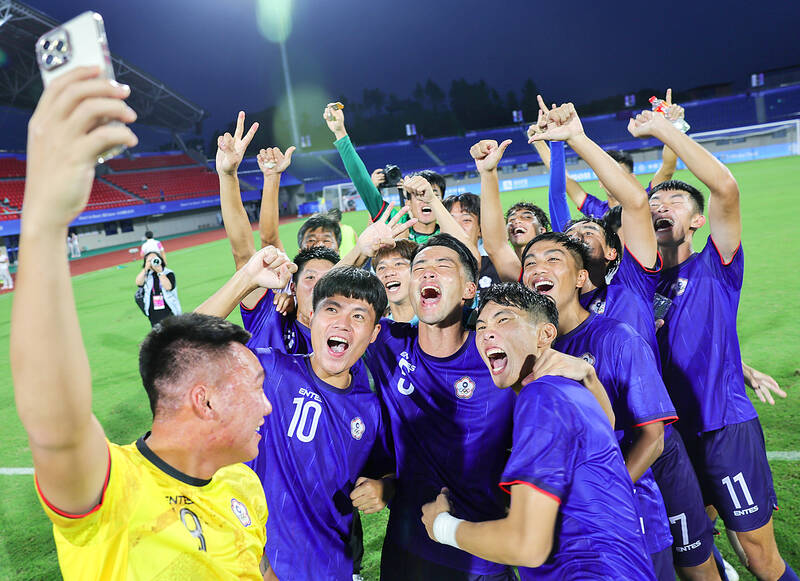
Photo: CNA
Local officials would be aware that Xi previously worked in Hangzhou, is known to like big sporting events and is to host a long list of leaders and other VIPs — including Syrian President Bashar al-Assad on only the second visit by a Syrian leader to China since the nations established diplomatic ties in 1956 — but enthusiasm in Hangzhou and elsewhere in China is lacking, with some saying the new stadiums and other gleaming facilities reflect misplaced priorities.
“After three years of COVID, the economic and social atmosphere in China and the confidence are really low, and for Hangzhou these Asian Games are just a cash-burning project,” said John Yan, founder of the Chinese media firm Score Sports and a leading soccer commentator in China.
“People care more about their own lives and the Asian Games are not on the top of their list of concerns,” Yan said. “People just don’t care.”

Photo: CNA
Organizers have not disclosed spending for the Games, though the Hangzhou government has said it spent more than 200 billion yuan (US$27 billion) in the five years through 2020 on transport infrastructure, stadiums, accommodation and other facilities.
“It would be better if this money were spent on the common people and on the youngsters,” said Jiang, 69, a Hangzhou resident who asked to be identified only by her surname. “It’s hard to find a job now. Some companies have closed down. It’s really not easy for young people nowadays.”
The expected flow of Chinese medals could lift the public mood around the Games. Various issues marred the buildups to Beijing Olympics in 2008 and last year, but “when the sporting action kicks off, then the narrative very much changes,” said Beijing-based commentator Mark Dreyer, author of a book on China’s sporting ambitions.
Still, in an indication of the subdued tone for the Asian Games, state media coverage until this week has been less comprehensive than before last year’s Olympics — which were much smaller than these Games and held under strict COVID-19 restrictions.
It is easy to be unaware of the Games, some Chinese social media users have written, unless you visit Hangzhou, where the slogans and other promotion are overwhelming.
The city in the wealthy province of Zhejiang near China’s financial capital, Shanghai, known for its picturesque lake, greenery and tea plantations, has been transformed in a huge spruce-up akin to Beijing’s before the 2008 Olympics.
Hangzhou’s streets wear bright colors to match Games posters, pensioners have received English lessons and officials have adorned some older-looking or road-facing properties with flowers or other decorations.
“The impression I have is that over the past year, the entire city has been under construction,” said 42-year-old city-center resident Wu Lili, an e-commerce business owner. “There’s a saying online: ‘The Hangzhou city government, when encountering even a dog, wishes they could catch it and give it a fresh coat of paint.’”
Several residents said they were happy with the improved transport links and hoped for a boost to the local economy. Some saw the Games as a welcome sign of opening up to the world amid concerns Xi’s China was taking an inward, national security-focused shift.
“Over the past few years due to the pandemic, our entertainment activities and mental well-being have been suppressed for a long time, so we need such events to boost our confidence,” said a 24-year-old auto sector worker who asked to be identified only as Zhang.
Jules Boycoff, an academic who studies the politics of sport at Pacific University in Oregon, said that for China’s authorities, “it’s about registering power at home, but it’s also about putting your best foot forward to a global audience at a time when there’s a lot of skepticism in the West toward China.”
Taiwan yesterday bounced back from their 2-0 defeat to North Korea on Tuesday to defeat Indonesia 1-0 in Group F of the men’s soccer tournament.
Chin Wen-yen scored two minutes after halftime and the team held on for their first Asian Games victory in 65 years.
In the first round of the women’s soccer tournament later yesterday, Taiwan came from behind to beat India 2-1 in Group B.
In Pool D of the preliminary round of the men’s volleyball, Taiwan defeated Mongolia 25-22, 25-20, 25-21.
Additonal reporting by staff writer
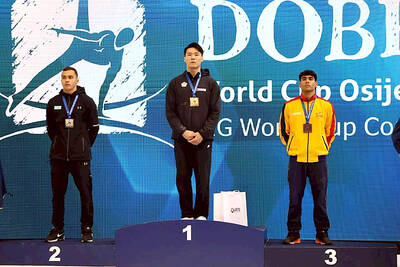
Taiwanese gymnast Tang Chia-hung on Sunday topped the men’s horizontal bar event at the International Gymnastics Federation (FIG) World Cup in Osijek, Croatia, scoring 15.233 to take his third title this season. Tang delivered an outstanding performance in the final, earning a difficulty score of 6.500 and an execution score of 8.633 with a 0.1 stick bonus. His closest competitor was Milad Karimi of Kazakhstan, who finished second with 14.933 points. It was Tang’s third gold medal in the FIG World Cup series this year, following his horizontal bar wins in Azerbaijan on March 8, and in Turkey on March

This year’s Taiwan Athletics Open, which offers Taiwanese athletes an opportunity to compete against their international peers, would be held under a new name after its organizers had earlier announced the event’s cancelation. In a statement issued yesterday, the Chinese Taipei Athletics Association said the competition would still take place on June 6-7 at Banciao Stadium, but under the name “New Taipei City Athletics Open 2026.” The event was given a new name to emphasize its local identity and conform with the international practice of naming World Athletics Tour events after cities, the association said. It said it would soon

Taiwan’s Lee Hao-yu on Friday went 0-for-3 in his MLB debut for the Detroit Tigers against the Boston Red Sox at Fenway Park, becoming the 19th Taiwan-born player to reach the big leagues. The Tigers ultimately lost 1-0 in 10 innings, ending their six-game winning streak. The 23-year-old started at third base and batted eighth for Detroit. He was promoted from Triple-A Toledo ahead of the four-game series against the Red Sox at the latter’s home stadium, replacing injured utility player Zach McKinstry. “Being right-handed, and given our schedule, I think six of the next 12 games are going to

Matheus Cunha on Saturday fired Manchester United toward the UEFA Champions League with a 1-0 win at Chelsea, while Tottenham Hotspur remain in the relegation zone after twice blowing the lead to draw with Brighton & Hove Albion. Chelsea failed to take advantage of a United defense ravaged by injury and suspension as a fourth straight league defeat for the Blues left their Champions League hopes in ruins. United have missed out on the riches of Europe’s elite competition for the past two seasons, but are closing in on a return thanks to an upturn in fortunes under interim manager


 RSS
RSS