


Dilma Mendes does not remember how many times she was arrested as a child. Her crime? Playing soccer in Brazil.
The nation might be synonymous with the beautiful game, but it banned women from the sport for nearly four decades until 1979.
Ahead of the FIFA Women’s World Cup starting next week in Australia and New Zealand, where Brazil will be in action, Mendes recalled the lengths she went to in order to fulfill her dream of becoming a soccer player.
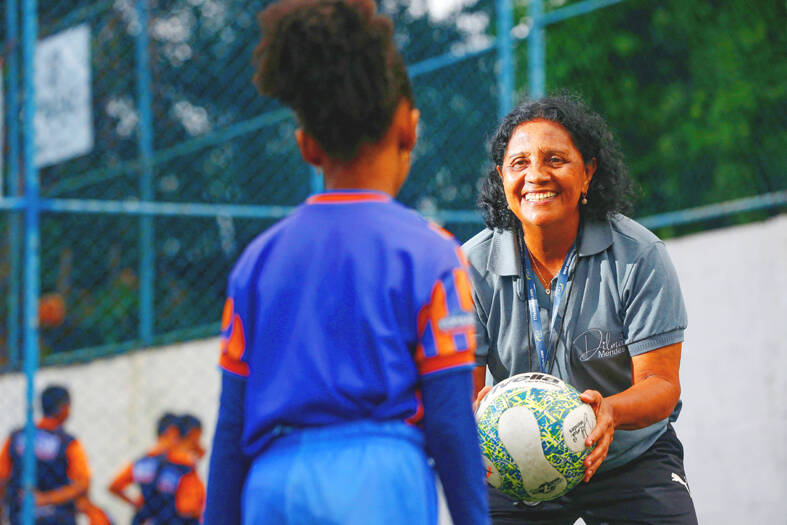
Photo: AFP
As a girl in the 1970s, she gave ice cream to the boys she played with in Camacari in Brazil’s impoverished northeast in exchange for an early warning of the arrival of police busting girls flouting the prohibition.
She used to dig a hole next to the pitch to hide in until the enforcers left, then crawled out again to continue kicking the ball around with her male friends.
When they let her, which was not always the case.
Sometimes all her precautions failed and Mendes found herself hauled off to a police station.
“When I was a child I thought the police stopped those who did something wrong, and I didn’t feel like I was doing anything wrong,” said Mendes, 59. “The cops treated me well, but some said I couldn’t play because football was for men.”
Then-Brazilian president Getulio Vargas promulgated a decree in 1941 to ban girls and women from soccer at a time many believed that participation in sport could inhibit childbearing ability.
The decree prohibited women from practicing “sports incompatible with the conditions of their nature.”
No specific sanctions were mentioned, leaving it open to individual police officers to decide how to deal with offenders.
Soccer associations elsewhere, such as in England, Germany and France, also barred women from the sport, but Brazil’s ban was the only one decreed by law. It remained in place until 1979.
While many like Mendes continued to play, the 38-year prohibition stunted development of the sport among Brazilian women during a period in which their male counterparts lifted three of their five World Cups.
The ban came at a socially conservative time when women were viewed as “maternal figures reserved for the domestic space” — a construct their presence on a sports field challenged head-on, Brazilian sports researcher Silvana Goellner said.
There are no records of women going to jail for contravening the decree, but they would be detained and only released after questioning.
Many “never stopped playing” despite the threat of arrest, said Goellner, who coauthored a book on the topic. “They created strategies to circumvent the law.”
Some dressed as men, others played at night or in places hidden from public view. When busted, they scattered in different directions to confuse their pursuers, but many were unable to evade a reckoning much closer to home — their families.
Mendes remembers sitting at a police station praying that her father — who supported her passion — would be the one to fetch her.
If it was her mother, she could count on a hiding for practicing a “men’s sport,” said the youngest of seven siblings — five of them boys.
“It was hard to arrive home and your mother and brothers beat you, and the next day you have to be ready to play again,” Mendes said. “I saw many friends leave football because of that cruel process.”
However, she never gave up, making a modest career in futsal — a variation of soccer played on a small court, often indoors — and in professional soccer when it was officially opened to women in Brazil in 1983 amid growing calls for equal rights.
After retiring as a player in 1995, Mendes moved into coaching and helped unearth Formiga, a legendary former midfielder for the Brazil women’s team.
She also coached Brazil’s women to victory in the seven-a-side world championship in 2019.
Brazil had “great players,” who never had a chance, Mendes said in hindsight of the “cruel” ban, which has also meant a very patchy historic record of women’s soccer in the South American nation, but things have changed, and now the Selecao are preparing to participate in their ninth Women’s World Cup.
They run out under veteran captain Marta, who has scored more World Cup goals (17) than any other player, man or woman.
Brazil’s best showing in the event, first staged in 1991, was in 2007 when they were beaten in the final by Germany.

Manchester United on Tuesday confirmed Michael Carrick as interim manager until the end of the season, tasking him with leading the Red Devils back into the UEFA Champions League. “Having the responsibility to lead Manchester United is an honor,” said Carrick, 44, who won 12 major trophies in his 12-year playing career at United. The former midfielder previously had an unbeaten three-game stint as caretaker boss at Old Trafford in 2021. Carrick then took on his first permanent managerial role at second-tier Middlesbrough in October 2022 and was sacked in June last year after the club finished 10th in the
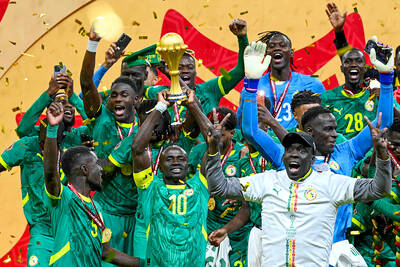
MARRED FINAL: As most of Senegalese players walked off the pitch after a controversial decision, some supporters threw objects and attempted to get onto the pitch Senegal on Sunday won the Africa Cup of Nations (AFCON) as Pape Gueye’s extra-time winner sunk hosts Morocco 1-0 after a chaotic final that saw the eventual champions storm off the pitch late in the game. Brahim Diaz could have won the trophy for Morocco with a controversial spot-kick in the 24th minute of added time at the end of normal time as ugly scenes broke out in the stands. However, Senegal goalkeeper Edouard Mendy easily saved the weak attempted “Panenka” chip by the Real Madrid winger, who was clearly distracted by the long delay that followed the penalty award.

James Harden on Friday scored 31 points and came up big in overtime to help the Los Angeles Clippers erase a double-digit deficit on the way to a 121-117 NBA victory over the Toronto Raptors. Harden scored 16 points in the fourth quarter and overtime as the Clippers pushed their wining steak to five games despite the absence of star Kawhi Leonard with a sprained right ankle. The Clippers trailed by 11 entering the fourth quarter, but Harden drilled a pair of free-throws with 1:24 left in regulation to tie it and after misses from both teams, they went to

Dallas Mavericks rookie Cooper Flagg on Wednesday was ruled out for the second half of their 118-109 loss to the Denver Nuggets after the No. 1 pick sprained his left ankle in the first half. Flagg was called for a foul while defending against Peyton Watson and turned the ankle as he fell to the floor with 6 minutes, 1 second left in the second quarter. Flagg limped to the bench and continued to the locker room, but returned for the final 2 minutes, 35 seconds before the break. The 19-year-old did not come out for the second half before the announcement that


 RSS
RSS