


Being shot in both eyes and completely blinded did not stop Zion Ricks-Gaines from skateboarding. It made him want to do it even more.
“I still want to go pro, I still want to accomplish being a professional skateboarder,” the 19-year-old said as he readied a kickflip at a skate park in San Francisco.
He wants to share that enthusiasm with everyone he meets.
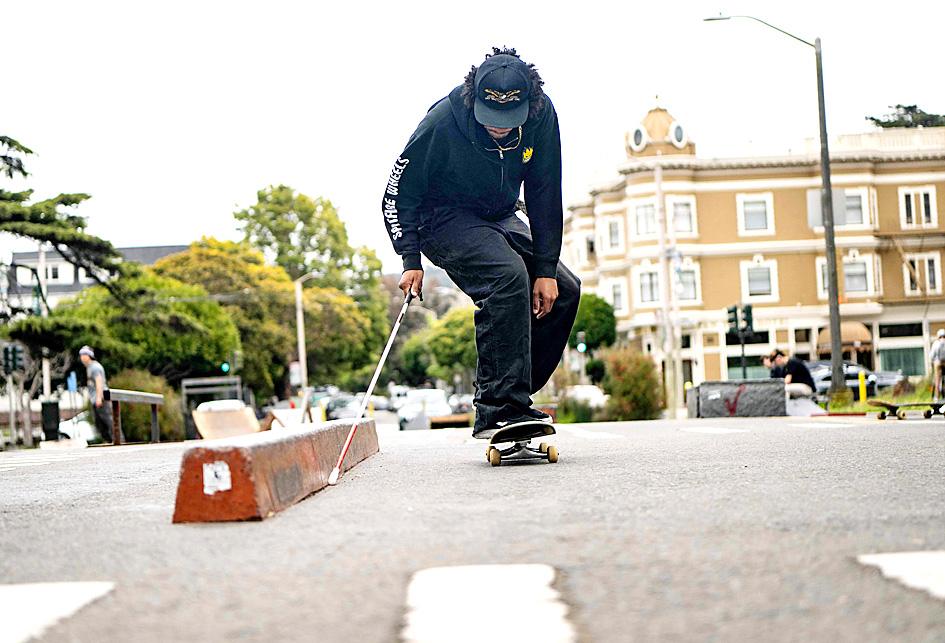
Photo: AFP
“I want to start more skate after-school programs for students. I feel like I wouldn’t have really looked in that direction if I had my sight,” he said.
Ricks-Gaines’ life was derailed outside a bar late last year when a man who had been drinking began shooting at him and his friends as they made their way home.
He was hit twice. One bullet destroyed his right eye; the other smashed the socket around his left, puncturing the eyeball and leaving it deflated and withered.
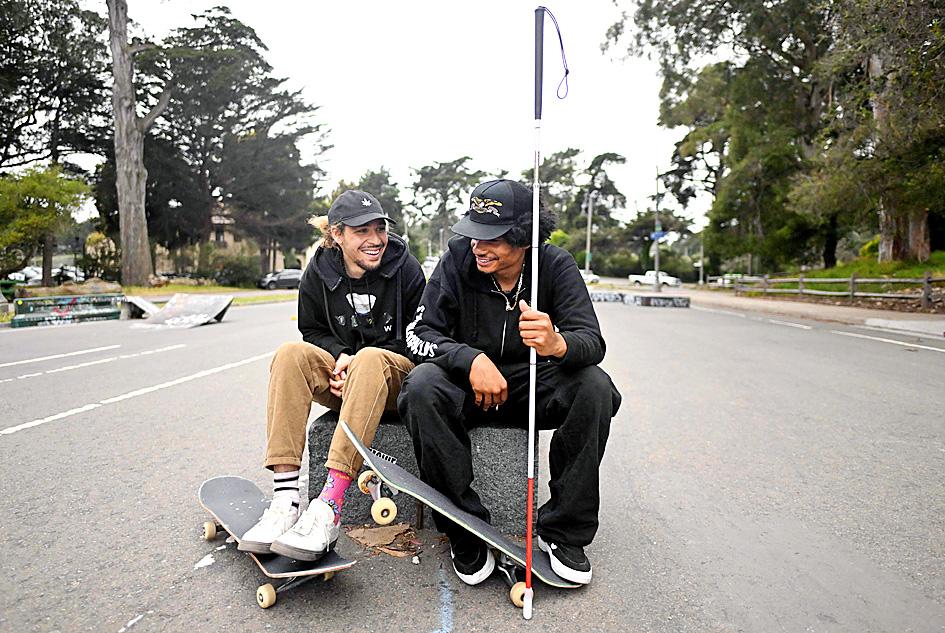
Photo: AFP
“It’s like night-sky purple ... with no stars,” he said of his vision.
After a long stretch in the hospital, he was fitted for a prosthetic eye.
Not content with a regular iris and pupil, he opted instead for an eye with the logo of his favorite skate brand, Spitfire, a grinning head of flames. He pops the prosthetic in and out of his socket on demand.
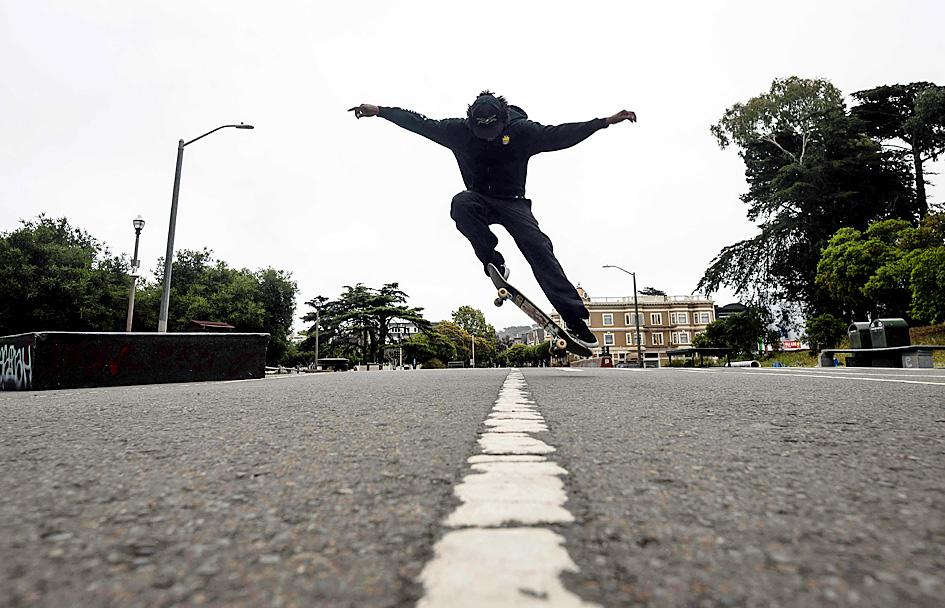
Photo: AFP
Soon he was back at the skate park, doing what he had been doing since he was 12.
“When I hopped on my skateboard, I felt like I had something to connect to my old life,” he said. “I felt a weight off my shoulders.”
Anyone who has spent time at a skate park will have marveled at the improbable feats of balance and daring on casual display.
Helmetless skaters race over wooden ramps, hurling themselves in the air as their board twists and pivots at their feet, before magically correcting itself to land right side up.
Metal rails offer almost 2m of board-sliding glory — or rib-shattering pain if it all goes wrong.
It is tricky, even in ideal circumstances, but harder if you cannot see the banks, ledges and curbs you are attempting, or even the board you are riding.
“When I approach a new obstacle, I usually feel it out with my cane, or ask friends what they see, how it’s set up, what should I try to look out for,” Ricks-Gaines said. “And I just work my way up and find what I’m most comfortable with.”
It helps that with seven years of skating, a lot of what his body needs to do is muscle memory, he said.
“If I want to land a trick, I know I can do it by committing and not being scared to fall,” he said.
He still falls.
“All the time,” he said, while laughing. “But that’s just a part of it. I fall now more than I used to, but it’s not from skating. I’ll try to skate a ledge, the grind won’t work and then I’ll pick my board up and start walking, and walk into the ledge and fall.”
Fellow skaters — who spray-painted a ramp with his name the day after he was shot — happily guide Ricks-Gaines through the park.
Dexter Lotz said that being blinded has made Ricks-Gaines an even better version of himself.
“He’s always been positive, but now he’s super positive,” said the 24-year-old, who has been a friend for six years.
“He seems like he got a second chance and he really needs to use it... He seems like he wants to share that with everybody around him,” he said. “It’s obviously unfortunate what happened, but what he’s doing is beautiful.”
With a criminal case against his alleged attacker under way, Ricks-Gaines shows no signs of bitterness toward the man who took his sight, focusing his anger instead on the gun violence that blights the US, and which claims tens of thousands of lives every year.
“I personally believe we don’t need guns,” he said. “I feel like we would be a way better society if we learn to do jujitsu or any style of fighting and handled it that way and put the guns down.”
He said that one day he wants to have children, and to be able to tell them about his experience, but what he tells them is never going to be negative.
“I could sit at home and just be sad because I have no vision, but that’s not gonna do shit for me, you know?” he said.
“I just appreciate everything I’ve got. Ninety percent of what you have is how you respond to it,” he added. “I feel like I really am so blessed to just be where I’m at in life.”

NO HARD FEELINGS: Taiwan’s Lin Hsiang-ti and Indonesia’s Dhinda Amartya Pratiwi embraced after fighting to a tense and rare 30-29 final game in their Uber Cup match The Taiwanese men’s team on Wednesday fought back from the brink of elimination to defeat Denmark in Group C and advance to the quarter-finals of the Thomas Cup, while the women’s team were to face South Korea after press time last night in the Uber Cup quarter-finals in Horsens, Denmark. In the first match, Taiwan’s top shuttler Chou Tien-chen faced a familiar opponent in world No. 3 Anders Antonsen. It was their 16th head-to-head matchup, with the Dane taking his fourth victory in a row against former world No. 2 Chou, winning 21-14, 13-21, 21-15 in 1 hour, 22 minutes. The

Jannik Sinner continued his quest to become the first man in history to win five Masters 1000 tournaments in a row with a 6-2, 6-3 victory over Danish qualifier Elmer Moller at the Madrid Open on Sunday. The world leader extended his winning streak to 19 matches, a run that began early March in Indian Wells, and he has captured 24 consecutive victories at the Masters 1000 level, dating back to the Paris Masters last October. Searching for a maiden title at this level on clay, Sinner advanced to the round of 16 at the Caja Magica with a 77-minute performance against
Tennis players are facing an unexpected opponent at the Madrid Open. A stomach virus or food poisoning has affected Iga Swiatek, Coco Gauff, Marin Cilic and others, raising concerns. World No. 1 Aryna Sabalenka avoided an upset by Naomi Osaka on the court on Monday and said she is trying to avoid illness by sticking to a diet of chicken breasts, rice and salad. The rumor among the players was bad shrimp tacos were to blame. Sabalenka knocked on wood for luck and said, “So far, so good. I heard that I have to avoid those tacos,” she laughed, adding “I stick to the
Kite-surfing fabrics, car tires and shortened shoelaces helped Kenyan Sabastian Sawe and Adidas crack the two-hour marathon barrier. When Sawe on Sunday shattered one of athletics’ most elusive barriers in storming to victory at the London Marathon in 1 hour, 59 minutes, 30 seconds, it did not come from just physiology and grit, but from design choices drawn from far beyond the course. Sawe debuted Adidas’ lightest-ever racing shoe, the Adizero Adios Pro Evo 3. “It starts with the mentality of the athlete, the coach, and the team behind the product, which is: What can we do better? What is the 1 percent


 RSS
RSS