


For Taiwan, every appearance on the global stage is fraught with politics — and even more so when that stage is China.
The four Taiwanese athletes competing in Beijing at the Winter Olympics, which open tomorrow, cannot use Taiwan’s flag. They have long competed under a name — Chinese Taipei — that is rarely used and was forced on the team by a geopolitical divide that predates the Cold War.
Lee Wen-yi, a 19-year-old slalom skier, found herself giving people an impromptu lesson in the name as she traveled across Europe for training and competitions ahead of the Olympics.
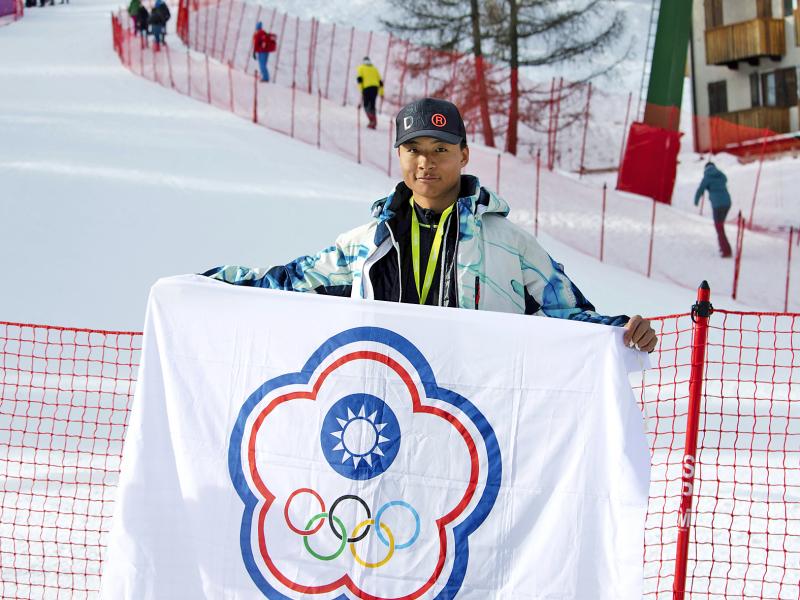
Photo: Szollos Peter via AP
“When I’m meeting people, I’ll tell them I’m from Taiwan, because if you tell people you’re from Chinese Taipei, nobody knows where you’re from, you can’t find it on Google,” Lee said.
The name issue first surfaced at the 1980 Olympics in Lake Placid, New York. Taiwanese athletes had competed as the Republic of China (ROC) in the previous two Winter Games, under the national flag.
It was the People’s Republic of China’s first time at the Olympics and Beijing successfully protested the ROC’s participation. The athletes got the bad news after arriving in Lake Placid, said Thomas Liang, a cross-country skier who competed in the 1972 and 1976 Games.
“We all went to the US, but they wouldn’t let us on the playing field,” Liang said. “I was sad because I couldn’t compete. Losing this opportunity was such a shame.”
The next time Liang went to the Olympics, he was a coach, and his team was known as Chinese Taipei.
A 1981 agreement with the International Olympics Committee created the name and allowed athletes to compete under a newly designed white Olympic flag. A flag-raising song is played at medal ceremonies instead of Taiwan’s anthem.
In the decades since, a Taiwanese identity distinct from China has grown stronger, even as the nation developed close economic ties with China.
The share of the population identifying as Taiwanese has risen to 62 percent, up from 48 percent in 2008, according to an annual survey by National Chengchi University, while 32 percent identify themselves as both Chinese and Taiwanese, and just 3 percent say they are Chinese.
Under President Tsai Ing-wen, who took office in 2016, Taiwan has sought to shore up its de facto independence, while stopping short of declaring formal independence.
China has responded by sending warplanes on training missions in Taiwan’s air defense identification zone and cajoling other nations to break their diplomatic ties with Taipei. It has also pressured airlines, hotels, luxury brands and others doing business in China to label Taiwan as a province of China online and on maps.
However, not everyone was satisfied with the “status quo.” Former Olympian Cheng Chi in 2018 launched a national referendum to change the Olympic team’s name to Taiwan for last year’s Tokyo Summer Olympics.
“Is our country’s name Chinese Taipei? Of course not,” Cheng said in a 2018 interview with the Chinese-language Liberty Times (the sister newspaper of the Taipei Times). “In the past, we accepted that one moment of injustice to ensure the fulfillment of a lifetime of striving.”
The vote failed after many athletes came out against it, worried that the change could result in them being blocked from competing.
Many say they just want to focus on the competition, and not the politics.
The name does not bother Lee.
“As long as we are clear on who we are, that’s enough,” she said.
At the Winter Olympics this week, the two skiers representing Taiwan say their focus is on doing their best, and that would serve their home nation better rather than political statements.
“I don’t have the right to deal with this issue, as an athlete,” said Ho Ping-jui, the other skier representing Taiwan. “I can only do what is within my ability, which is to train and compete.”

After letting another big lead slip with an error-strewn performance at the French Open on Wednesday, top-ranked Aryna Sabalenka felt like getting as far away from the courts as possible. “Just want to quit tennis right now,” Sabalenka said after wasting a lead of a set and two breaks in a 3-6, 7-5, 6-0 loss to Diana Shnaider in the women’s singles quarter-finals. “We’ll see in few days. Hopefully I’ll get back on track mentally.” Sabalenka’s wait for a first French Open title continues despite the four-time major winner leading 4-1 in the second set and being two points from victory while

BIG NAMES GONE: Zverev is the clear favorite for a maiden Grand Slam title, reaching semi-finals for the fifth time in six years and finishing second on three occasions Alexander Zverev on Tuesday breezed past Rafael Jodar to stay on course for an elusive Grand Slam title at the French Open, while Jakub Mensik halted Joao Fonseca’s scintillating run in the quarter-finals. Zverev, the highest-ranked player left in the men’s draw, put an end to Spanish teenager Jodar’s impressive Roland Garros debut, easing into the semi-finals with a 7-6, (7/3), 6-1, 6-3 win. The 29-year-old Zverev is the clear favorite for a maiden Grand Slam title. He has finished runner-up on three occasions, including at the 2024 French Open. “I want to win the matches that are ahead of

Liverpool are in advanced talks with former AFC Bournemouth manager Andoni Iraola as they seek a replacement for Arne Slot, reports said on Tuesday. Iraola has emerged as Liverpool’s top target to replace Slot, who was sacked on Saturday last week after a turbulent second season in charge. Liverpool have reportedly agreed a deal in principle to bring the Spaniard, who left Bournemouth at the end of this season, to Anfield. Sporting director Richard Hughes was heavily involved in hiring Iraola during his time at Bournemouth and is again spearheading the recruitment of the highly rated coach. The Reds are

KNICKS TAKE LEAD: San Antonio put on a 9-0 run to be up 95-94 with just over 2 minutes to play, but the rest of the game belonged to the New York Knicks It was past five minutes through the third quarter of Game 1 of the NBA Finals on Wednesday and the New York Knicks’ 11-game winning streak was in major jeopardy. The Knicks missed nine of their first 10 shots in the early part of the period and trailed the San Antonio Spurs by 14 points. They were floundering. Then something crazy happened. The Knicks found new life from an unlikely source: The Spurs. New York rallied to tie the game by the end of the period, gave up the lead briefly late in the fourth quarter, and pulled away late for a 105-95


 RSS
RSS