


There are sports heroes in the US whose names roll off the tongue, such as Michael Jordan, Babe Ruth, Tiger Woods and Tom Brady, then there are those who are not quite as obvious, despite their enormous impact.
Tucked underneath a towering highway overpass in northeast Atlanta, Georgia, is a nondescript brick warehouse.
That is where to find Jim Downing, the man who helped save auto racing.
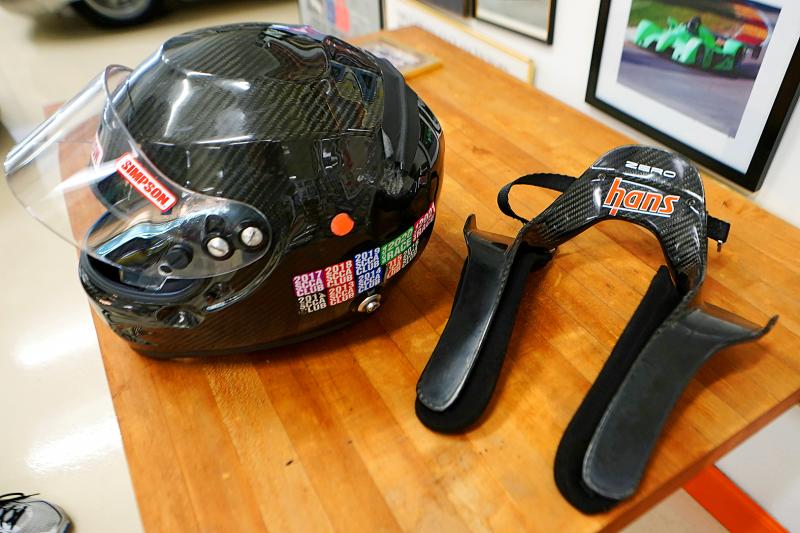
Photo: AP
A long-time sports car racer, he got tired of so many of his friends and competitors dying at the track.
For that matter, Downing had been spooked by his own violent wreck at the Canada’s Mosport road course in 1979.
“I was lucky,” Downing said.
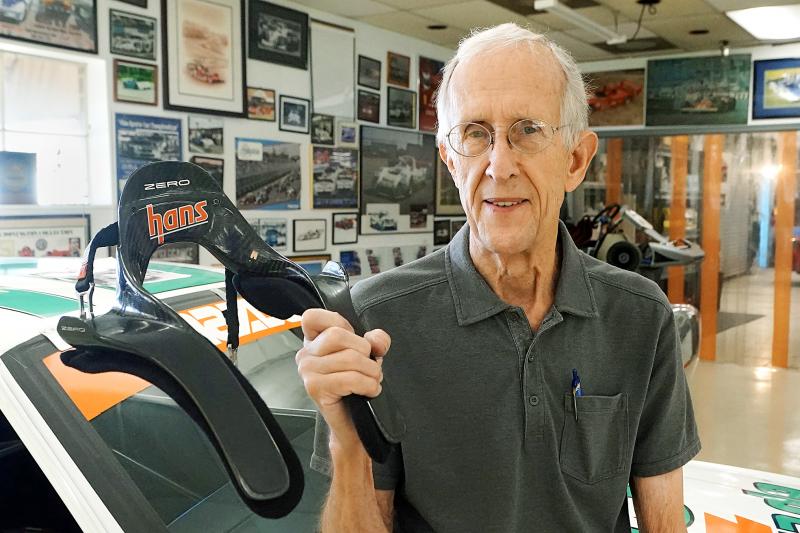
Photo: AP
So, he studied up on the issue, much like you would expect from his bespectacled, professor-like appearance.
Many of the deaths, he found, were caused by basilar skull fractures — essentially the head snapping forward violently in a high-impact wreck, while the rest of the body was tethered to the seat by belts and harnesses.
In a fortunate twist of fate, Downing’s brother-in-law, Bob Hubbard, taught biomechanical engineering at Michigan State University, worked with General Motors and also had a keen interest in racing.
Downing took his ideas to Hubbard, who came up with a simple, U-shaped contraption that goes around the neck and tethers to the helmet, keeping the head stable in high-speed crashes.
The Head And Neck Support device, they called it, or HANS.
Since its widespread introduction two decades ago, sparked by the stunning death of seven-time NASCAR champion Dale Earnhardt on the final lap of the 2001 Daytona 500, the HANS has become a standard piece of safety equipment in pretty much all forms of racing.
“I feel like it changed racing across the world,” said Chase Elliott, the reigning NASCAR Cup champion.
Indeed, the HANS was at the forefront of a remarkable era of improved safety in all forms of racing, along with softer walls, more protective seats and halo-like devices that guard open-cockpit drivers from flying projectiles.
Earnhardt was the last driver in any of NASCAR’s top series to die in a crash.
Formula One has lost only one driver in the past 27 years — Jules Bianchi, in a freak accident when his car slid off a wet track and slammed into a tractor that was collecting another wrecked machine.
Four IndyCar drivers have died in the past two decades, but the toll surely would have been higher without the HANS and other safety improvements.
At age 79, Downing still races occasionally and spends the rest of his time tinkering on an impressive collection of high-powered machines at a shop that doubles as a de facto museum, displaying everything from a futuristic, 1950s Lotus to the original sign that stood outside Road Atlanta after its opening in 1970.
“I usually work six days a week,” Downing said, stepping out from the workshop that remains a cacophony of drilling and sanding and welding. “We’re busier than we’ve ever been.”
However, whenever he watches a race, Downing still finds himself taking note of crashes that would have been much worse without the HANS.
“We all say: ‘Ohhh, that’s a HANS accident,’” he said. “If someone hits totally sideways, the HANS doesn’t really apply much, but anything that’s forward to 30 to 40 degrees left or right is a HANS accident. So we pay attention to those.”
So do many others.
Before Downing and Hubbard figured out a way to reduce the body count, auto racing’s very existence was being questioned.
In NASCAR alone, four drivers in the top three series were killed in a gruesome nine-month stretch covering 2000 and early 2001, culminating with the death of the sport’s biggest star in its biggest race.
Earnhardt and the others — Adam Petty, Kenny Irwin Jr and Tony Roper — all died from basilar skull fractures.
In an especially tragic twist, Downing and Hubbard had developed a workable HANS by the middle of the 1980s, but they were so far ahead of their time that most racers scoffed at the mere suggestion of wearing such a strange-looking device.
“Nobody was interested,” Downing says with a chuckle, putting a present-day spin on what he was up against. “I heard every argument in the world why ‘I don’t want to wear one.’ It’s almost like vaccines. There’s so much illogic out in the world that it astounds you.”
The resistance began to soften after Formula One’s biggest star, Ayrton Senna, and another driver, Roland Ratzenberger, were killed on the same weekend at the 1994 San Marino Grand Prix.
Indy Car got interested after budding star Gonzalo Rodriguez died from a basilar skull fracture when he slammed into a wall at Laguna Seca in 1999.
Michael Andretti helped with much of the testing.
However, there was hardly a rush to embrace the device — especially in NASCAR, the most popular racing series in the US.
“We started offering them for sale in 1991. For the next 10 years, we sold 250, which is to say we lost money on every single one, but we believed in it,” Downing said.
Then Earnhardt was killed and everything changed.
“That, suddenly, put us in business,” Downing said. “The next week, I took orders for 250. And I had three on the shelf.”
Downing ramped up production at his racing and composite facility, the building he still occupies today. He hired extra workers and hastily cleared out space in the back to set up an assembly line to make the HANS, but demand far outweighed production for a while.
“I had people mad at me for a year because we couldn’t supply them fast enough,” Downing said.

Yu Yao-hsing on Tuesday nabbed Taiwan’s only goal in the final round of qualifiers for the 2027 AFC Asian Cup, as they fell 3-1 to Sri Lanka at Taipei Municipal Stadium. Early goals from Sri Lanka in the first half left Taiwan struggling to get on the board, and Christopher Tiao’s own goal at 53 minutes sealed the team’s fate in the third round of qualifiers. While acknowledging that the defeat, Taiwan’s sixth in Group D, was disappointing, head coach Matt Ross said he saw reasons to stay positive about the team’s development. “There were lots of positive signs in terms of the
INDIGESTION: Italy failed to qualify for the World Cup for a third consecutive time after a 4-1 defeat to Bosnia on penalties in a loss Gattuso said was ‘difficult to digest’ Coach Graham Arnold on Tuesday challenged his players to “shock the world” after Iraq became the 48th and final team to qualify for the FIFA World Cup with a nerve-shredding 2-1 win over Bolivia in an intercontinental playoff in Mexico, as Bosnia and Herzegovina, Turkey, the Czech Republic, Sweden and the Democratic Republic of the Congo (DRC) also secured their places at the finals. Iraq, whose preparations were disrupted by the war in the Middle East, sealed their first appearance at the finals in 40 years and are to play in Group I against France, Senegal and Norway. Goals from Ali al-Hamadi

“I don’t remember the moment, but ever since I was a kid, that’s the first thing I loved,” two-time NBA All-Star Isaiah Thomas said of his lifelong romance with basketball. However, that journey unfolded against the limitations of his size in a game where height often dictates opportunity — a reality he confronted throughout his career. At 175cm, Thomas is less than 2cm taller than the average Taiwanese adult male, while NBA players during his career stood at about 200cm on average. Compared with the NBA’s average career length of less than five years, Thomas’ 13-season career stands out as
Teng Kai-wei, the only Taiwanese player on an opening-day roster in this year’s Major League Baseball (MLB) season, took his first win of the year with the Houston Astros in his season debut. Teng entered in relief in the top of the fifth inning against the Los Angeles Angels on Saturday, with the Astros trailing 5-0. He pitched 2-1/3 scoreless innings with two strikeouts, as Houston scored 11 runs during his outing to snatch an 11-9 comeback victory. The win is the Astros’ first of the season and the third of Teng’s MLB career. “It’s my first time pitching for the Astros, so


 RSS
RSS