


For Taiwanese gymnast Lee Chih-kai, his skillful performance of the challenging “Thomas flair” on the pommel horse at the Tokyo Olympics only made him want to perfect the routine further.
The 25-year-old won a silver medal in the pommel horse on Sunday, the first Olympic medal ever won by a Taiwanese athlete in gymnastics.
He nailed his 45-second routine, centered around the move named after late US gymnast Kurt Thomas, in which he skillfully maneuvered around the pommel horse on alternate hands while swinging his split legs in a continuous circular motion.
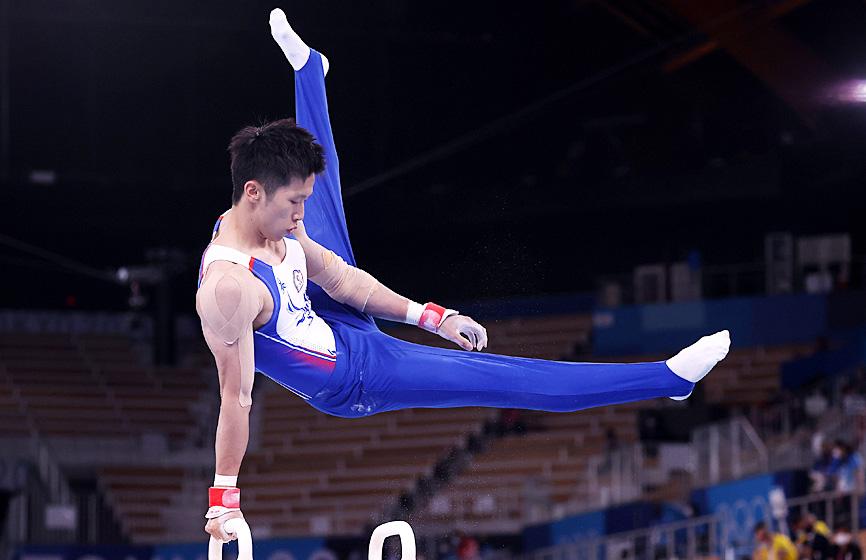
Photo: EPA-EFE
Yet the score it earned — 15.400 — was not good enough to prevent the UK’s Max Whitlock from winning his second consecutive Olympic pommel horse gold medal with a score of 15.583.
Lee’s 8.700 for execution was the best of any gymnast, even better than Whitlock’s 8.583, but his 6.7 for difficulty was 0.3 points lower than Whitlock’s 7.0.
“I did my best. I have no regrets,” Lee said after his performance. “Right now, I’m the 3.0 version of Lee Chih-kai, and I’ll push to evolve further by beating Whitlock.”
The defeat of the veteran champion would be the birth of “Lee Chih-kai 4.0,” he said, adding that he aims to achieve a Thomas flair maneuver the world has never seen.
As with any gymnast, Lee’s road to the Olympics has been rife with injuries, muscle pulls and general aches, evidenced by the tape covering several parts of his body.
There have also been tears, as seen in an award-winning 2005 documentary, Jump! Boy, featuring seven young gymnasts training in Yilan County, including Lee.
Recalling his more than a decade of training, Lee described the grind of repeating the same routines every day as “boring and demanding.”
However, it is his ability to endure that routine that has set him apart, he said.
“I’m not talented. I just grind more than others,” Lee said.
Born in 1996 in Yilan, Lee started gymnastics at the age of six, coached by Lin Yu-hsin, who is also the coach of Taiwan’s gymnastics team at the Tokyo Olympics.
Lee joined the gymnastics team of Gongzheng Elementary School in Luodong Township (羅東) when he started there as a first grader.
At first, training was not painful, he said, attributing his fondness for the sport to the “sense of achievement” he felt when a new move drew applause.
However, as the training got harder and more serious, physical and mental pain set in.
He and his teammates occasionally shed tears on a big pillar in front of the gym at the school, Lee said, adding that he would hug that pillar crying whenever his mother sent him to train.
He would actually pray that his mother would take him home because she could not bear to see her son in pain, but that never happened, he said.
Despite thinking of quitting the sport several times because of the pain, the harsh training regimen and the sense of frustration that came after failing to execute a routine well, he pressed on.
Lee was 20 years old when he competed in his first Olympic Games in Rio de Janeiro in 2016. There, he fell from the pommel horse, and at that moment “my brain went blank, except for the thought of wondering why my life was so painful,” he said.
In 2018, he completed a Thomas flair routine to win gold at the Asian Games in Jakarta, and he also bagged a gold in the pommel horse at the 2017 Taipei Summer Universiade and the 2019 Napoli Summer Universiade.
From the 1.0 version of Lee Chih-kai in Rio and 2.0 in Napoli to 3.0 in Tokyo, he has steadily improved, and earning an Olympic medal has only pushed him to strive harder.

Taiwan’s Lee Hao-yu on Friday went 0-for-3 in his MLB debut for the Detroit Tigers against the Boston Red Sox at Fenway Park, becoming the 19th Taiwan-born player to reach the big leagues. The Tigers ultimately lost 1-0 in 10 innings, ending their six-game winning streak. The 23-year-old started at third base and batted eighth for Detroit. He was promoted from Triple-A Toledo ahead of the four-game series against the Red Sox at the latter’s home stadium, replacing injured utility player Zach McKinstry. “Being right-handed, and given our schedule, I think six of the next 12 games are going to

When Paddy Dwyer arrived in China in 1976, crowds jostled to catch a glimpse of him and his companions — the first Western soccer team to play in the country. China was emerging from the chaos of the Cultural Revolution, and on the brink of market reforms that would take the country from economic stagnation to explosive growth. “All we could see was lines of people running beside our bus, trying to look in the windows, to see their first visual of a white person,” he said. “It was all bicycles,” he said. “There were very few cars to be seen.” Dwyer,

Matheus Cunha on Saturday fired Manchester United toward the UEFA Champions League with a 1-0 win at Chelsea, while Tottenham Hotspur remain in the relegation zone after twice blowing the lead to draw with Brighton & Hove Albion. Chelsea failed to take advantage of a United defense ravaged by injury and suspension as a fourth straight league defeat for the Blues left their Champions League hopes in ruins. United have missed out on the riches of Europe’s elite competition for the past two seasons, but are closing in on a return thanks to an upturn in fortunes under interim manager
A new NZ$683 million (US$404 million) stadium that was a symbol of Christchurch’s struggle to rebuild after a deadly earthquake struck the New Zealand city is to host its first match tomorrow in front of a sellout crowd. A magnitude 6.2 earthquake killed 185 people in February 2011 and toppled or damaged buildings, including the city’s old Lancaster Park. The stadium, which hosted international rugby and cricket, and was home to the Canterbury Crusaders, was badly damaged and never reopened. It was bulldozed in 2019 and turned into sports fields, leaving the Crusaders without a permanent home. Government funding for a new stadium was


 RSS
RSS