


Zhang Shupeng appears untroubled as he surveys the jagged mountains of a national park in central China — before diving headfirst off a cliff to bullet down at 230kph.
Any potential disaster is averted when he opens a parachute and drops gently to the ground — Asia’s top wingsuit athlete in his element.
After China’s decades-long focus on rigorous, state-controlled training in established sports, aimed at winning medals and national glory, Zhang is among a different breed of Chinese sports star that is inspiring the next generation.
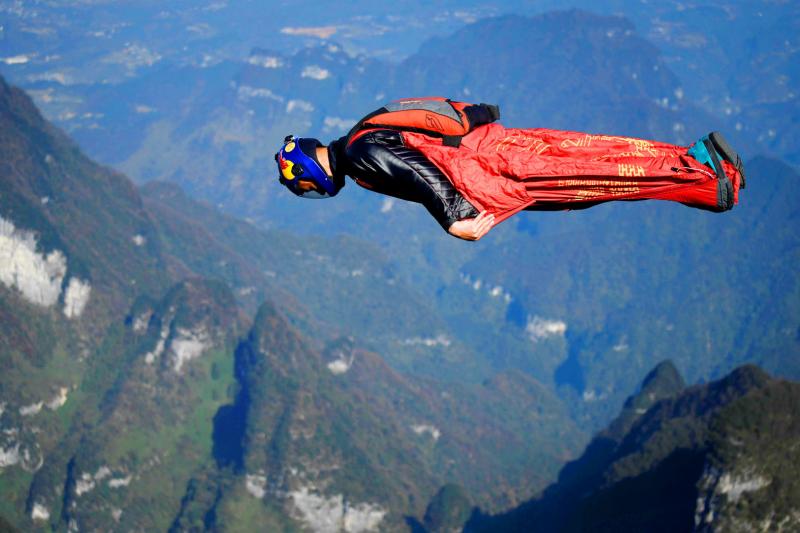
Photo: AFP
Zhang’s sport — one of the most extreme in the world — sees practitioners jump into the void from a mountain, an airplane or a helicopter wearing a flexible, wing-shaped suit that allows “human flight” in the form of a high-speed glide.
“When I walk up to the top, my pulse is racing, but during the flight, I am super-serene,” 34-year-old Zhang said with a smile, seconds before jumping off Tianmenshan in Zhangjiajie.
Custom-made in the US, his red Batman-style suit cost more than 70,000 yuan (US$10,700) and is emblazoned with a picture of the Great Wall, a symbol of his country.
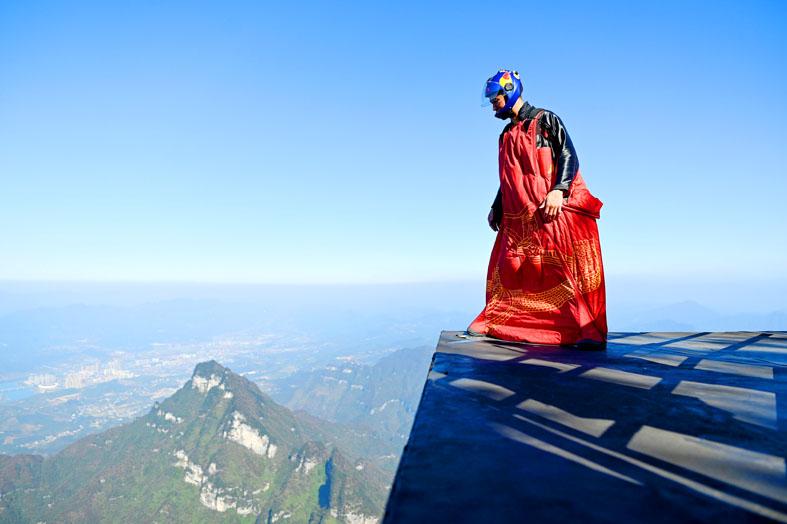
Photo: AFP
Unlike the rest of the world, where many athletes are stuck at home due to restrictions amid the COVID-19 pandemic, China has gotten COVID-19 almost completely under control — which means that Zhang could return to training.
During a jump, the air rushes into the suit, which becomes rigid and generates lift, allowing him to glide in a more horizontal trajectory.
“I feel like a bird,” said the former world paragliding champion, who has carried out more than 3,000 wingsuit flights. “It becomes one with my body. By changing my posture, I can turn, speed up or slow down.”
Wingsuit jumping arrived in China in 2011, when US star Jeb Corliss glided through the “Gate of Heaven,” a 130m-high natural arch on Tianmenshan, in front of local TV cameras.
Zhang attended the first edition of the world championship the following year, held at the same location, and was hooked.
He left China to train in Europe and the US, and by 2017 was among the best in the world.
Wingsuit jumping is a modern sport, unencumbered by the bureaucratic pressures of mainstream events, such as swimming or gymnastics in communist-led China.
“We are moving toward more and more openness,” Zhang said. “The current environment in China allows and supports the emergence of sports, which give more space to the personality of the athletes. It is my dream to make the image of Chinese athletes cooler.”
The sport inevitably comes with risks, including soaring too close to a cliff edge or a sudden strong gale throwing the jumper off course, but Zhang is sanguine in the face of danger.
“There is no dangerous sport,” Zhang said. “There are just dangerous people, who want to go beyond their capabilities or challenge themselves with every jump.”
Despite his assertion, several wingsuit athletes are killed each year, including a US jumper who died in the Swiss Alps in September.
Zhang, who is married and has a young son, said that his family supports him in his daredevil career choice.
“With my experience in paragliding, they know that I know how to keep myself safe... I’m not going to do anything rash,” he said.
Despite no competitions this year, because of the pandemic, Zhang considers himself lucky compared with athletes still confined by restrictions elsewhere in the world.
“When the weather is nice, I can come to train here,” he said, smiling. “I must be the happiest wingsuiter on the planet right now.”

NO HARD FEELINGS: Taiwan’s Lin Hsiang-ti and Indonesia’s Dhinda Amartya Pratiwi embraced after fighting to a tense and rare 30-29 final game in their Uber Cup match The Taiwanese men’s team on Wednesday fought back from the brink of elimination to defeat Denmark in Group C and advance to the quarter-finals of the Thomas Cup, while the women’s team were to face South Korea after press time last night in the Uber Cup quarter-finals in Horsens, Denmark. In the first match, Taiwan’s top shuttler Chou Tien-chen faced a familiar opponent in world No. 3 Anders Antonsen. It was their 16th head-to-head matchup, with the Dane taking his fourth victory in a row against former world No. 2 Chou, winning 21-14, 13-21, 21-15 in 1 hour, 22 minutes. The

Marta Kostyuk’s maiden WTA 1000 title in Madrid came on Saturday thanks to her power, poise and a pair of unexpected lucky shorts. The world No. 23 beat eighth-ranked Mirra Andreeva 6-3, 7-5 in under 90 minutes to secure the most prestigious trophy of her career, her third professional singles title and second in less than a month after Rouen. Yet as the 23-year-old Ukrainian posed for photographs at the Caja Magica, it was not just the silverware that caught the eye. Held alongside her team and her two dogs, Kostyuk showed off a piece of black men’s underwear, prompting

Throwing more than US$5 billion at a divisive new tour and walking away after five seasons does not look like good business, but LIV Golf was not all bad news for Saudi Arabia. Oil-funded LIV, which poached top stars and sent golf’s establishment into a tailspin, helped push the conservative kingdom into global view — one of its key aims, experts said. The exit, confirmed on Thursday after weeks of speculation, does not signal a flight of Saudi money from sport, even after the Middle East war that sparked Iranian attacks around the Gulf, they said. “Saudi Arabia is not

Kite-surfing fabrics, car tires and shortened shoelaces helped Kenyan Sabastian Sawe and Adidas crack the two-hour marathon barrier. When Sawe on Sunday shattered one of athletics’ most elusive barriers in storming to victory at the London Marathon in 1 hour, 59 minutes, 30 seconds, it did not come from just physiology and grit, but from design choices drawn from far beyond the course. Sawe debuted Adidas’ lightest-ever racing shoe, the Adizero Adios Pro Evo 3. “It starts with the mentality of the athlete, the coach, and the team behind the product, which is: What can we do better? What is the 1 percent


 RSS
RSS