


Five centuries ago, newly arrived in what is now Mexico, Spanish conquistadors banned an indigenous game involving a heavy ball, circular stone goals and human sacrifice.
Now, a group of young players are bringing the game back to life for the first time in Mexico City — without the human sacrifice — at the site of an old garbage dump.
The players proudly tie thick leather belts around their waists as they prepare to play ulama, as the game is known in the Nahuatl language, which is a mixture of sport, ritual and ceremony being used by its promoters to help at-risk youth in a downtrodden neighborhood on the Mexican capital’s north side.
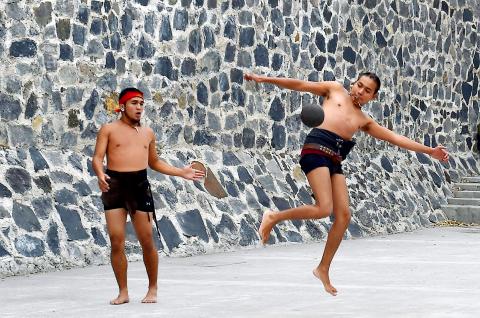
Photo: AFP
Pre-Columbian ball games dating back thousands of years were once played across a broad swathe of the Americas by civilizations including the Mayas, Incas and Aztecs, and they have been revived elsewhere in Mexico and the region in modern times.
However, this is the first time in half a millennium that there has been a place in Mexico City, once the capital of the Aztec empire, to play the game known in Spanish as juego de pelota.
“The game had been forgotten,” said Emmanuel Kakalotl, who coaches players at the cultural center where the ulama court was built.
“It was toppled 500 years ago, but now we’re raising it up again,” he added.
Wearing their traditional belts and loincloths, his players hit the nearly 4kg rubber ball with their hips, trying to send it through a vertical stone ring that is 6m high.
The game is played by teams of one to seven players.
Centuries ago, they were all men, but here, the game is open to women, too.
“We’re women warriors at heart, because it isn’t easy. Not just anyone can play this sport. It takes a lot of practice, and your body takes a beating,” 25-year-old Beatriz Campos said.
In pre-conquest Mexico, ulama was played in various contexts, including fertility rituals and wars.
The court was a symbolic realm, representing the duality of the universe, but the outcome was very real for the players, who risked being sacrificed, usually by decapitation.
According to researchers, the tradition varied over the centuries: Sometimes, it was the winners who were sacrificed, which was considered an honor, while at other points, it was the losers.
“The game and its religious connotations changed over time. Firsthand accounts from the post-classical period [900 to 1521] suggest that by that stage, it was the loser who was sacrificed,” said Annick Daneels, an expert on pre-Columbian ballgames at UNAM, Mexico’s largest university.
The ritual died out soon after the conquistadors arrived in 1519.
“When the Spanish arrived, because of the political and religious aspects of the ball game, it was probably one of the first things they banned,” Daneels added.
It was never played again in what had been the Aztec capital, Tenochtitlan — until the cultural center, looking for projects to revive the blighted site of an old garbage dump in the Azcapotzalco neighborhood, decided to build an ulama court there.
Players take the game very seriously. No alcohol or smoking is allowed at the court. For some, ulama is an escape from drug addiction or a history of crime.
“There are some basic fundamentals in the indigenous worldview: the unity of our physical, intellectual, emotional and energetic beings. A lot of times, when people lose their way, it’s because they don’t have that unity. We help find it again,” said Lia Membrillo, coordinator at the city-operated cultural center.
Giovanni Navarro, 30, takes issue with the idea that he and his fellow players are “rescuing” ulama.
“Actually, the game is rescuing us,” he said.

Taiwan’s Lee Hao-yu on Friday went 0-for-3 in his MLB debut for the Detroit Tigers against the Boston Red Sox at Fenway Park, becoming the 19th Taiwan-born player to reach the big leagues. The Tigers ultimately lost 1-0 in 10 innings, ending their six-game winning streak. The 23-year-old started at third base and batted eighth for Detroit. He was promoted from Triple-A Toledo ahead of the four-game series against the Red Sox at the latter’s home stadium, replacing injured utility player Zach McKinstry. “Being right-handed, and given our schedule, I think six of the next 12 games are going to

When Paddy Dwyer arrived in China in 1976, crowds jostled to catch a glimpse of him and his companions — the first Western soccer team to play in the country. China was emerging from the chaos of the Cultural Revolution, and on the brink of market reforms that would take the country from economic stagnation to explosive growth. “All we could see was lines of people running beside our bus, trying to look in the windows, to see their first visual of a white person,” he said. “It was all bicycles,” he said. “There were very few cars to be seen.” Dwyer,

Matheus Cunha on Saturday fired Manchester United toward the UEFA Champions League with a 1-0 win at Chelsea, while Tottenham Hotspur remain in the relegation zone after twice blowing the lead to draw with Brighton & Hove Albion. Chelsea failed to take advantage of a United defense ravaged by injury and suspension as a fourth straight league defeat for the Blues left their Champions League hopes in ruins. United have missed out on the riches of Europe’s elite competition for the past two seasons, but are closing in on a return thanks to an upturn in fortunes under interim manager

A new NZ$683 million (US$404 million) stadium that was a symbol of Christchurch’s struggle to rebuild after a deadly earthquake struck the New Zealand city is to host its first match tomorrow in front of a sellout crowd. A magnitude 6.2 earthquake killed 185 people in February 2011 and toppled or damaged buildings, including the city’s old Lancaster Park. The stadium, which hosted international rugby and cricket, and was home to the Canterbury Crusaders, was badly damaged and never reopened. It was bulldozed in 2019 and turned into sports fields, leaving the Crusaders without a permanent home. Government funding for a new stadium was


 RSS
RSS