


With their whips cracking neighing horses, an unruly scrum of riders battled in a muddy field for the headless carcass of a calf — this is the Afghan sport of buzkashi.
Passion, raw aggression, horsemanship and a fierce competitive instinct were on display in country’s biggest annual tournament held in northern Mazar-i-Sharif city, set against a backdrop of the snow-peaked Hindu Kush mountains to celebrate the Persian New Year. A ferocious version of polo, Afghanistan’s national sport is not for the faint-hearted.
The action is fast and furious as hundreds of horsemen known as chapandaz — dressed in colorful robes, baggy trousers and leather boots — wrestle over the dead animal, fighting off competitors eager to snatch it away.
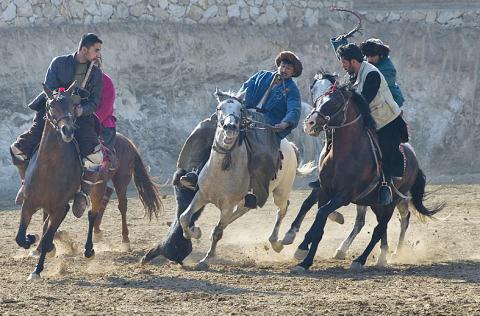
Photo: AP
The rider who manages to scoop up the heavy carcass, often after sliding down perilously close to the ground, charges across the dusty pitch, swerves around a pole and drops it into a small circle to score a point.
“If you don’t whip the horse hard enough, the horse will be too slow and another chapandaz will grab the goat,” said Gulbudin, a 61-year-old spectator. “The sport inspires great passion.”
An adrenalin rush swept through the audience despite the dangers as the wild contest, held late last month, raged.
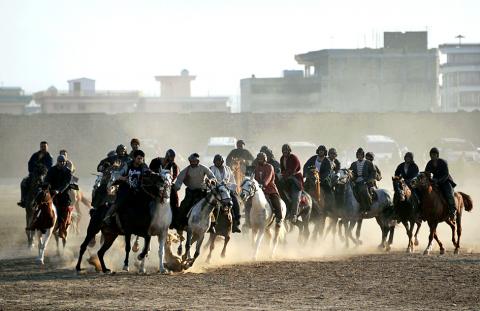
Photo: AFP
The game, banned under the 1996-2001 hardline Taliban regime, is the ultimate test of the Afghan male. It is seen as a rite of passage into manhood in male-dominated Afghanistan.
Not a single woman was in sight among the players and spectators. In fact, even the horses are all male.
“All the chapandaz you see here are former mujahidin fighters,” said Abdullah Quraishi, a former buzkashi player.
“They first fought against the Soviets in the 1980s, before waging a fight against the Taliban. Peace has now returned to this area,” he said, referring to the relatively tranquil province of Balkh, of which Mazar-i-Sharif is the capital.
A wild winter pastime, buzkashi is believed to have originated in central Asia, reputedly around the time of 13th century emperor Genghis Khan.
Legend has it that the sport was initially played by warriors using the corpse of a defeated enemy.
The sport still has a proud following, primarily among northern Afghanistan’s ethnic Uzbeks, Turkmens and Tajiks.
The game has key parallels with politics in Afghanistan, a country that has seen numerous power swaps and invasions over the course of centuries.
Observers say that a rough-and-tumble atmosphere and pumped-up show of might are common to both.
The sport is also seen as a symbol of prestige and power for Afghanistan’s affluent, who alone are capable of buying the best horses, paying for the best players and funding their own pitches.
Buzkashi players certainly have to be talented horsemen, as they stay balanced at high speeds and must remain onboard, despite rivals trying to push them to the ground.
Players often hold their whips between their teeth, or use them to hit other competitors as much as their horses.
Despite its inherent violence, the game is a welcome distraction in a country decimated by decades of war.
“Buzkashi has been a sport for [hundreds] of years,” said Haji Sharif Salahi, president of the buzkashi federation in Balkh.
“Vice President General Dostum [a former warlord] wants to export buzkashi to other destinations, such as Dubai and the United States,” he said.
Players of the sport compete for individual, as well as team, glory, but for professional riders like Hassan Pahlawan, buzkashi is a way to earn a livelihood.
Those who manage, after the mad dash around the field, to hurl the carcass back into the circle and score a goal, usually earn cash prizes — sometimes thousands of dollars, if the game is sponsored by a wealthy warlord.
“Many years ago, at a buzkashi event organized for a wedding, the prize was US$7,000 and a Toyota Prado. It was I who won it,” beamed 48-year-old Pahlawan, who claims to have won several competitions over three decades.
“In buzkashi, men compete with horses. It is a sport, a passion and a way to earn a living,” Pahlawan said.
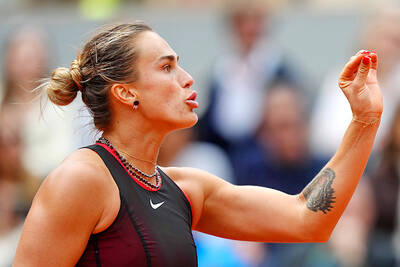
After letting another big lead slip with an error-strewn performance at the French Open on Wednesday, top-ranked Aryna Sabalenka felt like getting as far away from the courts as possible. “Just want to quit tennis right now,” Sabalenka said after wasting a lead of a set and two breaks in a 3-6, 7-5, 6-0 loss to Diana Shnaider in the women’s singles quarter-finals. “We’ll see in few days. Hopefully I’ll get back on track mentally.” Sabalenka’s wait for a first French Open title continues despite the four-time major winner leading 4-1 in the second set and being two points from victory while
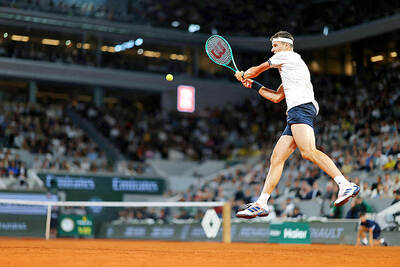
BIG NAMES GONE: Zverev is the clear favorite for a maiden Grand Slam title, reaching semi-finals for the fifth time in six years and finishing second on three occasions Alexander Zverev on Tuesday breezed past Rafael Jodar to stay on course for an elusive Grand Slam title at the French Open, while Jakub Mensik halted Joao Fonseca’s scintillating run in the quarter-finals. Zverev, the highest-ranked player left in the men’s draw, put an end to Spanish teenager Jodar’s impressive Roland Garros debut, easing into the semi-finals with a 7-6, (7/3), 6-1, 6-3 win. The 29-year-old Zverev is the clear favorite for a maiden Grand Slam title. He has finished runner-up on three occasions, including at the 2024 French Open. “I want to win the matches that are ahead of
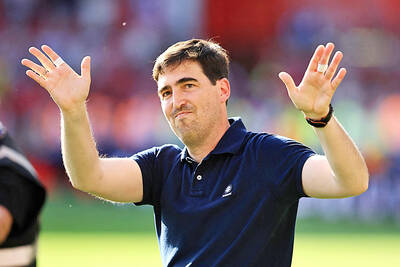
Liverpool are in advanced talks with former AFC Bournemouth manager Andoni Iraola as they seek a replacement for Arne Slot, reports said on Tuesday. Iraola has emerged as Liverpool’s top target to replace Slot, who was sacked on Saturday last week after a turbulent second season in charge. Liverpool have reportedly agreed a deal in principle to bring the Spaniard, who left Bournemouth at the end of this season, to Anfield. Sporting director Richard Hughes was heavily involved in hiring Iraola during his time at Bournemouth and is again spearheading the recruitment of the highly rated coach. The Reds are
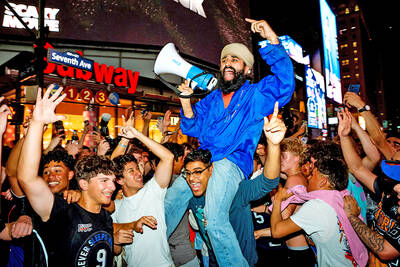
US President Donald Trump said he would attend Game 3 of the NBA Finals on Monday at Madison Square Garden, but said he does not have much sympathy for ordinary basketball fans who cannot afford sky-high ticket prices to do the same. “They can watch it on television,” Trump said aboard Air Force One on Friday as he flew to Wisconsin for an event with farmers, after he was asked about tickets that have climbed as high as US$8,000 each when the New York Knicks and San Antonio Spurs square off in Manhattan for the first time in the series. “It’s sorta


 RSS
RSS